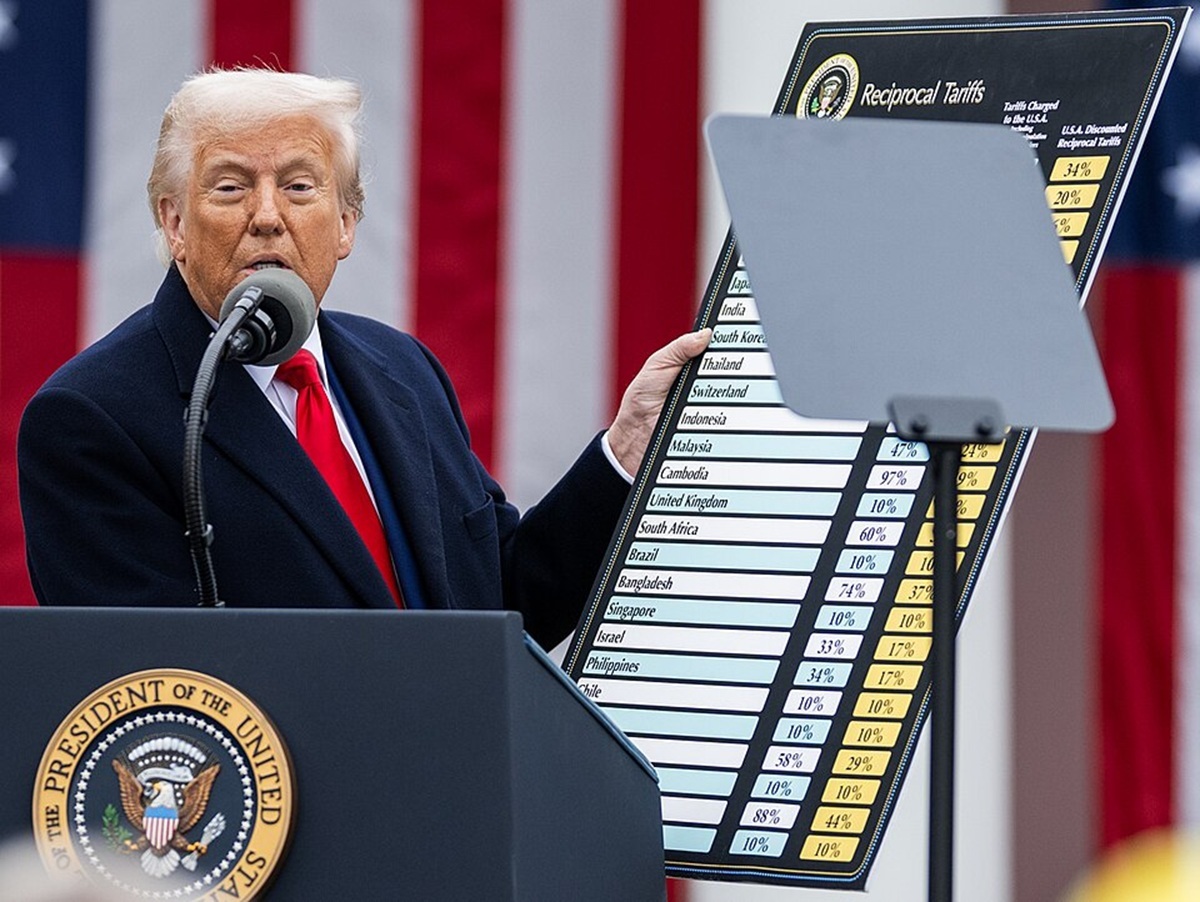
The Tax Foundation is out with a new report summarizing the key economic impacts from Pres. Donald Trump’s tariff regime, kicked off by his “Liberation Day” announcement on April 2, 2025.
In short, the Tax Foundation analysts found that Trump’s tariffs have: imposed significant costs on U.S. households, harmed GDP, did not reduce America’s trade balance, and amounted to the largest tax increase since 1993.
Here is a summary of their key findings:
- The Trump tariffs amounted to an average tax increase of $1,000 per US household: According to Tax Foundation analysis, the tax burden passed along to U.S. households amounted to an average of $1,000 per household in 2025. They project this burden will be $900 per household this year.
- Tariffs created great uncertainty, rose to highest level since 1947: Since the beginning of Trump’s second term, U.S. tariff rates have changed more than 50 times. The constant fluctuations create great uncertainty, which is devastating to businesses and job creation. The overall average effective tariff rate rose to 7.7 percent in 2025, up from 2.4 percent the prior year, the highest since 1947. That rate is expected to remain historically high at 6.6 percent this year.
- Tariffs did not reverse the trade balance: One of the top stated goals of Trump’s tariff regime was to reverse America’s trade balance. A negative trade balance, of course, is not a reflection of a poor economy and can largely reflect sizeable foreign investment, as the country is seen as a profitable place to invest. Indeed, the U.S. has experienced negative trade balances for fifty years. After the implementation of Trump’s tariffs, the overall trade balance dropped by just $2.1 billion. The trade deficit in goods, however, actually deepened by $25.5 billion in 2025.
- Tariffs are a drag on the U.S. economy: The Tax Foundation estimates that Trump’s tariff regime will reduce U.S. long-term GDP by 0.4 percent, which could cause a net loss of 367,000 U.S. jobs.
- Tariffs amounted to largest tax increase in more than 30 years: Because of their negative economic impact, the revenue generated from the tariffs – on net – will be lower than the headlines will proclaim. Slower economic growth caused by the tariffs will result in less tax revenue, offsetting part of the revenue collected by the tariffs themselves. Even on net, however, the taxes collected due to Trump’s tariffs in 2025 equated to the largest tax hike since 1993, and the 19th largest since 1940.