Written by
- Declining enrollment is reshaping public education policy.
-
Fewer students mean a tighter budget and closure decisions that can affect parent choices.
- Public schools need to adapt to the “choice” landscape by better marketing their value.

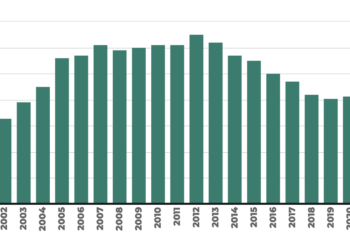
The number of public K-12 students nationwide dropped 2% from 2014 to 2024, according to the recently released “Report on the Condition of Education 2026” from the U.S. Department of Education. The report shows that the decline began after the COVID-19 pandemic, and most of it is evident in elementary and middle schools.
Furthermore, on average, states spent a little over $20,000 per pupil during the 2022-23 school year. Of course, there is variation based on individual states. To no one’s surprise, Utah ($13,075) and Idaho ($12,406) rank at the bottom for per-pupil spending, a ranking they have been both criticized and praised for. On the other end, the District of Columbia ($40,216) and New York ($33,576) spent the most per pupil.
Several issues challenge public schools across the country – chronic absenteeism, low literacy rates, poor outcomes despite increased spending, and technological evolutions – but enrollment is noteworthy both as a symptom of these challenges and as a cause of others. How state and local leaders address these issues will have a crucial impact on the future of public schools.
A look at the national versus Utah trends
The decline in public school enrollment is predicted to continue. Analysis from the Reason Foundation says that “The National Center for Education Statistics projects that public school enrollment will decline to 46.9 million students by the 2032 fiscal year, representing a 5.3% decrease from 2024.”
In fact, most states are set to lose enrollment. NCES predicts that “States such as Hawaii, California, Mississippi, New Mexico, and New York are forecasted to lose over 12% of their public school students during this time, with only 13 states projected to increase the number of students.”
Utah has been dealing with declining enrollment over the past several years. According to the most recent enrollment data, the state experienced a drop in public school enrollment again, with experts predicting it will decline by another 10% over the next two years. In fact, all Utah districts except for Beaver and Tooele saw a drop in the most recent enrollment data. The districts that saw the biggest drops this year were Salt Lake City, Granite, and Washington County.
But it’s not just those three that have felt the effects strongly enough to have to either close or consider closing schools in the recent past. Closure discussions have hit Alpine, Canyons, Granite, Nebo, Provo, Salt Lake City, and more.
Furthermore, declining enrollment has forced the Weber School District to make tough budget choices, resulting in a loss of funding tied to the number of students it serves.
Of course, if a district serves fewer students, the reduction in funds per student makes some sense, but the impact on teachers, administrators, and overall programs can be significant as well. This, likewise, can impact the degree to which these schools are attractive to parents.
Researchers and education leaders attribute the decline in enrollment to a combination of factors, such as a declining birthrate, reduced in-migration, and the growth of education choice options. Alternatives like charter schools and homeschooling are gaining popularity quickly and have been since the COVID-19 pandemic. While education choice might be only a small variable in the enrollment story, it may grow over time.
How should public schools respond?
While some forces are beyond the control of leaders in the public education system (such as the fertility rate), public schools can make some adaptations to fit the landscape of education choice. To do this requires that they respond to parents as nimbly as other education providers do.
Put simply, public schools should better promote their value in the new education marketplace by being more parent-focused, transparent, and marketplace-minded.
Become parent-focused
Schools teach students, but they ultimately serve parents as the “customer.” It’s parents who are the decision-makers and “choosers” of school for children.
Districts should consider appointing or employing a district-level parent liaison, similar to the Utah State Board of Education’s Parent Liaison and Engagement Specialist, whose purpose is to specifically assist parents with questions about their choices and rights. This would also strengthen the feedback loop with district leaders on what parents need, want, or have concerns about before they leave for other educational options that better meet their needs.
Increase transparency
In terms of public policy, this means that public school districts need to be as transparent as possible. Utah statutes already require certain forms of transparency regarding curriculum and open-enrollment capacity. But schools can go beyond what’s required by law or add features to what’s already required that are more prominent and user-friendly, so parents can use them with ease. Even using social media to reach parents about upcoming public meetings, curriculum adoption changes, or school policy changes can improve transparency. Assessing where transparency can be increased can help the customer understand their options and increase their trust and confidence if they choose it.
Use a marketplace mindset
Public schools are one choice among many in a growing marketplace. Gone are the days when parents would simply enroll their children without searching for other options. While most students currently attend public school, leaders cannot take their attendance for granted.
Innovative education providers and alternative schools are clearly marketing their offerings, and parents are paying attention. Public schools should market their unique offerings, make open enrollment easier, and invite opportunities to share information on navigator tools that are growing in capacity. Navigators exist now for charter schools, microschools, homeschool co-ops, as well as navigators that compile all school types together. This change reflects a shift in the default for families from public school to any school that communicates how it can best meet the family’s needs.
Conclusion
Public district schools still serve most students, but shifting enrollment suggests they cannot assume that will always be the case. To remain competitive, public schools should clearly communicate their unique value so parents can decide whether they are the best fit for their children.

Insights: analysis, research, and informed commentary from Sutherland experts. For elected officials and public policy professionals.
- Declining enrollment is reshaping public education policy.
-
Fewer students mean a tighter budget and closure decisions that can affect parent choices.
- Public schools need to adapt to the “choice” landscape by better marketing their value.
Read More
Rebuilding trust in America’s elections | Ben Ginsberg & Bill Duncan
The conversation explores the constitutional role of states in election administration, the limits of federal authority, the importance of institutional trust, and why federalism may offer a better framework for addressing election concerns moving forward.
Opinion: Utah voter roll audit proves that federalism in elections is working
There is no need for federal bureaucracy involvement if the evidence shows that state and local election officials are doing their jobs.

Federalism isn’t about states’ rights. It’s about responsibilities.
Federalism is implicated in a wide range of current controversies, like the conduct of elections, business regulation, even immigration. Sometimes, though, the way we talk about it obscures its nature and purpose.
Connect with Sutherland Institute
Join Our Donor Network
Follow Us
The post What does the future hold for public schools? appeared first on Sutherland Institute.