Unions don’t work for teachers; they work for themselves. Let me spill the tea.
I started my career as a public school teacher in the rural American South. I vividly remember attending a multi-day new teacher orientation session the week before school started, which included a short drive across the expanse of farmland blanketing my county to the neighboring high school’s gymnasium. There, I joined several dozen other first-year teachers to attend a “benefits fair,” where representatives from district-sponsored providers lined the walls.
After spending the morning learning about pension options and choosing critical things like my vision, dental, and health insurance plans, I was greeted by a booth sponsored by the state’s largest teachers’ union. Capitalizing on my fears as a new teacher, an eager union representative told me horror stories about teachers being injured or sued on the job. She explained how the union provided legal protection and liability coverage in the event that I “had problems” at my school. “Everyone joins the union,” she explained. “You’ll be glad you did.” So, I naively obliged.
This union, which positioned itself as equally critical to my job as retirement and insurance plans, proceeded to drain dollars from my paycheck for years, while providing nothing in return. I was never sued. I never needed liability coverage. What I did need was support and guidance, like help with classroom management or sample lesson plans—none of which were provided by the union. Luckily, I had great mentor teachers at my school and a strong teacher preparation program, but my experience begs the question:
Exactly what benefits do teachers’ unions provide?
I can tell you that on a national level and in my home state of Tennessee, the answer is “not much.”
Nationally, teachers’ unions spend more time fighting political battles than advocating for better working conditions for members. In fact, since 2015, the nation’s two largest teachers’ unions, the National Education Association (NEA) and the American Federation of Teachers (AFT), have spent over $660 million on left-wing political activism.
These advocacy efforts aren’t confined to the national stage. Unions are quick to use biased data to critique reform-minded states like Tennessee and ignore real education progress. Recently, on the heels of a school year that saw universal choice expansion and significant gains in public-school student achievement, the NEA released a report claiming that Tennessee ranks dead last in per-pupil spending. I won’t devote much time disputing that finding, as it has already been done by Tennessee House Education Committee Chairman Mark White in a recent op-ed. What I will say is this: not only is the NEA’s Tennessee-specific per-pupil spending data wrong, which calls into question the fidelity of the entire report, but their assertion that more spending is inherently good for education outcomes is a false narrative unsupported by research and Tennessee’s own data.
According to a recent Brookings report, which builds on consensus from a half-century of education funding research, simply funneling more money into education doesn’t automatically lead to better student outcomes. Research shows that funding must be intentional and targeted to move the needle. Tennessee has done just that through strategic investments in early literacy, academic summer programming, and school choice. Like any good researcher also knows, you can’t just look at the inputs of a system to measure how well it’s working, as the NEA has done with its report—you must also examine the outputs.
So, what do Tennessee’s outputs show?
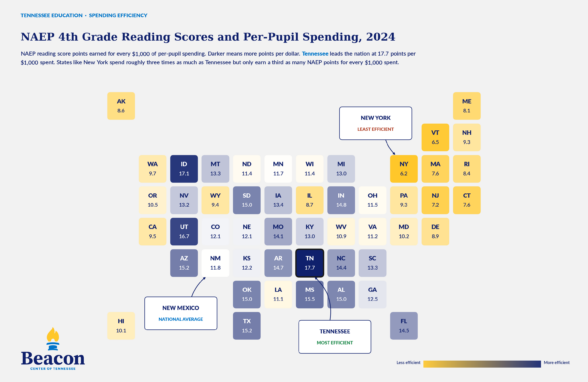
As it turns out, when you examine student achievement—an important output of our education system—you find Tennessee is excelling. According to the National Assessment of Educational Progress (NAEP), Tennessee ranks above the national average in reading and math. In fact, Tennessee is number one on the NAEP in the entire South. Tennessee also receives an incredible return on investment, as measured by the NAEP. The map below shows how many NAEP 4th grade reading points each state earned in 2024 for every $1,000 spent on education. Tennessee leads the nation at 17.7 points earned per $1,000 spent.
In addition to the NAEP, Tennessee’s own state testing data paint a picture of student success. In May of this year, the Education Recovery Scorecard, a collaborative project among researchers at Harvard, Stanford, and Dartmouth that tracks the pace of post-pandemic academic recovery, found that between 2022 and 2024, Tennessee ranked fourth in reading and second in math growth nationwide.
So, the facts are clear: Despite the national union narrative, Tennessee is excelling in education. Rather than acknowledge the incredible progress Tennessee has made, the NEA chooses to use flawed data to tell half the story poorly.
Here in the Volunteer State, our own teachers’ unions aren’t any better. In addition to funneling money to its progressive-minded national counterparts, the Tennessee Education Association (TEA) maintains a political action committee with a $600,000 war chest it uses to influence elections rather than investing in teachers. It spends an additional $150,000 annually on lobbying, rather than on supporting policies that would lead to better working conditions. The TEA has opposed merit-based pay policies that pay higher-performing teachers more. Additionally, the TEA fought important elements of Tennessee’s early literacy initiatives and strongly opposes school choice—policies that have contributed to Tennessee’s steady rise in student achievement. To top it all off, many TEA staff make over $100,000 a year, which is twice the salary of a starting teacher.
Tennesseans are incredibly lucky for so many things, but the fact is, we work hard for our money and should care about where it’s spent. If you’re a teacher, do yourself a favor: keep your hard-earned dollars. Unions like the TEA aren’t brewed for you.