Written by
This year has seen a remarkable amount of federal action across multiple branches of government, aimed at expanding the federal footprint in elections. The Trump administration issued an executive order on voting by mail, the U.S. Postal Service proposed a federal rule to enforce the order, the U.S. Department of Justice sued 30 states to gain access to private voter information, and members of Congress have repeatedly sought to enact the Safeguard American Voter Eligibility Act, also called the SAVE America Act.
This comes on the heels of attempts under the Biden administration to expand the federal role in elections via executive order and congressional legislation.
As we are currently celebrating the 250th anniversary of enshrining the principle of the consent of the governed in the Declaration of Independence, it seems appropriate to ask American and Utah voters what they think about who should run elections in the United States.
Sutherland Institute and Y2 Analytics recently surveyed a nationally representative sample of 762 American voters and a statewide representative sample of 605 Utah voters to explore their views on which level of government they trust most to run elections. American voters were surveyed between May 1 and May 7 with a margin of error of +/- 3.6 percentage points, and Utah voters were surveyed between May 5 and May 31 with a margin of error of +/- 4 percentage points.
There are three main takeaways from the Sutherland/Y2 Analytics survey of voters’ views on who they trust the most to run elections:
- Partisan control and partisan identity significantly influence voters’ views
- Partisanship doesn’t explain everything
- Voters’ views on the competence, accountability, and trustworthiness of various levels of government are additional important factors
American Voters: Partisanship Is Important, But Not Everything
Partisan control of government and partisan identity are clearly important factors for American voters’ view of who should run elections. Nationally, Democrats trust federal government the least to run elections, placing their confidence instead in state government, followed by local government. Nationwide Republicans, on the other hand, trust the federal government most to run elections, followed by state government and then local government. Political independents’ views nationwide generally track with those of Democrats: State government garners the greatest trust, then local government, with the federal government in a distant third.

Breaking out American voters by whether they live in a red state or a blue state further highlights the importance of partisan control and identity, while simultaneously showing that partisanship isn’t everything.
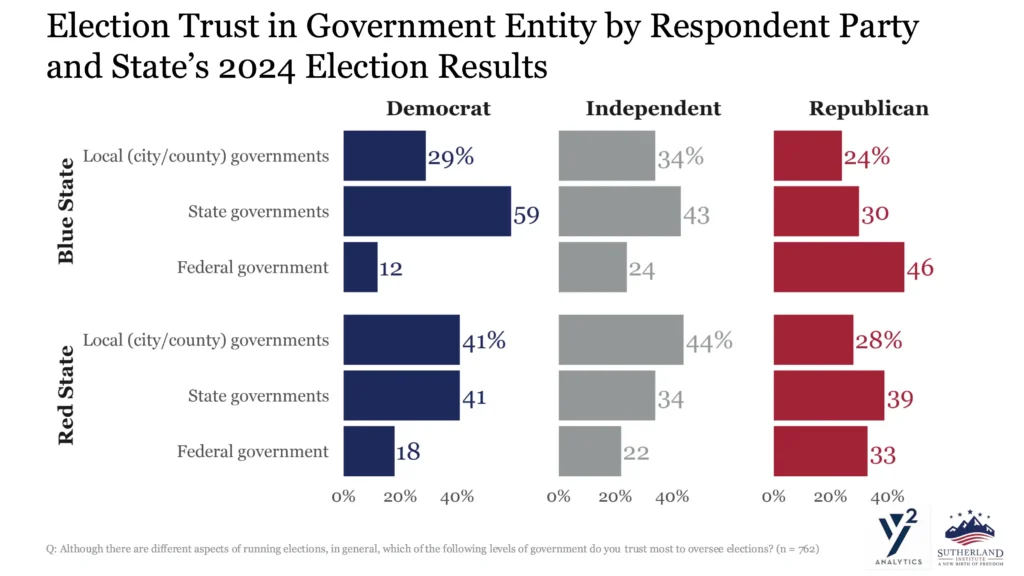
Blue-state Democrats and red-state Republicans trust state government the most to run elections, while blue-state Republicans trust the federal government the most – bolstering the importance of partisan considerations as a significant factor for American voters. However, red-state Democrats trust their Republican-controlled state government as much as they trust local government to run elections – suggesting that factors other than partisanship may be at play. Interestingly, red-state independents are the only group that places the greatest confidence in local government.
Utah Voters: Exceptional Outliers
Utah voters further illustrate how partisanship fails to explain everything when it comes to voters’ view of who should run elections.

Utah Democrats differ from their national and red-state counterparts in their clear preference for local government oversight of elections, followed by state government, with very little confidence reserved for the federal government. This makes sense given Republican control of both federal and state government in Utah. Utah independents track Utah Democrats fairly well, similar to how national independents track national Democrats.
However, Utah Republicans also trust local government the most – where partisan control is least certain, and where the top local election official in Utah’s most populous county is a Democrat. If partisan control and partisan affiliation explained everything, the expected outcome would be for Utah Republicans to trust state government or federal government the most, rather than a distant second and third, respectively.
Filling the Gap: Competence, Accountability, Trustworthiness
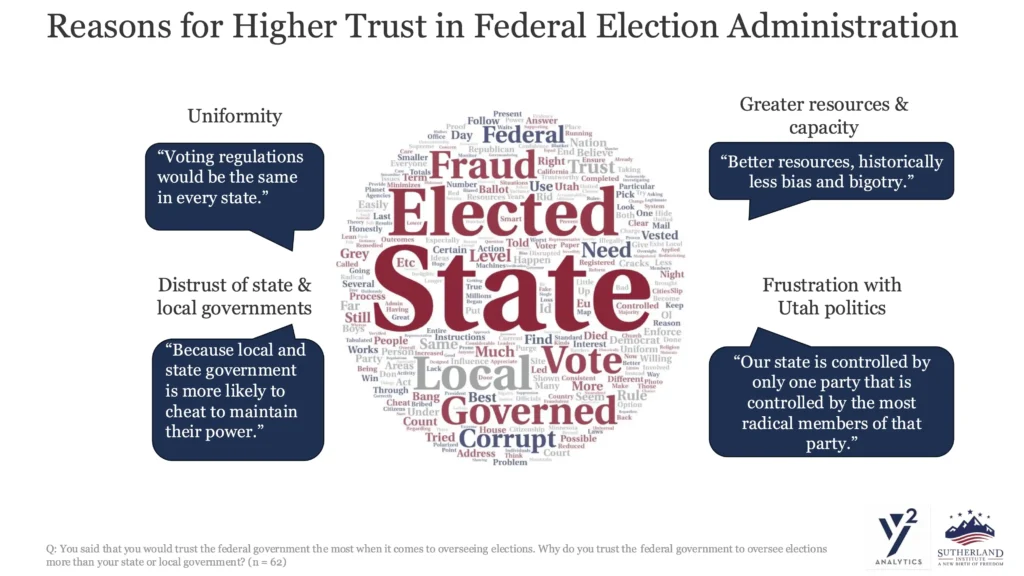
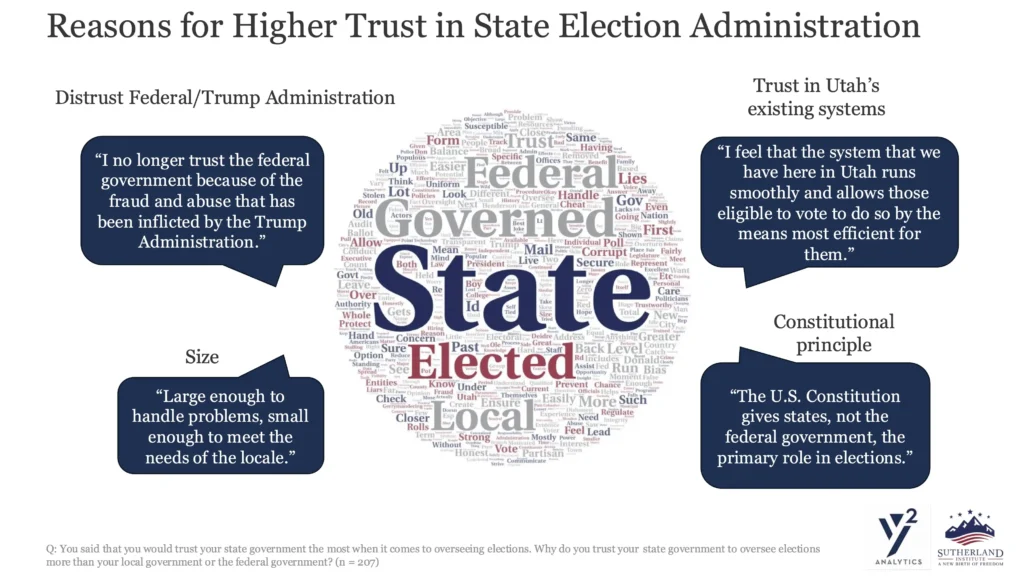
What explains the anomalies that do not seem to follow the partisan pattern of American and Utah voters’ views on who should run elections? Voters’ responses to open-ended questions about why they trust their preferred level of government the most offer some insight (see appendix for word clouds and representative comments of voters from each sample and level of government).

Analysis of the reasons American and Utah voters give for trusting federal, state, or local government the most reveals patterns that help fill the gaps left by the partisan explanation. Distrust is a common theme: American and Utah voters say their confidence in their preferred level of government is in part driven by distrust of one or both of the other levels of government. Only Utah voters who are most confident in state government identify their express trust in that level of government as a reason.
Another common theme among the reasons voters give for their preferred level of government is the actual or perceived competence they see. For instance, federal resources, state capabilities, and local government being better equipped all reflect the belief that a level of government has what is needed to run elections competently.
Finally, some answers directly or indirectly note accountability as a significant reason for trusting a particular level of government. Both American and Utah voters who trust local government most explicitly cite accountability as one reason, while the proximity of local and state government to voters indirectly points to the accountability made possible by proximity as an important factor for voters.
In sum, one explanation for red-state Democrats’ trust in state government and Utah Republicans’ trust in local government could be their belief in the competence and/or accountability of those levels of government relative to other options.
Conclusion: Takeaways For Voters and Policymakers
Despite efforts by both major parties to expand the federal role in elections when in control of the federal levers of government, none have been particularly successful. There are likely multiple reasons for this.
One explanation highlighted by the Sutherland/Y2 Analytics survey is the challenge federal elected leaders face in generating partisan unity across the country, when factors like state and local government competence in election administration and greater accountability to voters due to proximity can override partisan logic. These contextual factors matter to voters when they consider whether it is a good idea for the federal government to crowd out state and local roles in elections.
This survey suggests that federal or state policymakers seeking to navigate a desired reform across this sea of voter opinions and priorities need something more than partisan interest to stand on. Proposed election reforms will be most likely to succeed in this political landscape when they come with a compelling case, grounded in observable realities and evidence, that they will build competence and accountability in American elections. The proclivity of federal elected officials to argue the necessity of federal intervention in election administration when their party controls the levers of power in D.C., only to object to it when the opposite party takes control, undermines the likelihood that any policy reform can be enacted.
If lawmakers strive to craft their reforms to gain the consent of the governed by advancing competent and accountable election administration, they may find the legislative success that they are looking for.
Appendix
American voter trust in federal government

Utah voter trust in federal government
American trust in state government

Utah voter trust in state government
American trust in local government

Utah voter trust in local government

More Insights
Read More
Who American Voters Trust to Run Elections – A Sutherland Institute/Y2 Analytics Survey
If lawmakers strive to craft their reforms by advancing competent and accountable election administration, they may find the legislative success that they are looking for.
How Utah is bringing hidden federal guidance into the open
Support for these laws has been entirely bipartisan. Ensuring the people of the state and their representatives are aware of direction from federal agencies, and can challenge it where necessary, is not a party issue.
The roadmap to restore trust in elections | Matthew Weil & Derek Monson
The conversation covers California’s ballot counting process, why states should learn from one another, a new survey on voter confidence, and why transparency, evidence, and citizen engagement remain essential to maintaining trust in American elections.
Connect with Sutherland Institute
Join Our Donor Network
Follow Us
The post Who American Voters Trust to Run Elections – A Sutherland Institute/Y2 Analytics Survey appeared first on Sutherland Institute.