Washington lawmakers chose to include teachers’ pensions, police and fire pensions, and the retirement benefits of other public employees in their new income tax. Public pension benefits come nowhere close to the million dollar incomes the tax supporters keep talking about, yet lawmakers devoted 14 sections of the law to revising public pension statutes so the state could tax and collect from retirement benefits.
I spent 15 years working on public pension policy, including as the Managing Director of the Pension Integrity Project at Reason Foundation and working with legislatures around the country. In that work, I studied some of the largest public pension benefits in the country. None comes remotely close to $1 million a year.
Consider two of the pension systems lawmakers amended. Washington’s PERS 2 and TRS 2 systems, covering general public employees and teachers respectively, provides a defined benefit pension of 2% of final average pay for each year of service. Someone retiring with an unreduced benefit after 30 years, with $100,000 in annual pensionable pay used in that calculation, would receive $60,000 a year.
In the Department of Retirement Systems’ 2025 financial report, PERS 2 members who retired in fiscal year 2024 with at least 31 years of service averaged about $62,000 a year. These are the retirement benefits lawmakers chose to include for taxation: monthly payments people depend on after three or four decades of public service.
A retiree receiving a $62,000 pension would need more than $938,000 in other income before owing the tax. That scenario is so impossibly rare it cannot plausibly explain why lawmakers went through the public pension statutes. Therefore, the current threshold cannot explain why lawmakers did this.
Due to federal law, even an exceptionally high salaried public position falls far short of the $1 million threshold lawmakers are advertising. The federal annual benefit limit under IRC Section 415(b), which governs defined benefit pension plans, is $290,000 in 2026, subject to inflation adjustments each year. To produce a $290,000 pension under the PERS 2 or TRS 2 basic formula, a member who worked for 40 years would need an annual pensionable pay of $362,500. And even that pension would be $710,000 below the current $1 million deduction.
The only conclusion a rational person can make, then, is that lawmakers built this tax in preparation for the deduction coming down.
That is why public retirees need to care now. The $1 million deduction is the only thing keeping their pension income out of reach, and Washington’s repeated budget shortfalls make it increasingly likely that lawmakers will quickly lower it. If they do, they will not need to amend the pension statutes or take another vote to include pension benefits.
While the current majority has long stated its desire for an income tax, creating it did not require Washington lawmakers to tax public pensions. They chose to, while other states with income taxes chose the opposite.
Ten states with income taxes provide broad, uncapped exemptions for qualifying pensions from their own public systems. New York fully exempts its own state and local pensions, along with federal pensions. Alabama exempts qualifying defined-benefit pensions, while Illinois broadly excludes qualified retirement income. Washington could have written a public pension exemption into the income tax law.
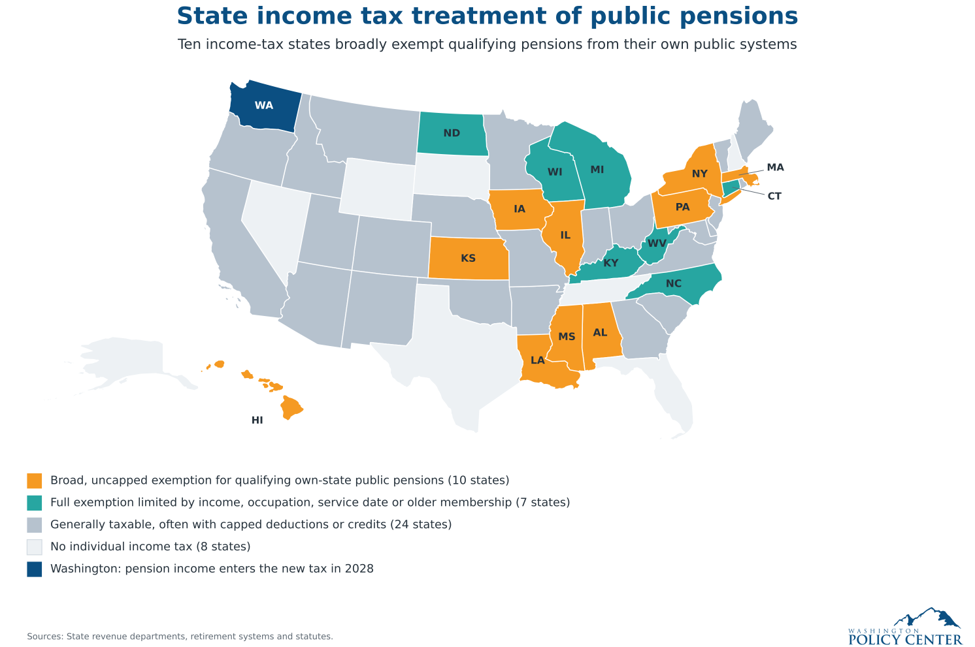
Federal law did not force our lawmakers’ hands either. Federal law prevents states from taxing comparable federal retirees more harshly than their own public retirees, but it does not require states to tax public and private pensions alike. New York, for example, fully exempts its own state and local pensions and federal pensions while limiting its exclusion for qualifying private pension and annuity income to $20,000.
A private-sector worker will now also face a state income tax bill if they withdraw their retirement savings in a lump sum. A single cash distribution from a traditional 401(k), or other similar retirement vehicle, counts as income in the year it is received. Someone cashing out their entire $1.5 million account in 2028 would have $500,000 subject to Washington’s income tax after the $1 million deduction, assuming no other income or applicable adjustments. The state would collect $49,500, in addition to federal taxes, from that single withdrawal of retirement savings. That single state tax payment could equal a full year of planned retirement income.
Pension decisions are made over a working lifetime: how long to stay on the job, when to retire, and how much of a monthly benefit to sacrifice to provide continuing income for a surviving spouse. Once those decisions are made, a retiree cannot go back and negotiate a larger pension to cover a new state tax. The benefit formula does not increase because lawmakers decide to take a share of the payment. A public employee retiring today therefore has good reason to care about how this law could apply a few years from now, even if it produces no tax bill for them in 2028.
Voters have already seen how quickly a statutory promise about income taxes can disappear. Washington enacted a ban on personal income taxes in 2024. Two years later, lawmakers amended that ban to authorize this tax. Retirees are being asked to trust that a Legislature willing to reverse the income tax ban will leave the $1 million deduction untouched, even though it deliberately included their pensions in the tax and the tax’s primary architect openly supports a universal income tax.
The income tax is coming for your pension. Vote yes on Initiative 645 to repeal it before lawmakers lower the deduction and begin taxing it.