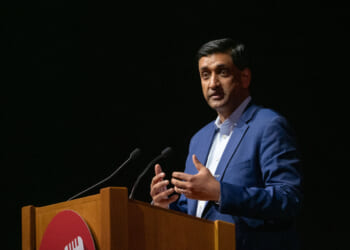
Michael Clark has learned a lot through trial and error in 15 years of teaching, and he wants to bring that learning method to the rest of us.
“My whole philosophy is that feedback matters a great deal,” Clark, an associate professor of economics at Hillsdale College, tells the Overton Window Podcast. “It does in research. In terms of learning, if you give a wrong answer and you let it go for a week, your brain thinks that’s the right answer. Even if you weren’t sure about whether or not it was the right answer. Well, if I tell you right away and explain it to you and then we have a little mini-conversation and you repeat it back, that’s another chance for me to help you learn.”
Clark, who holds Hillsdale’s Wallace and Marion Reemelin Chair in Free Market Economics and recently received the school’s Emily Daugherty Award for Teaching Excellence, introduces students to the method of learning from feedback through an interactive learning tool called the Alchian Maze.
“It’s a very simple, cheap, easy game,” says Clark. “Basically you put a little maze of cards on the ground. It’s kind of like Minesweeper, where you have to go until you hit a mine and then you’re done and you have to start over. But you basically try and find your way through the maze. If you get a Go card, you can go to the next one and the next one, but you have options in front of you. And every time you get through the maze, I give you a piece of candy.”
The Alchian Maze received the 2019 Best in Class Award from the National Economics Teaching Association for effectively teaching students about spontaneous order and the power of profit and loss.
“What happens is students don’t know how to find their way through their maze,” he says. “But they get some feedback, and it says: No, that way didn’t work. And you start again. It’s a really great metaphor for how a market economy actually works.”
It’s also the reverse of the way many Americans learn about market success — by starting at the end, after the success has already happened.
“We tell stories of everybody figuring out the entire economy, as if Steve Jobs just knew everything, or this other person just knew anything,” says Clark. “Well, there’s some serious survivorship bias there. There are many other people who thought they knew everything, and it failed utterly. And the reality is you don’t get those stories. If you ask somebody how to get rich and you only ask the people who are super rich, you’re going to have somebody saying, ‘Play the lottery.’ You never talk to the people who lost the lottery, right? And even if you talk to Steve Jobs, he’s going to say, ‘Hey, we made mistakes, but we had to learn from them.’”
Clark explains how feedback from multiple parties on a large scale generates market order.
“I view mankind in a market economy as kind of limited cognitively,” he says. “But we become incredibly creative and smart through the invisible hand process, through spontaneous order, trial and error with profit and loss. We come to incredible solutions that we couldn’t have thought of on our own. When it gets through that filtering mechanism, it’s great. And that is really my philosophy of teaching. How do I become smarter? Because I’m not that smart. I’m not that great. But if I can go through a mechanism like that, I can become much better than when I am just trying to think.”
Clark points to public choice economics to show why government programs suffer from insufficient feedback. He points to welfare programs, where neither beneficiaries nor taxpayers have much opportunity to comment on how well the system is working. This weakness also applies in the minimum wage debate.
“A voter who cares greatly about helping the poor votes in favor of the minimum wage,” says Clark. “As an economist, I would argue that this hurts the least among us more than it helps them, much more. It takes away opportunities because a business will say, ‘Hey, I have to pay you $20 an hour, and you’re not really actually worth $20 an hour. You’re a low-skilled laborer, so I’m going to replace you with a machine.’ So now that low-skilled laborer never gets on the ladder, never gains the basic skills of showing up, being professional, doing what’s expected in the job. When we have a minimum wage policy, we get unemployment for the least among us.
“But as a voter who doesn’t know economics, I say, ‘Hey, elected official, go get that minimum wage policy.’ And they do. The next step is they get to pat themselves on the back. Politicians get to congratulate themselves because it seems like it will help. There’s a heart behind it, but it doesn’t actually help.”
Hillsdale, an independent school that accepts no state or federal subsidies, provides a sound environment for the professor to find out what works and what does not work, and Clark has adapted his classroom methods over the years — even in small ways such as figuring out the best time to assign oral exams.
“The way that I teach has changed drastically, through very subtle, slow, marginal shifts in what I’m actually doing,” he says. “I think in some part that is because I have changed, in some part because the audience has changed, and in some part because the content that I’m covering slightly changes. So there has been this kind of gradation as to what I’ve done, but it’s great because I have students who are now professors, and I remember them being in class and seeing them through. So a lot of things for me have definitely shifted and adjusted.”
Listen to the full conversation on The Overton Window Podcast.