“Time and again, the Court has stepped beyond its constitutional role and instead engaged in activities reserved to the more democratic branches of government: the legislature and the executive branch.”
The following has been adapted from an excerpt of the Frontier Weekly Newsletter written by Tanner Avery for the April 23rd edition.
Over the last few years, we’ve been raising the alarm about Montana’s Supreme Court engaging in significant judicial activism. Time and again, the Court has stepped beyond its constitutional role and instead engaged in activities reserved to the more democratic branches of government: the legislature and the executive branch.
Kalarchik v. State of Montana is the latest example of Montana’s Supreme Court stepping far beyond its authority and completely undermining the democratic process.
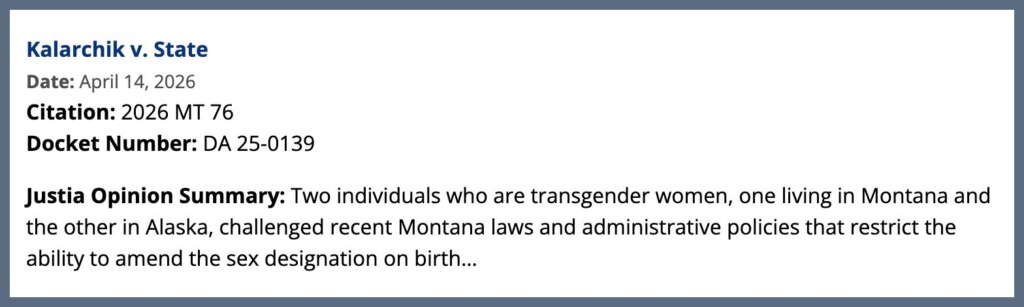
In this case, Montana’s high court upheld a preliminary injunction against SB 458, a bill that clarified in law that there are two sexes for matters of public policy. However, this was far from a typical ruling.
In a 5-2 decision, the Court rejected basic principles that preserve the separation of powers and stepped directly into the core functions of the other, more political branches. In piercing dissents from Chief Justice Swanson and Justice Rice, they did not mince words. Chief Justice Swanson put it best:
“The challenge in any of these politically-charged cases is to ensure we follow our established rules of jurisprudence and do our job—not the policy makers’ jobs—under the Constitution. We should set aside the controversy of the issues to decide the case exactly as we would any other: facts and law, not politics. The Majority has stepped past the correct and readily available resolution to instead intrude upon the policy-making-and-enforcing authority of the Legislative and Executive Branches. It is both unfortunate and unnecessary.
…
If we enjoin the State from enforcing its law, what do we instruct the State to do? Apparently, we must somehow supply a judicially-created law in its place. Our job is to interpret the laws, not write them. The Majority’s activism supercharges the policy debate by placing the courts as the central actor in the daily political dispute. This cavalier approach to statutory construction contradicts our avowed role by saying what the law should be, rather than what the law is.
…
But now that we have spoken from the judicial mountaintop, where is the incentive toward continued public debate, mutual respect, and accommodation? Each side is in fact incentivized to stake out maximalist positions and then rush to the courthouse so the least democratic branch can settle political disputes better left to the policy-makers.”
This is yet another example of Montana’s highest court having no qualms about engaging in judicial activism. We aim to continue keeping you filled in on issues like these. In the meantime, you can go here to learn more about the history of the court and how things got to the place they are today, and you can read the full court opinion here.