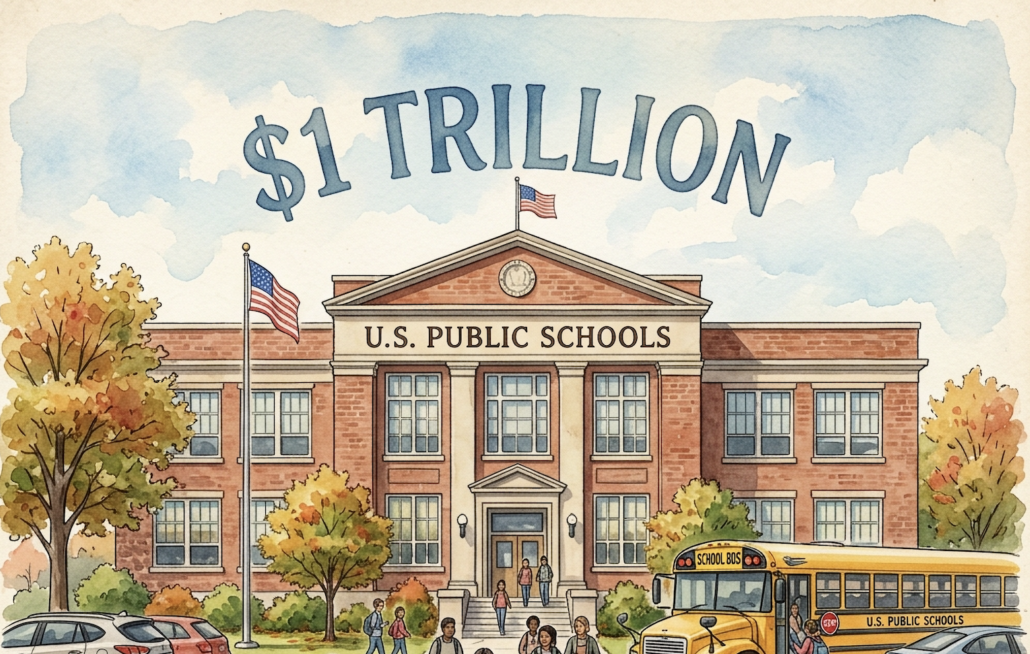
Spending on K-12 public education in the United States passed the $1 trillion mark in the 2024 fiscal year, just-released data from the federal National Center for Education Statistics (NCES) reveal.
“Time to update all mentions of the size of this sector,” commented the Edunomics Lab at Georgetown University’s McCourt School of Public Policy.
“Revenues grew faster than inflation when compared to the prior year,” the Edunomics Lab team wrote in a post on the new data. “Federal was steady (remember, FY23 also had ESSER). More noteworthy was the large jump in state and local revenue (growth that is unlikely to continue). Both grew by over 7% nationally, at a time when inflation (averaged 3.3%) was coming down off its high. To be fair, the education system’s response to inflation often lags by a year or more.”
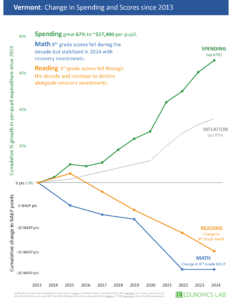
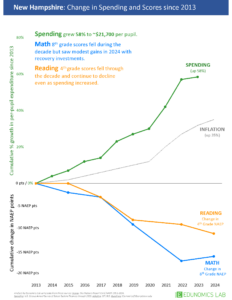
Per-pupil operating expenditures averaged $17,644 in FY 2024. New Hampshire, at $23,083 per pupil, ranked 7th in the nation. Three New England states (Connecticut, Massachusetts and Vermont) ranked higher. Vermont was one of only three jurisdictions, including New York State and the District of Columbia, to spend more than $30,000 per student.
Adjusted for inflation, New Hampshire’s current expenditures per pupil increased by 3.1% from the prior fiscal year, exactly the same as the national average, according to the NCES report. That was much better than our neighboring states. Their increases were 3.5% in Maine, 5.2% in Massachusetts and 6.2% in Vermont.
Total revenues per pupil (including capital, construction and debt) averaged $21,065 nationally. New Hampshire again was well above the national average, with total revenues per pupil of $25,270.
The numbers are based on reports states file with the federal Department of Education. The report for FY 24 is a first look, and some data could be incomplete. (New Hampshire’s data do not include at least one local education agency, for example.)
Breaking $1 trillion in K-12 public education spending for the first time is a significant milestone. Conventional wisdom regarding education funding holds that higher spending equals better results. Were that true, hitting $1 trillion in annual K-12 public school spending would be a cause for celebration, as it would mean an improvement in student outcomes.
But this is not the case, as the Edunomics Lab’s tracking of spending and student outcomes shows. Below are the lab’s charts that track spending and outcomes for Vermont, New Hampshire and Mississippi. Note the differences. Mississippi has managed to generate improved outcomes despite lower rates of spending growth and lower spending overall vs. New Hampshire and Vermont.