You may have heard of the term “living large.” Benjamin Cleveland, one of North Carolina’s heroes of the American Revolution, embodied that phrase in many ways.
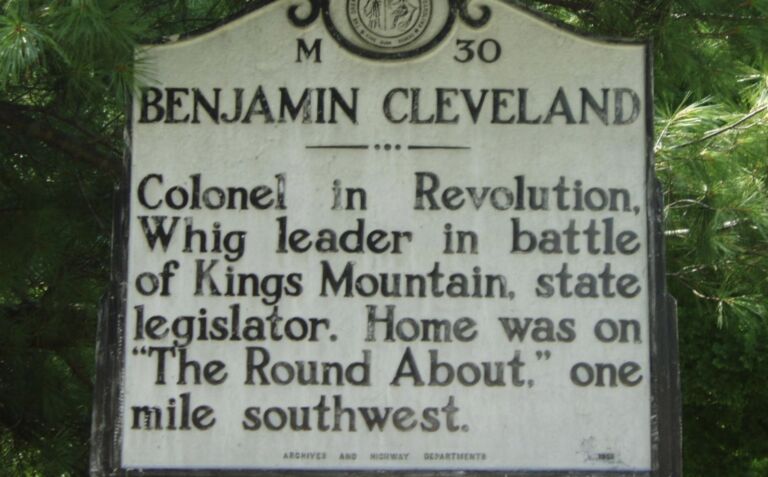
Known primarily as a colonel in the Wilkes County militia who joined with the Overmountain Men and led his forces to victory in the 1780 Battle of Kings Mountain, Benjamin Cleveland was a key Patriot leader in the colony’s northern mountains.
Born in 1738 in Orange County, Virginia, Cleveland came to what would become Wilkes County in northwestern North Carolina in 1769. There, he established a farm and home he called “The Round About” that was known far and wide, and he became known as the wealthiest man in the county.
Well-known also for his size, Cleveland was a big man, standing at least six feet tall and tipping the scales at well over 300 pounds. Stories abound of Cleveland living a wide-open frontier lifestyle in his early days, including gambling, fighting, carousing, drinking, and horse racing. He is said to have loved hunting and trading in furs and skins gained in the wilderness.
After moving to North Carolina, Cleveland befriended a neighbor, Daniel Boone, and upon learning of the great hunting opportunities in Kentucky, made his way west with four others in 1772. His group was attacked by Cherokees, who robbed them of all their furs and belongings, and the hunting party was forced to head back to North Carolina. Undeterred, Cleveland gathered his rifleman friends, went back into Cherokee country, and brought back their stolen horses to great acclaim from his neighbors.
Clearly an experienced Indian fighter, Cleveland epitomized the North Carolina militia fighter that participated in most of the Revolutionary skirmishes fought in North Carolina during the war. Clad in buckskins, moccasins, and hunting shirts and armed with Kentucky long rifles, both Patriot and Loyalist (Tory) militias fought tree to tree using guerilla-warfare tactics.
After word arrived in the mountains of the 1775 battles of Lexington and Concord between Patriot minutemen and the British, Cleveland joined the Surry County Regiment and soon rose to the rank of colonel. He and his men went on to fight against the Cherokees past the Blue Ridge Mountains with Gen. Griffith Rutherford in the fall of 1776.
Cleveland not only led his men (now known as the Wilkes County Regiment) in skirmishes against Loyalists over the next few years, but he also served in the North Carolina House of Commons in 1778, then in the state Senate in 1779 and 1780. He was also the presiding justice of the Wilkes County Court of Pleas and Quarter Sessions. It was widely known that Cleveland had little tolerance for Loyalists and that he had no qualms about hanging them.
In fact, the seal of Wilkes County today has an image of the “Tory Oak” — a black oak tree that grew in what became Wilkesboro that Benjamin Cleveland used for hanging Loyalists. It lived until 1992 when a storm blew it over.
It was reported that when Tory prisoners were taken by local militia, Cleveland administered his own mountain brand of punishment for what he thought was justice. As writer and educator Betty Linney Waugh explained, “Reconstructed Tories were allowed to take an oath of loyalty to the state and were set free; unregenerate Tories were hanged.”
In 1779, in what was a classic story of the vengeful justice that went back and forth through the backcountry between Patriot and Loyalist neighbors, two Loyalists looted and stole from a friend of Cleveland’s after they had been robbed themselves by Patriots. When they were caught, Cleveland hanged them with the clothesline they were said to have stolen from his friend. Upon hearing that story, a band of Loyalists under Capt. William Riddle pursued, captured, and proceeded to take him up into the mountains near the New River. Before they went far, several Patriot militiamen, including Cleveland’s brother Robert, followed the trail of Riddle’s band and rescued Benjamin Cleveland.
Cleveland’s troops eventually tracked down Riddle, captured him, and brought him and two of his men to the Wilkesboro area where they were court-martialed and hanged.
In 1780, after British Maj. Patrick Ferguson went to recruit Loyalists in the mountains to fight for the Crown and threatened the lives and property of Patriot rebels, Benjamin Cleveland joined with settlers from the other side of the Blue Ridge Mountains to fight back. These men were called the Overmountain Men and came out of mountains and river valleys of eastern Tennessee, Virginia, South Carolina, and Georgia to put an end to the threats.
They joined Cleveland at the Quaker Meadows, near what is today Morganton, and marched after Ferguson’s Loyalist army. They met on Kings Mountain, and the Patriots crushed the Loyalists in a great victory for the Patriot cause that reverberated across the colonies. Maj. Ferguson was killed in the battle, and Cleveland — whose own horse was shot out from under him — took Ferguson’s white stallion back to Wilkes County with him as a “war prize.”
After the war was over, Cleveland moved to Oconee County, South Carolina, in 1784 and stayed active in public life there. He died in 1806 from heart disease.
Benjamin Cleveland was larger than life in many ways. He cut a wide swath in whatever he endeavored. His perseverance, drive, and determination were the qualities needed to lead hard men in a rough frontier. His brand of justice was cruel and often driven by vengeance. His zeal for the American cause cannot be questioned, and his leadership helped bring about the major victory in the southern colonies, the Battle of Kings Mountain, that turned the tide for the Patriots and led to the ultimate victory at Yorktown that ended the war. For this, a North Carolina county bears his name. He deserves our respect.
The post Benjamin Cleveland: Frontier Patriot appeared first on John Locke Foundation.