Nearly 1.3 million fewer people are employed today than this time last year.
Beyond the headlines reporting on the recently-released April jobs report that told us 115,000 jobs were added that month is the report reflecting how many people have jobs.
The establishment survey measures the number of payrolls on the books of business establishments. Meanwhile, the household survey measures the number of people who have at least one job.
So if a person has two jobs, he is counted as one employed person in the household survey but is counted as two payroll jobs in the establishment survey.
The two have been diverging for quite a while, and especially so over the past year.
The establishment survey reported that 115,000 increase of jobs in April, which marked a one-year increase in jobs of 251,000.
Conversely, the household survey reported 226,000 fewer people working in April, contributing to a decline of 1.28 million fewer people working compared with April 2025.
The distinction is important. Much of the difference can be explained by people holding multiple jobs. Indeed, those counted as working part time for economic reasons increased year over year from 4.7 million to 4.9 million.
Notably, manufacturing jobs have fallen from 12.7 million a year ago to 12.6 million, a loss of about 64,000.
The unemployment rate held steady in April at 4.3%, but that was largely a reflection of the dwindling labor force.
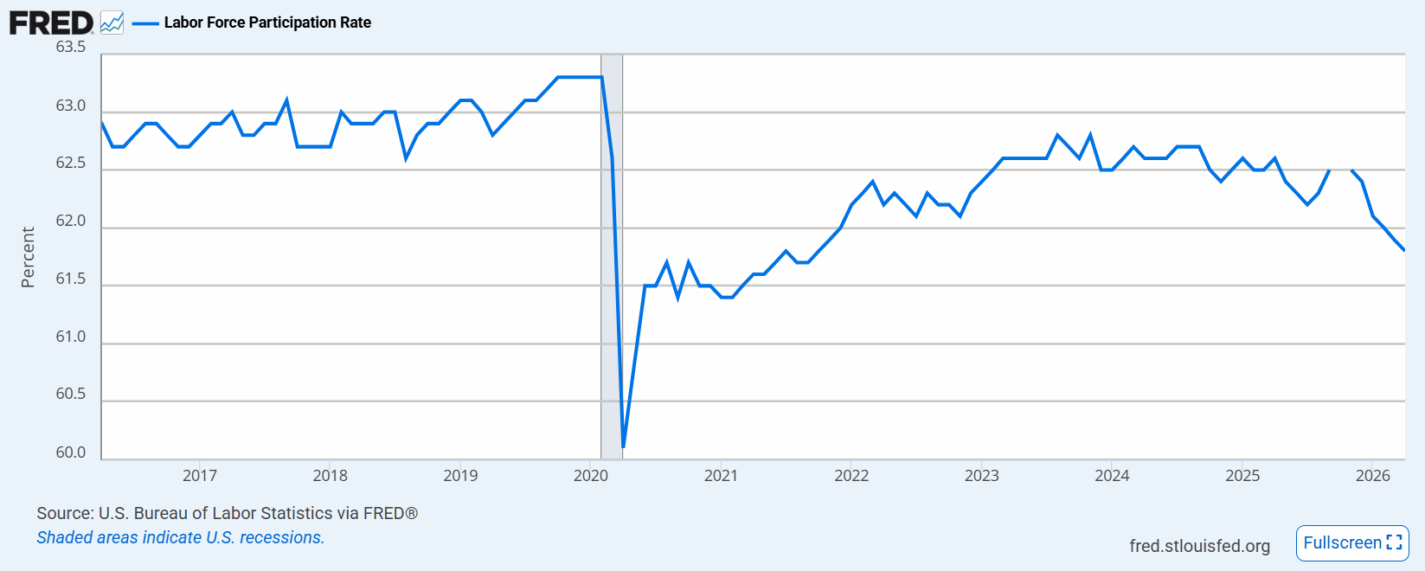
The labor force participation rate year over year fell from 62.6% to 61.8%, reflecting about 2.8 million people dropping from the labor force year over year. The rate has remained solidly below pre-Covid levels. When unemployed people leave the labor force, it reduces the unemployment rate.
In North Carolina, the trendlines are similar. State-level data is a month behind so these measures are from March 2026. Year over year, the establishment survey showed an increase of 44,000 jobs. The other employment number reported at the state level is not purely from the household survey, but rather a statistical blend of the household and establishment surveys. Nevertheless, that data point showed an increase of 18,671 people employed year over year, less than half the establishment survey.
The state suffered a loss of 10,000 manufacturing jobs during the year, while the labor force participation rate dropped from 59.6% to 59.0%.
All this is not to inspire panic nor doom and gloom. It is, however, intended to provide a realistic analysis of an economy and labor market that is showing cracks. Recent spikes in inflation and massive energy disruptions due to the war in Iran are not helping.
North Carolina state legislators should bear this in mind as they plan for this year and future budgets. Don’t make the same mistakes as were made in previous recessions.
Limit spending, especially recurring expenditures. Continue to save for a rainy day. Continue with tax cuts because a recession is easier for workers to bear with a lower tax burden, and lower rates will make recovery easier. Plan now for the coming funding gap for the Medicaid expansion population. Resist the urge to enact “temporary” taxes when recession does hit.
Good fiscal times won’t last forever. Even the supposedly strong labor market is showing cracks. State legislators should act accordingly.