In the summer of every federal election year, North Carolina is treated to a bit of drama over early voting sites, with Democrats and Republicans trading barbs over a handful of counties where election boards could not reach consensus on early voting sites, days, or hours.
2026 is hardly different.
Following acrimony over early voting plans in the primary, the North Carolina State Board of Elections had to decide on early voting plans for 20 county elections boards that could not reach a unanimous agreement in a meeting that stretched over nine hours.
Comparing 2026 to 2022
For an apples-to-apples comparison, I will compare early voting sites and hours with those from the last midterm election in 2022. I will use a dataset compiled by Western Carolina University political scientist Chris Cooper (it is publicly available, but I still secured permission to use it).
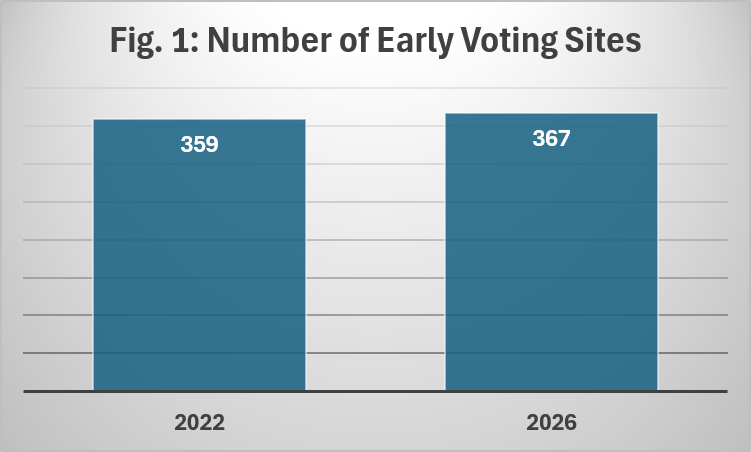
As seen in Figure 1, the number of early voting sites increased from 359 in 2022 to 367 in 2026, a 2.2 percent increase.
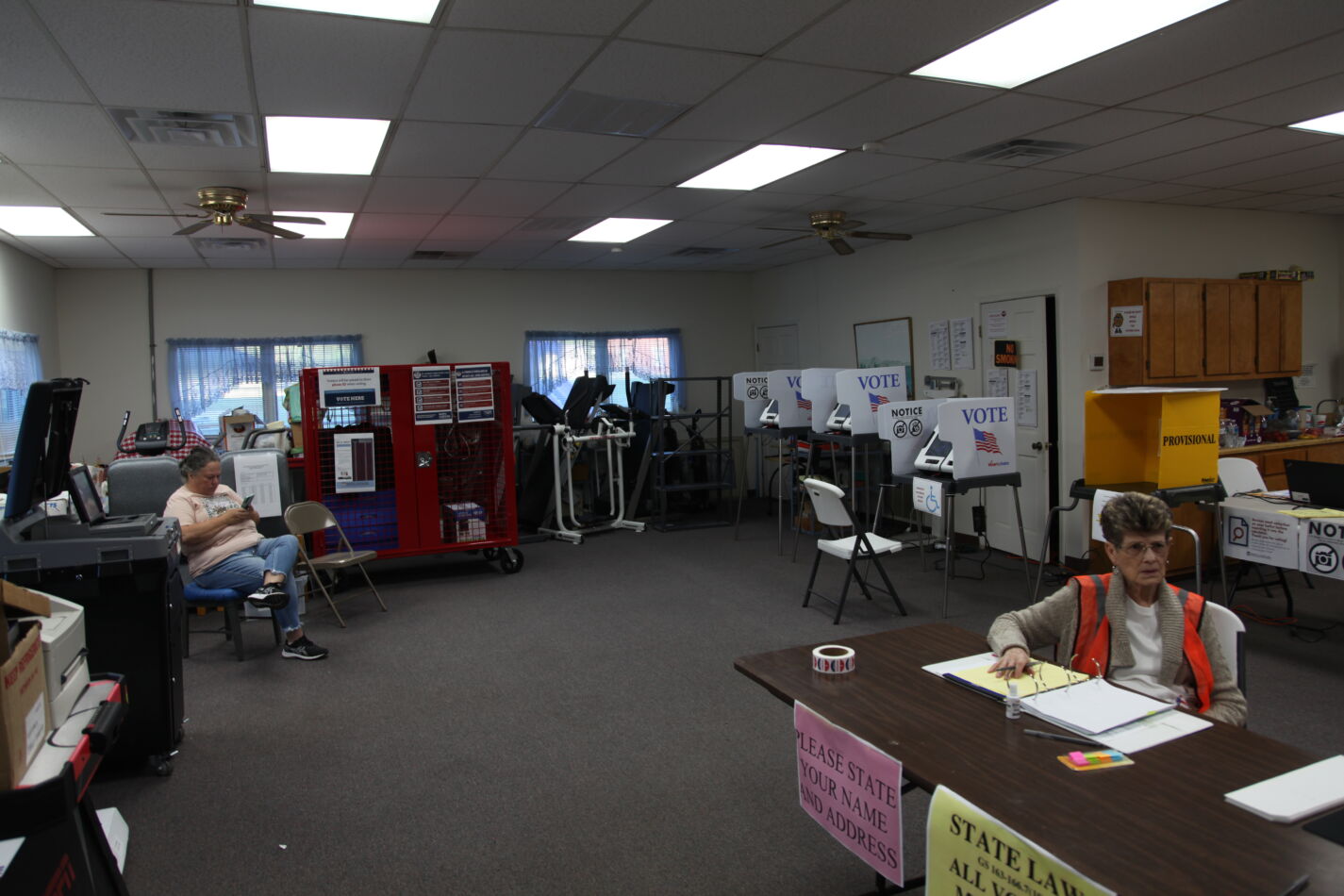
While that does not keep pace with the 6.6 percent increase in the number of registered voters in North Carolina, it does not represent a significant drop in access. As seen in the graphic below from the 2022 general election on Vote Tracker, with the possible exception of the last Friday of the early voting period, few sites operate anywhere near capacity.
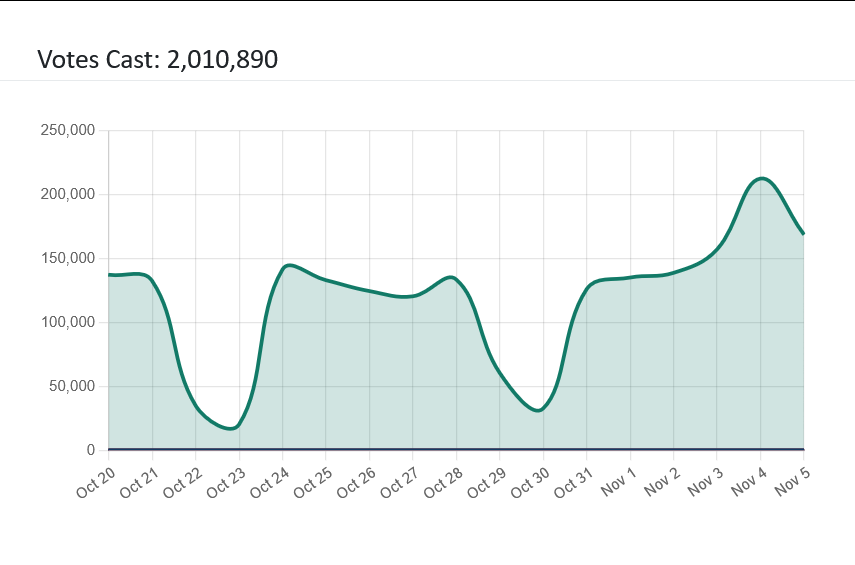
That is especially true in many rural sites. There are busier times, especially in the evening, but many early voters only have to wait a few minutes, if at all. Of course, not all sites are situated for maximum utility. Some are placed to shorten the travel time to voting sites for significant portions of a county’s voters.
State law permits, but does not require, counties to open their sites on Sundays and the first two Saturdays of the early voting period (They are required to keep early voting sites open on the last Saturday before election day). That makes it possible for the total hours of early voting to decline even as the number of sites increases.
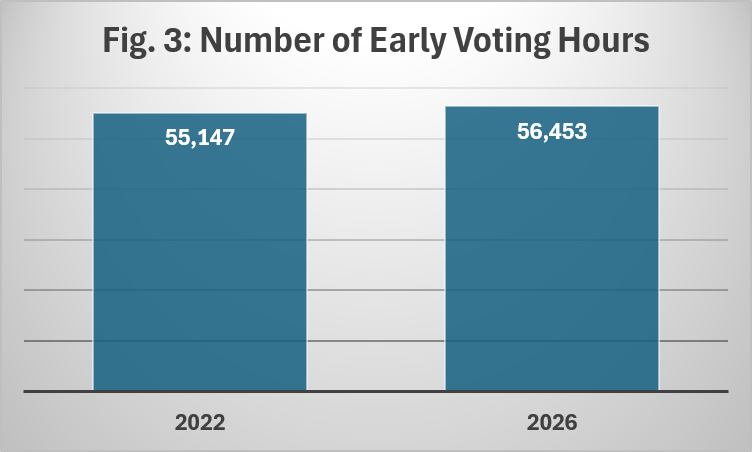
That is not the case this year. The total number of early voting hours increased 2.4 percent from 55,147 in 2022 to 56,453.
Aside from total voting sites and hours, two of the most divisive disputes among Democratic and Republican election board members have been campus locations and Sunday voting. Here is how the State Board came down on those conflicts.
Sunday voting
While state law requires almost every county to keep all early voting sites open on weekdays and the last Saturday before election day, counties have the option of operating on the two other Saturdays and two Sundays during the early voting period.
Those who vote on Sundays tend to favor Democrats. According to data from the John Locke Foundation’s Vote Tracker, Democrats accounted for 46.2 percent of early voters on Sundays in the 2022 general election compared to 37.7 percent of early voters overall. The most cited reasons for that difference are “Souls to the Polls” events, often backed by the Democratic Party, in which mostly Black organizations and churches, encourage participants to vote as part of an organized group.
However, a not inconsiderable reason for that variance is that a disproportionate share of Sunday voting occurs in a handful of urban counties. As seen in Figure 4, five urban counties accounted for over half of all votes on the second Sunday of early voting in 2022 (17,700 of 32,765 votes).
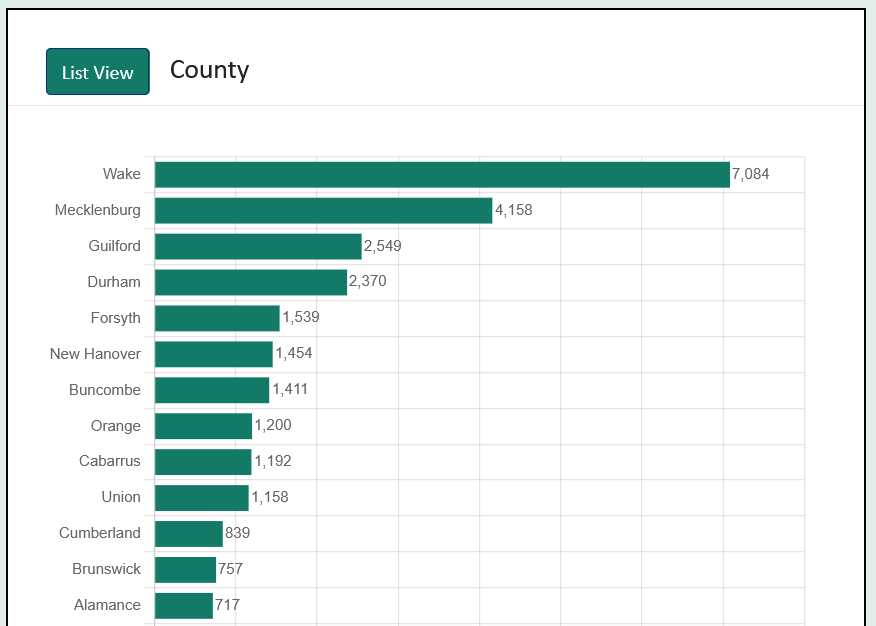
Sunday voting will decline markedly in 2026, going from 40 counties in 2022 to 17.
Campus locations
The question of where to locate early voting sites on Campus is a balance between providing students with access to voting and keeping the sites accessible to the general community. Many campuses are insular by design to help foster a sense of campus community. That can make it difficult for people unaffiliated with the college or university to access them. Access problems can include a lack of available parking and navigating the campus.
According to Cooper, the number of campus locations declined from 11 in 2022 to 9 this year, although it remains higher than the average for midterm elections over the past two decades.
Three campus locations seemed to raise the most ire. For two of those, North Carolina State and Western Carolina, officials maintained a site on campus but moved to a location on the edge of campus that is most accessible to the general public. As in 2022, there will not be an early voting site on the North Carolina A&T campus this year.
The bottom line
The bottom line is that there is not an appreciable difference in voting site access in North Carolina compared to the last midterm election in 2022. For more data, see Chris Cooper’s excellent post on the topic.