
Property taxes have been a hot topic at the North Carolina General Assembly. Responding to growing concerns from voters, in June 2026, the General Assembly approved legislation to enact a one-year moratorium on new property tax values in counties scheduled for reappraisal in 2026. In addition, lawmakers also put on the November ballot two constitutional amendments. One requires limits on property tax increases by local governments. The other asks if voters support or oppose a constitutional amendment to prohibit state government from raising the state income tax above three and one-half percent (3.5 percent). The outcomes of this fall’s elections and proposed constitutional amendments will have significant impact on households, businesses, state and local governments, and schools across the state.
In September, the Carolina Journal Poll asked North Carolinians how they felt about two of the constitutional amendments.
One question asked respondents whether they support or oppose a North Carolina constitutional amendment requiring limits on property tax increases by local governments.
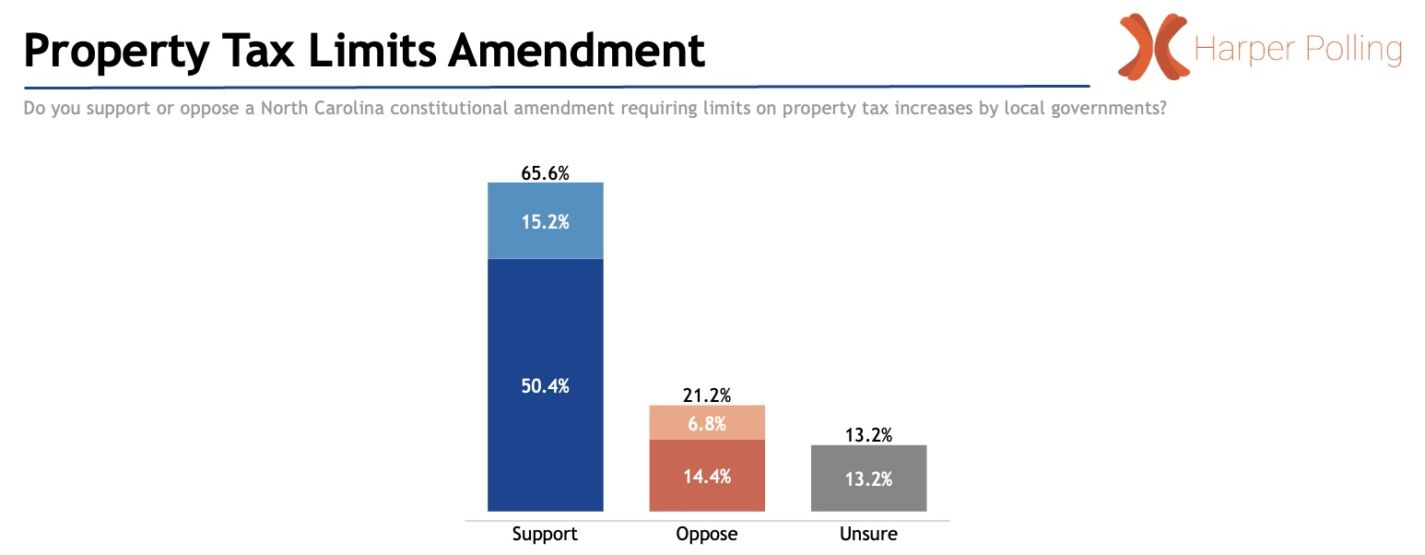
By more than a three-to-one ratio, respondents said they support limiting property tax increases. Sixty-six percent of respondents support the amendment, while 21 percent oppose it, with about 13 percent unsure.
A review of the question’s crosstabs is also instructive. Support for the amendment was wide and generally increased with age. For example, 47 percent of 18–34 year olds voiced support, while 74 percent of respondents over 65 years old do as well. With regard to political identification, 82 percent of Republicans support the measure, along with 54 percent of Democrats and 60 percent of Independents. Support for the amendment is also strong across races, with Hispanics at 50 percent, blacks at 69 percent, and whites at 65 percent. In addition, support is also strong across regions, ranging from a low of 60 percent in Raleigh-Durham to Central North Carolina at 78 percent.
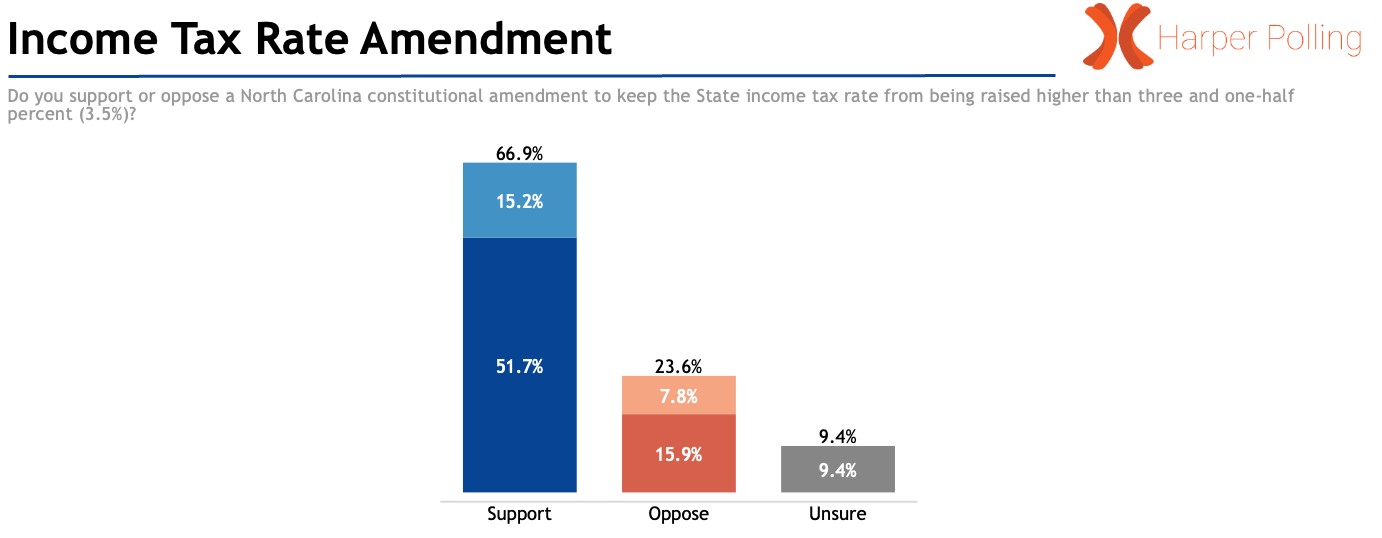
A second question asked respondents whether they support or oppose a proposed constitutional amendment to prohibit the state income tax from being raised above three and one-half percent (3.5 percent). Once again, support was strong, with 67 percent of respondents favoring the measure, while 24 percent oppose it. Nine percent of respondents were unsure.
Again, it’s helpful to review the crosstabs. They show the amendment is appealing across party registration, race, and geography. A full 80 percent of Republicans support the amendment, along with 66 percent of Independents and 56 percent of Democrats. Moreover, nearly three of every four (74 percent) blacks favor the amendment along with nearly two of every three (65 percent) whites. Support remains high across Lastly, support for the measure remains strong across types of communities. Nearly three quarters (74 percent) of respondents in rural areas favor the amendment, compared with 71 percent in towns, 66 percent in suburbs and 59 percent in urban areas.
Are these findings surprising? They shouldn’t be. The same poll asks respondents, “How satisfied are you with the way your local governments prioritize spending of your property tax dollars?” Fifty-six percent of respondents said they were unsatisfied; only 31 percent of respondents said they were satisfied.
Frustration needs an outlet.
In a month voters will decide who wins this battle.
The post Is a tax revolt brewing? appeared first on John Locke Foundation.