Two recently published charts tell an eye-opening story about New York City’s economy:
The first, found in a report from the state comptroller, showed that the city’s health care and social assistance workforce is growing by leaps and bounds while every other job category is stagnant or shrinking.
The second, posted on X by an editor for The Economist, revealed that inflation-adjusted wages are plunging for city workers as they’re climbing for the nation as a whole.
These two trends are no coincidence, and they should be a wake-up call for Albany: The city’s economy is rapidly shifting away from its traditional economic mainstays – such as Wall Street and tourism – and becoming increasingly dependent on home health jobs at the bottom of the pay scale.
An updated version of the chart from the comptroller’s report (reflecting recently revised labor data) paints a stark picture. The health care and social assistance sector has dominated hiring over the past six years. It was already the largest of the major sectors heading into the pandemic, and it grew by almost 190,000 jobs or 23 percent in the six years since.
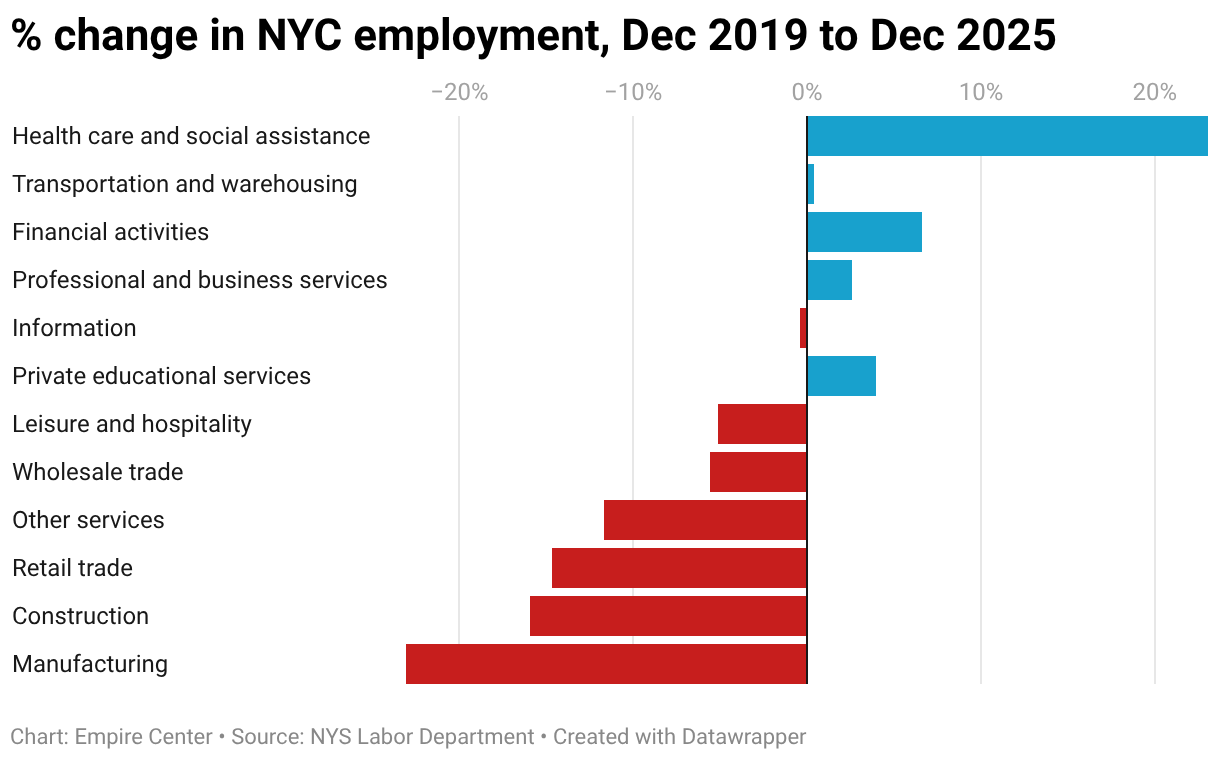
No other sector came close, and most were losing ground. If not for so much hiring in health care and social assistance, in fact, the city’s total workforce would have shrunk by 49,000. The sector accounted for 21 percent of all city jobs in December 2025, up from 17 percent in December 2019.
A closer look at the data indicates that less than one-fifth of the health-care growth involved high-paid professionals such as doctors or nurses. The vast majority of new hiring – 157,000 jobs – was in the burgeoning field of home health care, which is largely financed by taxpayers through Medicaid, and which typically pays workers just above the minimum wage.
In some cases, these workers effectively receive less than the minimum wage – when they put in a 24-hour overnight shift, but are paid for just 13 hours on the assumption that they take time off to eat or sleep. This week, a group of aides launched a hunger strike seeking a ban on this practice, which is an exception to normal labor laws.
The rapid growth of this type of employment goes a long way to explain why the city’s average wages have lost so much ground to inflation, as pointedly noted by The Economist‘s Wall Street editor, Mike Bird. Compared to January 2020, real hourly wages in the city have dropped by 7 percent or $3.20 an hour, even as the nationwide average went up by 4 percent or $1.32 (see chart below, which is a revised version of the one created by Bird).
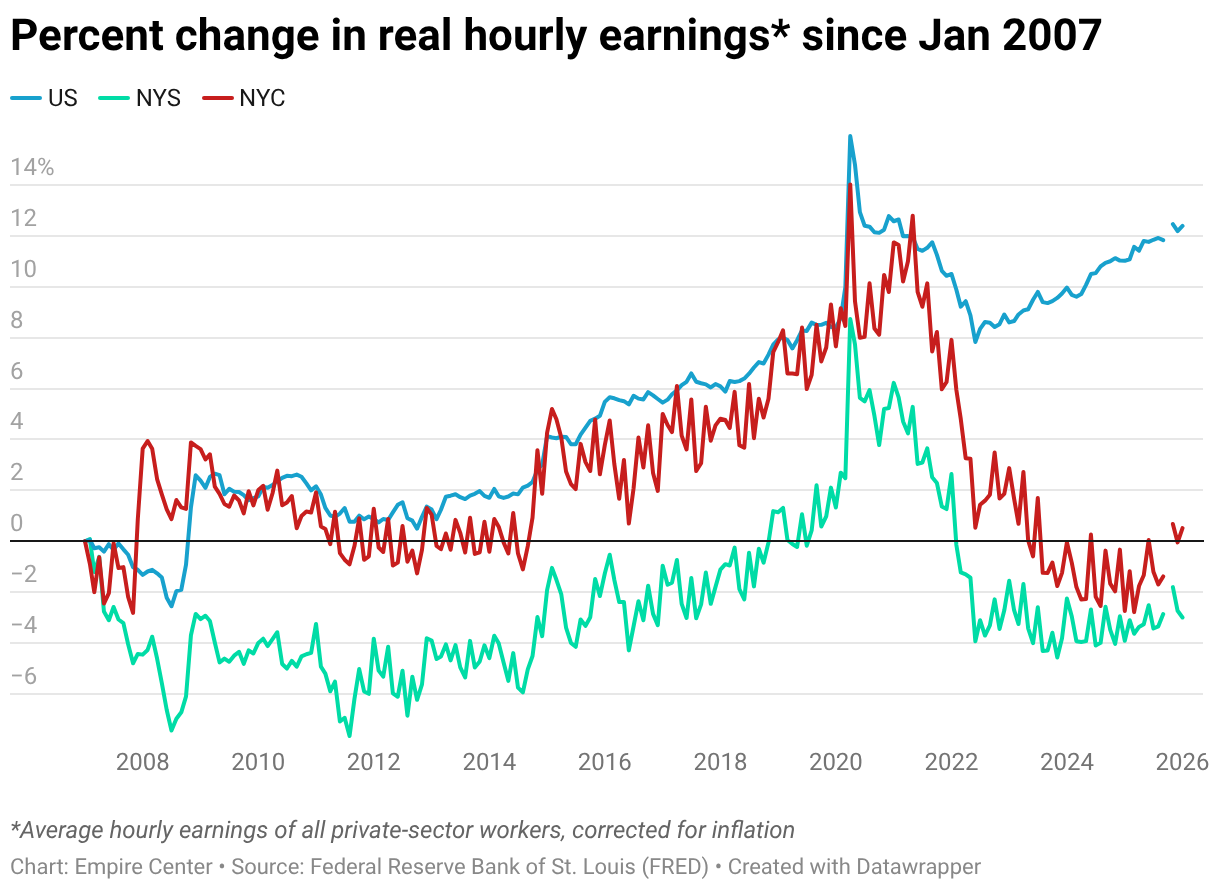
Over the decade, workers’ average inflation-adjusted hourly earnings have gone up 12 percent, while the city’s average gained only 1 percent.
The statewide picture is similar: Health care and social assistance jobs grew by 16 percent since 2025, by far the fastest rate among the major categories, while sectors such as retail, construction and manufacturing lost jobs. Real wages are down 4 percent since January 2020 and 3 percent over the past decade.
Health care and social assistance was the fastest-rising employment sector at the national level, too, growing by 14.1 percent since 2019. But that was balanced by more robust hiring in other areas such as transportation and warehousing (up 13.8 percent) and construction (up 10.1 percent), as well as overall job growth of 4.3 percent, which was double the rate in New York City and almost four times the rate for the state as a whole.
The city’s unhealthy employment and wage trends are at least partly a byproduct of state policy. The rapid growth of home care employment traces directly to the loose-fisted way that New York manages its Medicaid program. And the broad weakness in hiring can be tied, at least in part, to state-imposed taxes and regulations that discourage business development and put New York at the bottom of the Tax Foundation’s competitiveness rankings.
Unless Governor Hochul and the state Legislature change direction, low-wage health-care jobs will continue to be the only choice for a growing share of the state’s population.