Balancing a state budget is an exercise in tradeoffs. Every dollar allocated to one priority is a dollar unavailable for another. Yet those tradeoffs are often difficult to see, buried in lengthy documents, complex fiscal tables, and competing policy claims.
A new online tool from Longleaf Politics makes those choices more tangible by allowing users to build their own version of North Carolina’s budget. It also allows users to compare competing proposals from the House, Senate, and Governor, providing a clearer picture of how different policy approaches affect the bottom line.
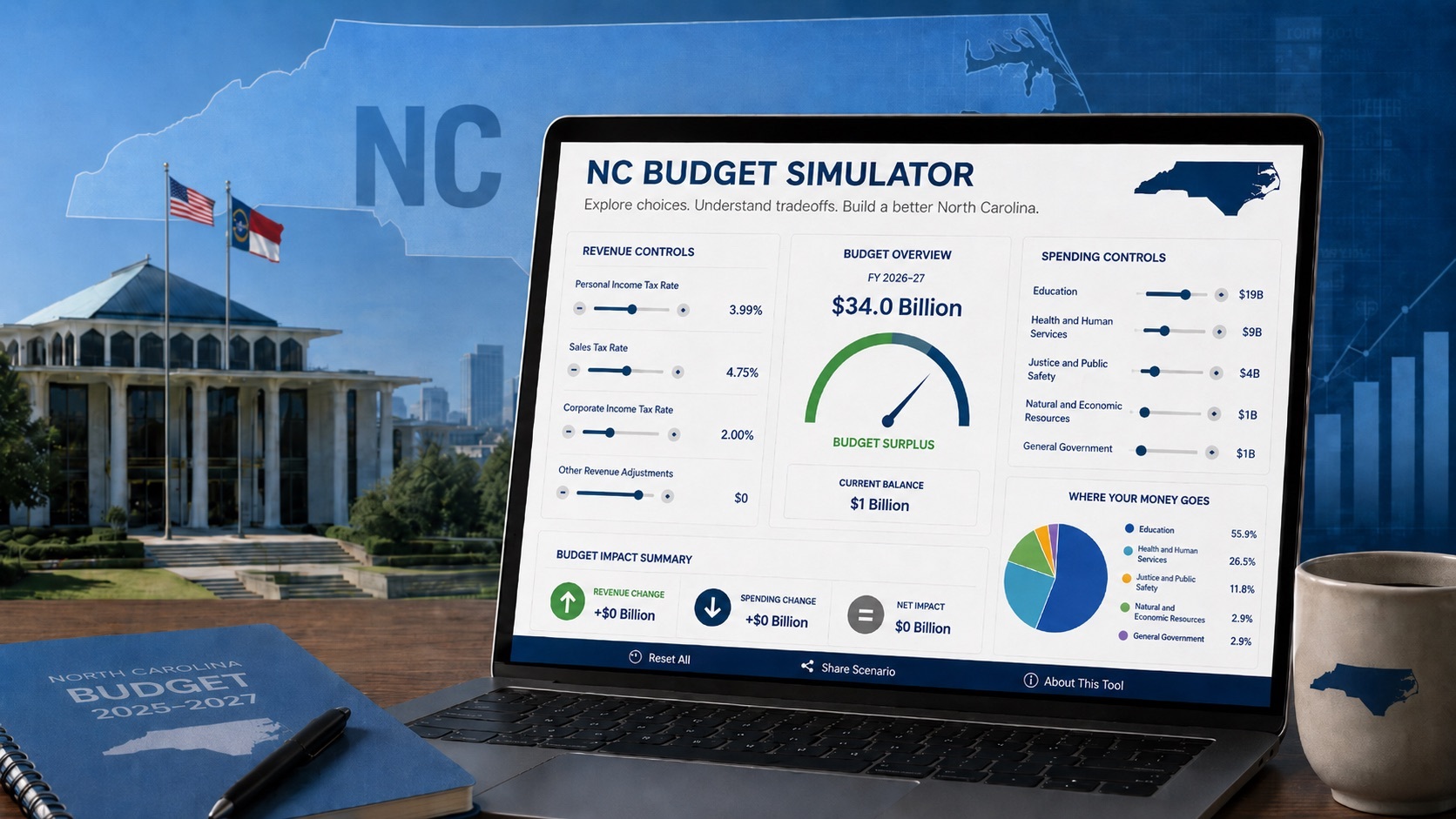
Longleaf Politics’ budget simulator
The simulator allows users to explore North Carolina’s budget by adjusting both tax policy and spending decisions in real time.
On the revenue side, users can change personal and corporate income tax rates or add targeted tax relief, immediately seeing how those choices affect total revenue. On the spending side, the tool includes major drivers of the state budget, such as teacher and state employee pay raises, and Medicaid funding, along with policy choices like school choice funding and disaster relief.
As each adjustment is made, the simulator updates whether the budget remains balanced, forcing users to reconcile competing priorities.
Increasing teacher pay, for example, carries a clearly defined cost: roughly $93 million per percentage-point increase, while state employee raises of the same size add about $70 million. These kinds of estimates help illustrate how quickly recurring costs can grow.
The result is a more intuitive way to grasp not just the size of the state budget, but the tradeoffs required to align revenues with expenditures.
A case for an official budget simulator
Tools like this demonstrate how interactive technology can make budget tradeoffs more visible and easier to understand. By allowing users to adjust tax policy and spending decisions in real time, a simulator highlights the fundamental challenge of budgeting: aligning limited resources with competing priorities.
That raises a broader question. If an independently developed tool can help clarify these decisions, why doesn’t North Carolina create an official version?
The state already has the necessary infrastructure. Agencies such as the Office of State Budget and Management and the Fiscal Research Division maintain comprehensive budget data. An interactive simulator built on that foundation could provide legislators — and the public — with a more accurate, transparent, and accessible way to understand the state’s finances.
Rather than replacing traditional budget documents, such a tool would complement them by translating complex fiscal decisions into a format that is easier to explore and evaluate.
Closing thoughts
In 2026, there is little reason for state budgeting to remain confined to static documents and dense spreadsheets. North Carolina has the data, the institutional capacity, and the technological ability to do better.
An official budget simulator would not replace the hard work of analysis, but it could make that work more transparent, accessible, and understandable. At a minimum, taxpayers deserve a clearer view of how their hard-earned money is being spent and of how policy choices translate into real tradeoffs.
Transparency should not end with publishing budget documents — it should include making them understandable.