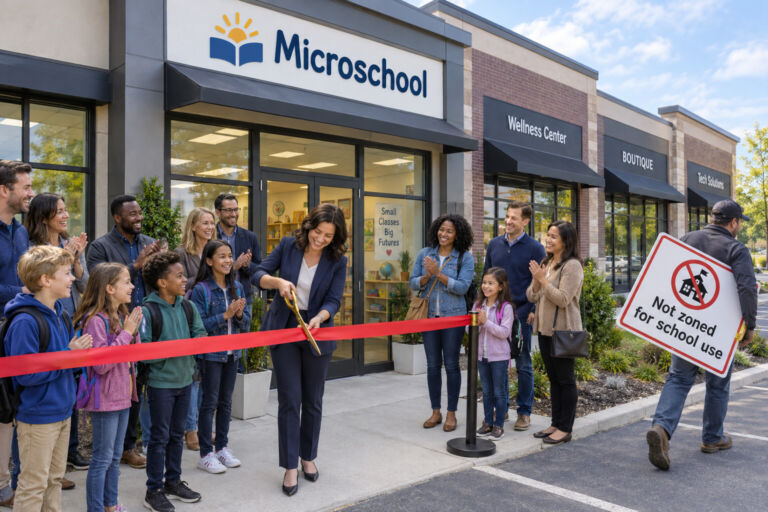
- Microschool founders and operators report facing a number of regulatory barriers, including land use and zoning regulations and permits, that limit their growth
- Utah shows how states can encourage the growth of microschools by addressing zoning and occupancy barriers in state law, while the town of Gibsonville, North Carolina, shows how local communities can do something similar in their municipal codes
- Policymakers can also examine Learning Pod Protection Acts from states like Tennessee and Texas for ways to loosen regulatory burdens that may not be applicable to microschools
School choice has been receiving a lot of attention lately. Earlier this month, the U.S. Department of the Treasury released regulations that provided some much-needed clarification on how the Federal Tax Credit Scholarships will operate in 2027. North Carolina has opted to participate in this program next year.
Meanwhile, at the state level, participation in North Carolina’s Opportunity Scholarship and ESA+ programs has reached record levels (see here and here, respectively), and enrollment in private schools is higher than ever.
Are there enough seats in private schools to satisfy such demand? One way to increase seat capacity is to address barriers preventing microschools from opening and expanding to meet the needs of students and families. States like Utah and West Virginia show North Carolina how to do so.
Defining microschools and identifying the barriers they face
What are microschools? As the John Locke Foundation’s “Room to Grow” report explains,
Microschools typically involve “a small group of families bringing their children together to be taught by one or a few dedicated educators.” They are different from homeschool co-ops, which tend to be parent directed, and because of their small size, they can offer the personalized education that many families want. Some consider microschools to be a revival of the one-room schoolhouse.
Microschools became popular during the Covid-19 pandemic and have remained so, but a number of barriers stand in the way of their growth and expansion. In a 2025 survey by Locke and EdChoice, education entrepreneurs identified land use or zoning regulations and permits as common policy constraints to starting or expanding schools.
Regulations/Policy constraints facing ed entrepreneurs in North Carolina

Source: “Room to Grow: Evaluating Private School Readiness for School Choice Demand in North Carolina”
Given growing private school enrollment and participation in school choice programs, it’s more important than ever to address the barriers facing microschools so that they can grow and expand to serve more students.
Addressing zoning and occupancy barriers in state law
States like Utah show how policy reforms can help address some of the barriers that limit the supply of microschools. One way is by amending zoning laws and ordinances to recognize microschools as a permitted use in more areas.
In Utah, state law defines a “home-based microschool” as a person or group of people registering as a business and providing K–12 educational services for compensation to no more than 16 students meeting in a home or other residential property. Daycares are specifically excluded from this definition.
Utah law also defines a “micro-education entity” as a person or group of people registered as a business and serving no more than 100 students. Daycares, home-based microschools, private schools, and schools operating within the public education system aren’t included in this definition.
Crucially, Utah law states that home-based microschools and micro-education entities “shall be considered a permitted use in all zoning districts within a county.” This makes it easier for microschools to find a suitable location from which to operate, which can be difficult when most zoning laws and ordinances weren’t designed with entities like microschools in mind.
A bill similar to Utah’s law was introduced in California this year but has not progressed out of committee. In its original form, the bill would have defined microschools (serving 16 or fewer students) and micro-education entities (serving between 16 and 101 students) in state law. It would have permitted microschools to operate on any land allowed for residential use and allowed micro-education entities to operate on any land zoned for “residential, mixed-use, commercial, or industrial use.” Microschools would have been subject only to residential building and fire codes, rather than the educational ones by which larger, traditional schools must abide.
Addressing zoning and occupancy barriers in municipal code
In the absence of microschool laws at the state level, one community in North Carolina has taken matters into its own hands. In 2025, the town of Gibsonville, North Carolina, amended its zoning ordinances to define a “micro school” as “[a] deliberately small community-based learning environment, with typical small class sizes operating outside of the traditional school system designed to prioritize personalized learning, flexible instruction, and values-based education.”
The ordinance allows microschools to operate within “designated commercial zoning districts,” such as those zoned for light office, neighborhood business, and shopping center use. It also clearly spells out the development standards for microschools, including relevant building and fire safety standards, parking requirements, and noise restrictions. Assuming that microschools meet the standards in the ordinance, the city will allow them to operate by right in the designated zones without requiring them to have a special conditional use permit.
Gibsonville’s actions show that local communities can take steps to promote entrepreneurship and innovative educational options even when state laws are unclear or outdated.
Drawing from Learning Pod Protection Acts
Learning pods are similar to microschools but seem to be slightly less structured or formal. During and immediately after the Covid-19 pandemic, Tennessee, Texas, and Georgia all moved to address and protect microschools in state law.
Tennessee’s law defines learning pods as “a voluntary association of parents choosing to group their children together at various times or places to participate in or enhance their children’s kindergarten through grade twelve (K-12) education, regardless of whether payment is made for any services provided to the children participating in the learning pod.” It also specifies that a learning pod is not a nonpublic school and exempts learning pods from state and local regulations governing educational facilities (class size and teacher licensure requirements, fire and building codes applicable to schools, etc.).
Similarly, Texas law defines learning pods and exempts them from local regulations governing schools and child-care facilities (including building and fire codes).
In Georgia, learning pods are seen as providing ancillary or supplemental educational services. Like in Tennessee and Texas, however, they are exempt from certain regulations, in this case those relating to operating a child-care center or day care.
In all these states, learning pods remain subject to regulations governing the facilities where they meet, even though they are exempt from many school-specific requirements.
Although enacted in response to the pandemic, these Learning Pod Protection Acts still offer a useful model for policymakers. By recognizing the nontraditional nature of learning pods and exempting them from regulations designed with traditional schools in mind, they encourage more microschools to open or expand.
Conclusion
Locke’s “Room to Grow” report suggests several ways to increase the supply of private schools and microschools so that North Carolina can accommodate growing demand. Policymakers in North Carolina could help meet this demand by defining microschools in state law, removing zoning and occupancy barriers that limit their growth, and exempting them from regulations that are unnecessary or inapplicable.
The post Removing regulatory roadblocks to help microschools grow appeared first on John Locke Foundation.