Gary Schmitt of the American Enterprise Institute critiques one of the president’s questionable plans.
What’s wrong with Trump’s proposed triumphal arch?
First is the aesthetic pomposity of the planned arch. It appears classical in design, echoing Rome’s Arch of Titus and Paris’s Arc de Triomphe. But in scale, ornamentation, and symmetry it is anything but. Like the president’s ballroom, it is a cartoonish, gilded version of what the form is meant to convey—the 250th anniversary of the nation’s birth with the Declaration of Independence. Indeed, the arch will reflect more about Trump’s own triumphalism than the coherent, rhythmically enunciated principles of the Declaration of Independence.
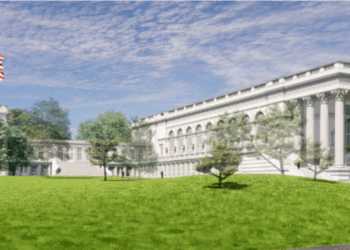
Second, an arch is unsuitable in both form and function. The templelike National Archives building, which houses and displays the Declaration, remains the most fitting repository for citizens and foreigners to ponder that document and its lasting place in US history. By contrast, the Arc de Triomphe and the Arch of Titus were built to celebrate military victories, as were other arches. There is no iron rule that ceremonial arches cannot be employed for other purposes, but still, architectural traditions shouldn’t be blithely ignored.
One could have imagined a significant-sized arch, for example, to celebrate America’s grand victory in World War II. Indeed, the World War II Memorial has two arch-shaped victory pavilions—one for each of the two major theaters of the war. Yet neither disrupts the sight lines from the Capitol to the Lincoln Memorial. If constructed, Trump’s arch would be 250 feet high and would completely obscure the sight line from the Lincoln Memorial to Arlington Cemetery. Instead of adding to the civic landscape, the arch would be a looming “pimple” on the capital’s most sacred landscape. Note that the Arc de Triomphe, no shy edifice, measures 164 feet high. That is, Trump’s arch would be 86 feet taller, or 52 percent greater in height, than France’s.
The post Taking aim at the ‘Arc de Trump’ appeared first on John Locke Foundation.