
This article is part 3 of a series that examines the policy prescriptions coming from the left-wing group Carolina Forward. With North Carolina at a crossroads, it’s a good time to evaluate the sort of policies advanced by those who desire to move our state in a more “progressive” direction.
You can read the complete introduction in part 1 here and an evaluation of their recommendations for population shifts, housing, and transportation in part 2 here.
This article focuses on Carolina Forward’s recommendations for North Carolina regarding health care and public education.
Health care
The health care section in Carolina Forward’s report outlines the “dual reality” of North Carolina’s health care system: Large and growing urban population centers are served by major health care providers that are experiencing consolidation through mergers, while rural areas suffer from a lack of access to care.
The result of mergers in urban areas, according to the report, is rising costs for patients. This is a fair observation, but the report makes no mention of the evidence that hospital mergers accelerated after the passage of the Affordable Care Act (ACA, also known as Obamacare) in 2010. For instance, this 2020 article in The New England Journal of Medicine (NEJM) reported that “[t]he hospital industry has consolidated substantially during the past two decades and at an accelerated pace since 2010,” noting specifically “a surge in mergers and acquisitions beginning in 2010.”
Many health care experts blame the incentives in Obamacare — such as rewards for consolidated care and managing the total cost of patients — for this surge in mergers after 2010. For instance, a 2014 article in the NEJM concluded that “the Affordable Care Act has unleashed a hospital-merger frenzy.”
Failure to acknowledge one of the causes of the merger issue minimizes the weight of any recommendations the report may have to combat it.
Meanwhile, the report notes, rural areas of the state that are losing population are suffering from a lack of available providers due in part to hospital closures.
The report also celebrates the 2023 expansion of Medicaid in North Carolina while neglecting to recognize the hefty price tag. State spending this year on Medicaid will have increased 59 percent in just four years, while total spending (state plus federal receipts) will exceed $41 billion — a stunning increase of 93 percent. Expansion means Medicaid is chewing up a greater share of the state budget. Ten years ago, state spending on Medicaid accounted for 16 percent of the state budget. This year it will be 22 percent.
Rapidly skyrocketing Medicaid costs crowd out billions in other potential state spending or tax cuts. The Carolina Forward report makes no effort to explain how taxpayers can be expected to pay for all of their priorities included in their report.
Unsurprisingly, Carolina Forward’s recommendations for North Carolina’s health care systems center on requiring more government management and spending more taxpayer dollars.
“Bolster Rural Healthcare Infrastructure”
Recommendations include more taxpayer dollars to further subsidize rural health care facilities. To their credit, the report acknowledges that rural health care facilities need to be “right-sized,” but their solution is to throw more taxpayer dollars at said facilities.
A better alternative would be to stop propping up oversized facilities and eliminate Certificate of Need laws in order to make it easy for smaller, more responsive, and localized rural facilities to be created.
The report also recommends more taxpayer dollars to incentivize more health care workers to work in rural areas experiencing shortages. Instead, expanding scope of practice for registered nurses would encourage more nurses to practice throughout the state, with a significant benefit accruing in rural areas. Arizona, for example, granted nurse practitioners full practice authority in 2002. Five years later, the state reported a 73 percent increase in the number of NPs serving rural counties. Allowing nurses to practice to the full extent of their training could free up more time for doctors to see more patients.
The report also recommends expanding telehealth by making reimbursements on par with in-person visits. Doing so, however, would undermine telemedicine’s cost-effective capabilities and end up discouraging its use.
“Increase Competition and Transparency in Urban Health Markets”
Here the report makes recommendations to limit hospital system mergers, imploring stronger antitrust oversight. Rather than more meddling in the health care market to counter the result of previous intervention (Obamacare), state legislators should look for ways to peel back the regulations helping to fuel the “surge in mergers” seen since 2010. The report also floats the idea of a hospital “rate-setting commission,” which would be a central-planning disaster.
“Secure Medicaid Expansion and Fill Coverage Gaps”
The report insists that “[t]he state must safeguard the Medicaid expansion coverage gains.” How the state is to pay for these “gains” is left unsaid.
The report also suggests taxpayer funding for a state subsidy (which would be in addition to the federal subsidies and tax credits already in place) for Affordable Care Act marketplace insurance plans. How much this new subsidy would cost and how it would be paid for is yet again unaddressed. The vision, however, is crystal clear: Continue to ratchet up the number of people reliant on government health care plans. The result would be growing government dependence, increasing taxpayer burdens, health care costs spiraling upwards, and the destruction of what few market mechanisms remain in our health care system.
“Improve Mental Health and Preventive Care Statewide”
Once again, the report recommends more government involvement and taxpayer dollars. It specifically mentions sending more taxpayer dollars to behavioral health urgent care centers and expanding school-based mental health programs. (With public schools already struggling to teach their students to read and do math at grade level, diverting more public school funding to mental health services would seem unwise, but of course the report would address that problem with an unspecified but enormous increase in taxpayer spending on public schools, too.)
The report also recommends greater taxpayer funding of public health departments for services like immunizations and maternal health. No amounts are specified, so there’s no way to gauge the added burden this would place on taxpayers.
Instead of still more government involvement and taxpayer spending, a potentially significant boost to mental health services, which the Carolina Forward report ignores, would be to eliminate North Carolina’s Certificate of Need (CON) law. A 2021 study released by the John Locke Foundation found that “CON is associated with a state having 20% fewer psychiatric hospitals.” Eliminating the barriers to care is a better alternative to improve access to mental health than further expanding the size and scope of government.
Public education
According to Carolina Forward’s report, the two main challenges facing North Carolina’s education system are funding schools equitably and shoring up a failing teacher pipeline. Although the report correctly identifies some pressure points, it misdiagnoses the root causes of the challenges facing North Carolina’s education system and incorrectly assumes that simply spending more is the answer.
First, the report claims that North Carolina has an inequitable and “under-resourced public education system.” This, it says, is partly due to the fact that “there has been no statewide school bond in nearly 30 years.” That has produced “large disparities,” since well-to-do counties have been able to spend more on education, build state-of-the-art facilities, and diversify course offerings, but poor counties haven’t. To underscore these arguments, two graphics prominently display news headlines about mold in schools in the Alamance-Burlington and Rowan-Salisbury districts.
Money isn’t unimportant. The real problem, however, is not how much money is being spent, but how it is being spent.
For one thing, education spending continues to increase. Over the past decade alone, total spending (including state, local, and federal) has grown from $12.7 billion in 2015–16 to $17.8 billion in 2024–25 (down from $18.0 billion in 2023–24 primarily due to expiring federal Covid-relief funds).
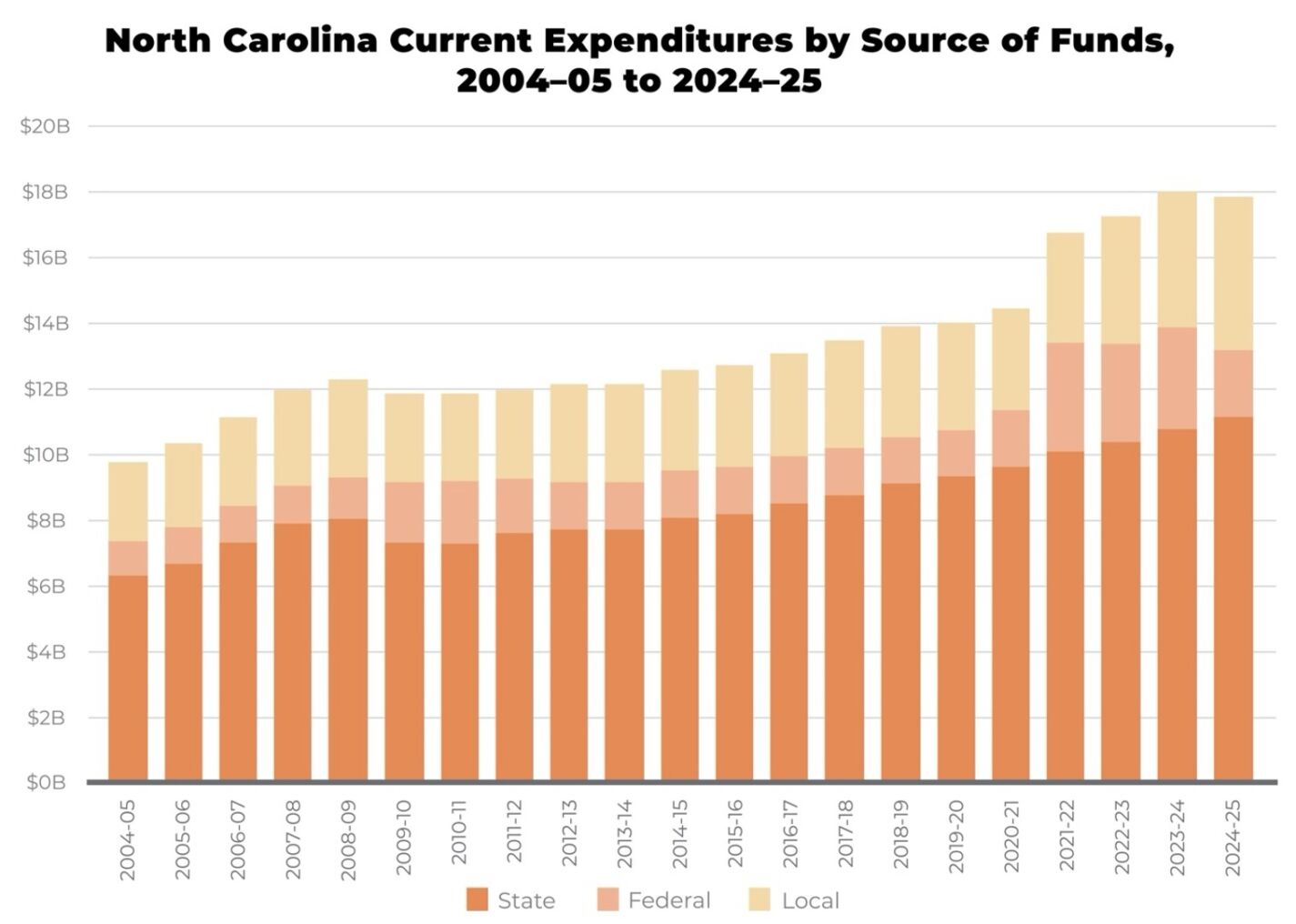
Source: North Carolina Public Schools Statistical Profile (table 22)
Even as spending increased, enrollment in traditional public schools decreased. In 2015–16, average daily membership in public district schools was 1,432,507 (82.8 percent of all students). By 2024–25, that number had fallen to 1,365,118 (75.1 percent of all students). Over that same time frame, 102 of 115 school districts experienced declining enrollment.
As a result, per-pupil spending during that time increased by 47.0 percent, well ahead of the cumulative inflation of 34.1 percent.
Enrollment in traditional public schools and percentage of K–12 market share, 2015–16 to 2024–25
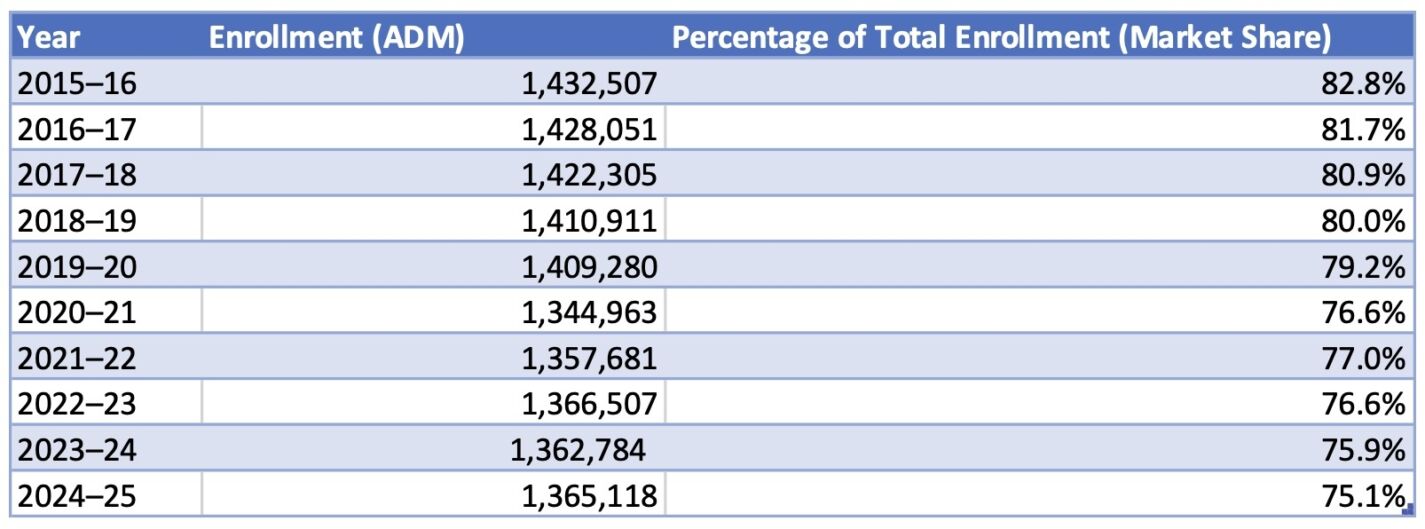
Sources: North Carolina Public Schools Statistical Profile (table 1); North Carolina Department of Administration, Division of Non-Public Education; author’s calculations
The Carolina Forward report specifically alleges that the Wake County Public School System (WCPSS) and Charlotte-Mecklenburg Schools (CMS) are “struggling to keep up with the sheer influx of students,” but the data don’t support that claim.
Over the past decade, enrollment in WCPSS has increased by only 0.6 percent, while enrollment in CMS has decreased by 6.2 percent. In both districts, enrollment has yet to recover to pre-pandemic levels.
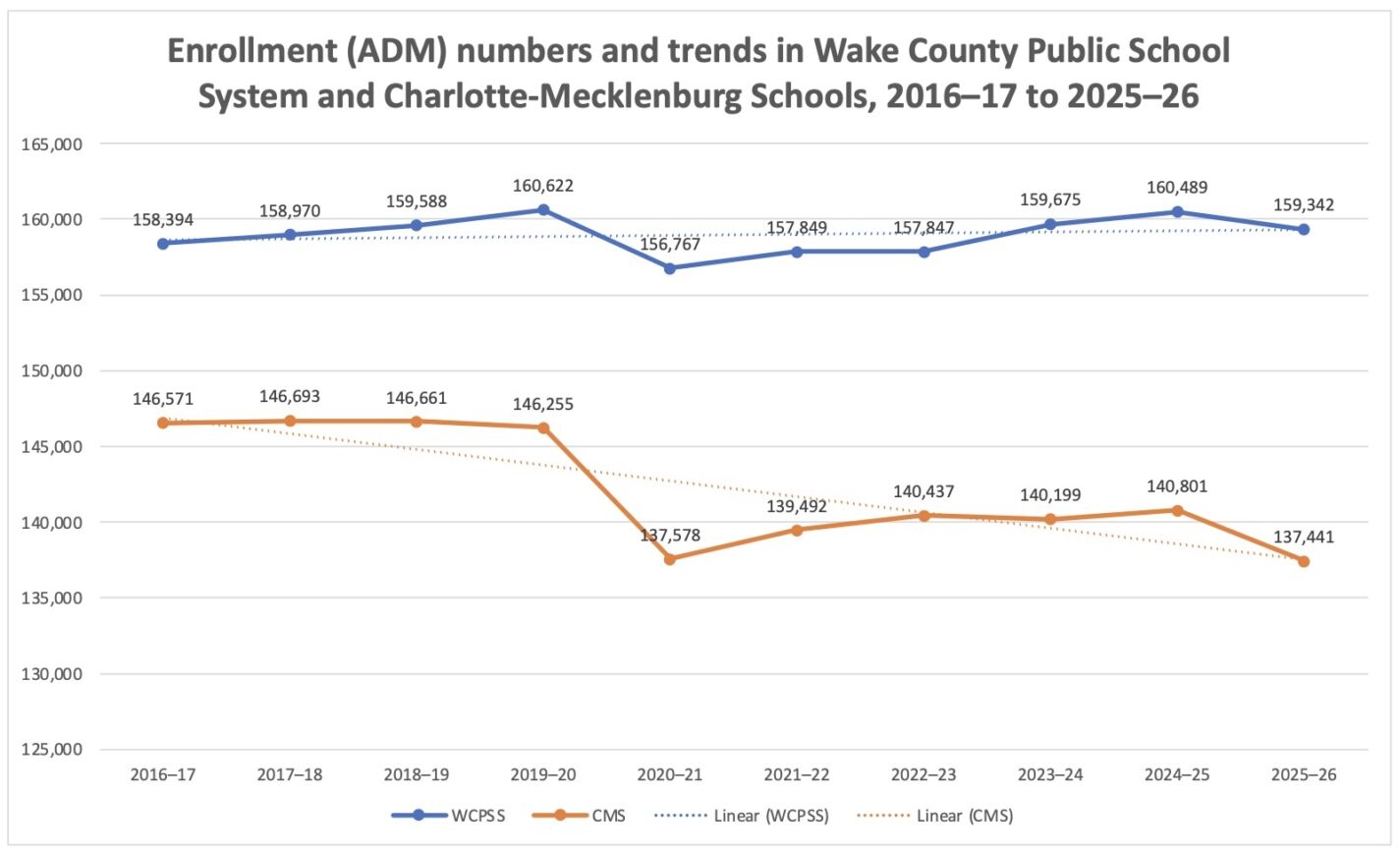
Source: North Carolina Public Schools Statistical Profile (table A1)
Despite increasing spending, academic outcomes remain lackluster. Although the latest round of state test scores showed some improvement, results indicate that about 40 percent of students still can’t read or do math at grade level.
Furthermore, North Carolina public schools received $6.2 billion in federal Covid-relief funding. Instead of using this money to hire tutors, make capital improvements, or repair failing HVAC systems, districts spent most of these funds on salaries and benefits.
In other words, access to more funds didn’t lead to improved academic outcomes or rejuvenated infrastructure. Nevertheless, the Carolina Forward report argues for spending even more. How much more would make a difference? The report doesn’t clearly say.
The report’s second claim is that North Carolina “faces a severe and growing teacher pipeline problem.” It argues that the pipeline is not “just weak,” but “buckling,” because current teachers are retiring or otherwise leaving the profession and fewer people are going into teaching because of “low pay, high stress, and perceived lack of respect.”
If this is the case, it is contradicted by recent data. The North Carolina School Superintendent’s Association’s annual report showed a steady decrease in teacher vacancies over the past four years, coming off a Covid surge.
The General Assembly has prioritized raising teacher pay in recent years, especially for starting teachers. The most recent budget boosted starting teacher pay to $48,000 (up from $41,000) and also raised overall teacher salaries by 8 percent on average. The budget also allocated one-time bonuses of $500 to all teachers with 0–15 years of experience and bonuses of $1,000 to those with 16 or more years of experience.
Those actions, however, don’t address the root causes of the potential pipeline problem. Focusing on teacher pay alone is overly simplistic because it overlooks other reasons teachers leave the classroom. It also ignores factors drawing them to North Carolina and keeping them here, including the state’s high quality of life, relatively low cost of living, and the rising value of teacher benefits.
Carolina Forward’s policy recommendations assume that higher spending would reduce educational disparities and prevent “a child’s experience [from] var[ying] dramatically depending on their ZIP code.” They would also chart the wrong course for North Carolina.
“Fund and Pass a Statewide School Construction Bond”
Carolina Forward recommends increasing the Needs-Based Public School Capital Fund (funded by North Carolina Education Lottery proceeds as set by the General Assembly) for high-need counties. A recent audit of the North Carolina Education Lottery found that only 16 percent of gross sales went to the Education Fund. As long as the lottery exists, revising its allocation formula so that a defined percentage goes to education would boost funding for high-need districts without asking taxpayers to bear the full cost. Carolina Forward also recommends asking voters to approve at least $4 billion for school construction and repair costs.
A better way to help students access higher-quality schools and ease congestion in crowded schools, however, would be for the General Assembly to pass a statewide open enrollment law to expand educational opportunity for students attending traditional public schools. Open enrollment can help students “transfer to more highly rated schools or districts,” increase graduation rates, and motivate schools to improve outcomes and expand offerings.
“Boost Support for the Teacher Pipeline”
Carolina Forward’s primary recommendation here is to “increase state teacher pay significantly (aiming to reach the national average or higher)” and also “raise the starting salary.” Would higher salaries alone ensure that more high-quality teachers enter and remain in North Carolina classrooms? Attracting and retaining high-quality teachers should start with eliminating the teacher salary schedule, which caps what effective teachers can earn and fails to reward demonstrated performance. Local salary supplements are evidence that the salary schedule doesn’t effectively address differing labor markets. It’s true that some positions, like special education, math, and science, have traditionally been harder to fill.
Market-based pay for these roles, paired with performance-based supplements, can help to remedy persistent shortages. To increase the supply of teachers, North Carolina should also ease or eliminate certification and licensure requirements, including by considering alternative certification programs. Pay flexibility, targeted supplements, and streamlined certification would do more to address the roots of teacher pipeline problems than across-the-board salary increases.
“Rebalance Funding for Fairer Distribution Across Districts”
Carolina Forward recommends adding more funding for “low-wealth and shrinking counties,” creating statewide purchasing programs or grants to ensure that all districts have “the same technology and curricular resources,” and financing the cost of sharing specialized teachers among districts. North Carolina relies on a school finance system that is outdated, ineffective, and plagued by a number of systemic problems.
The John Locke Foundation’s 2024 report, “Funding Our Future,” thoroughly described how the low-wealth supplemental allotment in particular is overly complicated and unreliable as a funding source. Instead of simply spending more, North Carolina should change how schools are funded by transitioning to a weighted student funding model that bases allocations on students’ needs. Doing so would give districts more flexibility to spend money where it is most needed and make North Carolina’s school finance system more understandable, transparent, accountable, and fair.
“Plan for Demographic Shifts in Enrollment”
The Carolina Forward report recommends creating a “comprehensive plan anticipating where enrollment will grow or decline over the next 10–20 years.” Long-range planning can be beneficial, but county-level enrollment projections so far into the future are inherently uncertain, as the unanticipated effect of Covid-19 school closures on public school enrollment showed.
Next up in the series is part 4, the final part of the series, which will focus on the Carolina Forward report’s recommendations for public finance and the urban/rural divide.
The post The fight for tomorrow: Assessing conflicting visions for North Carolina’s future, Part 3 appeared first on John Locke Foundation.