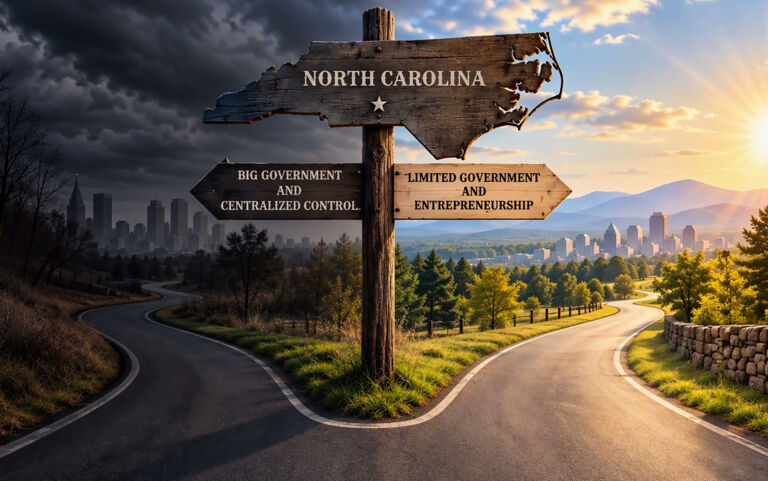
This article is Part 4 of a series that examines the policy prescriptions coming from the left-wing group Carolina Forward. With North Carolina at a crossroads, it’s a good time to evaluate the sort of policies advanced by those who desire to move our state in a more “progressive” direction.
You can read the complete introduction in Part 1 here, responses to their recommendations regarding population shifts, housing, and transportation in Part 2 here, and an evaluation of their recommendations on health care and public education in Part 3 here.
This article focuses on Carolina Forward’s recommendations for North Carolina regarding public finance and the rural/urban divide.
Public Finance
Carolina Forward’s public finance section hits the reader with misleading claims, important omissions, and self-contradiction right out of the gate.
In the section’s first paragraph, the author highlights the significant tax reforms that began in 2013, cutting income taxes that had topped out as the highest in the Southeast to a low, flat rate (with a generous standard deduction) and placing the corporate tax on a path to zero.
The report begins by insisting that “[t]hese tax cuts very disproportionately benefited higher-income earners and corporations.” But this claim is misleading. In terms of dollar amount, those who pay sizeable tax bills will of course receive a larger reduction than those who pay very little to no taxes already. As a percent reduction of taxes paid, however, a strong case could be made that middle- and lower-income taxpayers benefited more. In particular, the steady increase in the state’s standard deduction moved perhaps hundreds of thousands of low-income households to a zero-tax liability. This benefit goes unmentioned.
Moreover, corporate taxes don’t just benefit “corporations.” As has often been said, corporations don’t pay taxes, people do. Ample research has shown that the majority of benefits from a corporate tax cut go to workers. Corporate taxes eat away at a company’s bottom line, forcing it to cut expenses, and the biggest expense of most companies is payroll, meaning corporate taxes have a depressing effect on worker wages.
As a result of these tax reforms, according to the report, “the state shifted more of the state’s financial burden to consumption taxes like the sales tax.” According to state controller reports, last year the individual income tax made up 51.5 percent of total state tax collections, compared with 33.6 percent for the sales tax. In Fiscal Year (FY) 2012, the year before the reforms in question, the ratio was 55.6 percent to 28.5 percent. A change, to be sure, but not necessarily a sizeable “shift.”
Moreover, heavier reliance on a tax on consumption can reap benefits for the state because consumption tax revenue is more stable than individual and corporate taxes, which are far more volatile when the economy experiences boom and bust cycles.
The second paragraph isn’t any better. The report points out that legislators have “pointed to a growing economy and large nominal budget surpluses as proof of success” for tax reforms but then insists that these claims are “misleading.”
Here’s where the contradiction comes in. The report downplays North Carolina’s economic growth by saying it “actually under-performed many other nearby states,” but in the very next sentence writes that the “surpluses have largely resulted from underinvestment and a strong economy” (emphasis added).
Somehow, North Carolina’s economy is simultaneously underwhelming and underperforming the economies of neighboring states while also being robust enough to create substantial surpluses.
Moreover, the correlation between years of tax cuts and surplus-creating economic growth is ignored. Recent data show North Carolina’s economic performance to be stronger than Carolina Forward is willing to admit. For instance, according to this Carolina Journal article, from “mid-2016 to mid-2026, North Carolina posted a 17.3% increase in employment, larger than the national average of 9.9% and the employment gains of our neighboring states of South Carolina (17%), Tennessee (13.7%), Georgia (13.6%), and Virginia (8%).” The article adds that North Carolina “also experienced a 20% real gain in personal income per North Carolinian over the past decade, again beating the national average and most of our neighbors.”
The report then warns of a “looming fiscal cliff” coming in the next several years due to low tax rates supposedly being unable to generate sufficient revenue. But critics of tax cuts have been warning of this problem since 2013 and have been wrong by orders of magnitude. Indeed, in the decade following the 2013 tax cuts, backing out the Covid year, the state budget experienced more than $12.6 billion in surpluses.
The report includes a chart predicting a revenue shortfall for the current FY 2026–27, but even since the Carolina Forward report was published last November revenue projections have been revised upward by more than $700 million.
With such an abysmal predictive track record, there’s no reason anyone should take Carolina Forward’s “fiscal cliff” warnings seriously.
The report then claims that because the state has “not supported school capital funding, county governments have been forced to raise property taxes to build schools.”
This is a major oversight because in North Carolina, school construction costs have traditionally — and by statute — been the responsibility of county governments. Specifically, G.S. 115C-408(b) states: “It is the policy of the State of North Carolina that the facilities requirements for a public education system will be met by county governments.”
Despite this clear directive, the state created the Needs-Based Public School Capital Fund, the Public School Building Capital Fund, and the Public School Repair and Renovation Fund, which are financed primarily with lottery revenue and direct money to local governments to aid in public school capital expenses. The current year’s state budget appropriated more than $400 million to these funds.
Arguing that the state is somehow shirking its responsibility (which, according to statute, it does not have) to support school capital funding is either highly misleading or willful ignorance. Neither option reflects well on this report.
The report then suggests that the state should provide more funding to county governments, in large part because the state has more tools to raise revenue (i.e., income, corporate, and sales taxes) compared with local governments that rely very heavily on just the property tax.
Funding could then be distributed across counties more “equitably,” according to the report. The author does not, however, explain why taxpayers in Brunswick or Dare County, for example, should be forced to finance local amenities in Watauga or Buncombe County.
This suggestion further exemplifies the emphasis by Carolina Forward on the principle of more centralized, top-down control of people across this diverse state.
Based on the report’s misguided analysis of North Carolina’s economy and public finances, it comes as no surprise that its recommendations would hurt, not help, our state’s economic growth and working families.
“Rebalance the Tax Code for Adequacy and Fairness”
This phrase is a euphemism for raising taxes. Specifically, the report calls for “pausing” scheduled personal income tax rate reductions and maintaining the state’s corporate tax instead of allowing it to zero out. How much these moves would cost taxpayers isn’t specified, but we can get some indication from Gov. Josh Stein’s FY 2026–27 budget recommendation, which projects that freezing the individual income tax rate at 3.99 percent and keeping the corporate tax rate at 2 percent would drain roughly $20 billion out of the state’s economy over the next five years. Such a significant tax burden would weaken economic growth and job creation, disproportionately harming low-income households.
“Increase State Investment in State-Level Responsibilities”
Here the report echoes its call for more state spending to be sent to local governments. The claim is that it would help localities fill funding gaps created by a supposed decrease in state support, but that implies that increases in state support will not be offset by lower local government spending. Instead, increased state spending will supplement spending by local governments. The report does not give a price tag for how much this additional spending would cost state taxpayers, but it does recommend fully funding the Leandro decision regarding public school funding, which itself was originally estimated to cost more than $6.8 billion over eight years.
The report also recommends increasing (by an unspecified amount) funding to local governments for local infrastructure. The state is already heavily involved in such funding, but to Carolina Forward no amount of government spending will ever be enough. This recommendation is consistent with the report’s prevailing theme of calling for more spending of taxpayer dollars with no estimate of what the recommendations would cost while refusing to acknowledge the negative effects of raising the tax burden on North Carolina workers and entrepreneurs.
“Improve Fiscal Planning and Collaboration”
“Establish a state-local government commission or task force to study the allocation of costs” is the recommendation here. Basically, this recommendation represents a desire for the state to send more taxpayer dollars to local governments. Once again, the report offers no specific amount of spending or cost-sharing, making this just another recommendation for a blank check that taxpayers would be forced to cover.
Rural/Urban Divide
This section rightly points out that economic and population growth in North Carolina has not been spread evenly throughout the state. While urban centers like Raleigh and Charlotte have seen rapid increases in both categories, many rural parts of the state are losing population and, as a result, suffer from shrinking economies. This much is true, but North Carolina is far from unique in this regard.
This rural/urban contrast is problematic, according to the report’s author, primarily because of negative “perceptions” that rural communities may harbor against thriving metro areas.
The divide also manifests itself politically, as rural counties tend to be more Republican, while urban centers — and increasingly suburban communities — tend to be more Democratic. The tension between the interests of these “two Carolinas” threatens the state coming together to support “a statewide vision for growth,” according to the report. Once again, Carolina Forward’s preference for a singular, top-down, and centralized plan to be imposed across the state is made clear.
The report’s policy recommendations to ensure that the benefits of economic growth are “shared” among urban and rural communities alike involve increased government micromanagement of the economy and ever-increasing government spending.
“Deliberately Share the Benefits of Growth”
The main recommendation here is to focus more corporate welfare programs in rural areas. The blatant unfairness of forcing taxpayers to fund politically connected businesses is not addressed. Moreover, this recommendation is still further evidence of the report’s prevalent desire for greater central planning of the state’s economy through empowering politicians and government bureaucrats to pick winners and losers in the marketplace.
The report also ignores the terrible track record of government “economic incentive” programs. A 2025 brief by the John Locke Foundation reported that more than 80 percent of grants from North Carolina’s largest incentive program that have concluded ended in failure to produce the promised number of jobs.
“Invest in Rural Infrastructure and Human Capital”
The word “invest” is used a lot in this report, but it’s important to remember that its use of this term really just means “force taxpayers to fund something.” This recommendation seeks more taxpayer dollars to fund high-speed internet in rural areas, along with a “significant” increase in funding for rural public schools and community colleges. Internet access is already near universal, even in rural areas, and with companies like Starlink providing affordable internet virtually anywhere, a government program does not seem necessary here. Moreover, low-income, mostly rural public school districts already receive — on average — higher amounts of funding per pupil than higher-income urban school districts. According to the most recent data from Best NC, the least affluent school districts in the state received 24 percent more funding per pupil from the state than the most affluent. It’s a significant oversight for the report not to acknowledge this fact.
The report also recommends rural areas “expand access to renewable energy where possible to attract new industry.” This is nonsensical because renewable energy is more expensive and unreliable than traditional forms of energy. Why new industry would be attracted to nondispatchable and more costly forms of energy goes unexplained.
“Foster Rural/Urban Partnerships”
The recommendations here are quite vague, suggesting “collaboration” between urban and rural areas “to develop common issues like transit connections, supply chain development, or tourism trails.” No further specifics are mentioned. Also included is a suggestion to “promote” idea exchanges between experts from rural and urban communities. How these exchanges are supposed to be “promoted” is not specified, but one can speculate the taxpayers would be footing the bill.
The report also recommends that political leaders from both rural and urban communities should be included in “advisory councils for major state initiatives,” but there’s no evidence presented that this isn’t already happening.
“Craft a Unifying Narrative”
Here the report recommends that state legislators and other leaders “should intentionally frame policies in terms of One North Carolina, emphasizing how every region contributes to the state’s success.” Once again, there’s no evidence presented that this thinking is lacking or otherwise opposed by current popular rhetoric. Nevertheless, the author insists such rhetoric would somehow bridge divides between communities he already acknowledges have very different and at times conflicting challenges and needs.
Conclusion
This series of articles has taken a closer look at what is presented as a vision for North Carolina’s future by the “progressive” group Carolina Forward. It’s sold as a package of policy prescriptions to ensure a “shared prosperity” for the citizens across our state.
What it delivers, instead, is a mostly vague list of demands for unchecked government growth and unaccountable spending of taxpayer dollars. Making matters worse, it provides no estimates detailing how much each of their initiatives would cost taxpayers and fails to recognize the negative consequences that would follow the massive tax hikes that no doubt would be required to fund this wish list.
It is also telling that the subtitle to the report includes the phrase “harnessing growth.” To harness something means to control it. So, who should “control” the growth of North Carolina, both its economic and demographic growth? Carolina Forward clearly provides the answer: politicians.
While the report is correct in diagnosing many of the challenges facing North Carolina, its prescriptions not only miss the mark but would make things worse. Just because something is not right does not mean government is the best means to make it right. Indeed, most of the time society’s — and the economy’s — problems are caused by government interference in the first place.
Regardless, more government control over our paychecks, education, health care, transportation, and much more is the consistent theme throughout this report. This vision lies in stark contrast to the vision of the John Locke Foundation, which prioritizes individual freedom and the removal of government barriers to ensure North Carolinians flourish. Free markets and voluntary cooperation should take precedence over coerced taxation and government mandates enforced by threats of punishment.
The vision for North Carolina’s future should be shaped by its people, not its government.
The post The fight for tomorrow: Assessing conflicting visions for North Carolina’s future, Part 4 appeared first on John Locke Foundation.