

“Homeschooling is no longer on the fringe. Montana’s policies should reflect that reality.”
The following has been adapted from an excerpt of the Frontier Weekly Newsletter written by Cheryl Tusken for the October 8th edition.
Homeschooling has come a long way from the educational fringe, having grown from 93,000 homeschooling in 1983, the year Montana granted the exemption to compulsory education, to an estimated 3.4 million in 2025. Today, universities, colleges and military branches have established guidance on their admissions pages specifically for homeschool graduates, which usually include a parent-issued transcript, SAT or ACT scores, or in the case of the military, the Armed Services Vocational Aptitude Battery (ASVAB). General acceptance of homeschooling has come a long way in the past 40+ years, yet homeschool families still hit some obstacles, and sometimes outright roadblocks, when entering adult life.
Unfortunately, educating the public is still necessary. Recently, a 22 year old EMT and volunteer firefighter in Nebraska applied for a full time position in his city, but his application was rejected because he didn’t have a high school diploma from an accredited school. The application criteria didn’t state explicitly that the diploma needed to be from an accredited school. The city changed the application after they denied him.
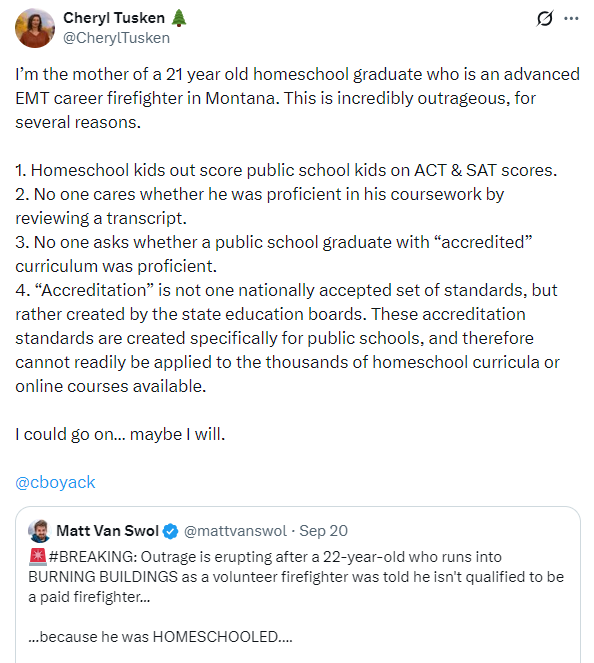
To see a story about a homeschool graduate who mirrored the same career path as my son, but faced such a roadblock, was frustrating to say the least. I took on the responsibility of homeschooling my children with fear and trembling. The last thing I wanted to do was hinder their career opportunities, so when we hit the high school years, I built an education plan that would ensure their ability to apply for a tech school, university or, if they so chose, enlist in the military. I created the Guide to Home Education based on my personal research as a homeschool mom to help other parents do the same.
The Homeschool Legal Defense Association (HSLDA) has stepped in on similar issues in Indiana, Oregon, and at the federal level where it is supporting legislation clarifying that homeschool graduates are high school graduates for purposes of financial aid. HSLDA reports that issues for homeschool graduates most often arise with trade schools, cosmetology schools and the University of Phoenix.
This Nebraska situation led me to do some preliminary research about homeschool graduates here in Montana.A representative from the Department of Labor and Industry, which handles professional certification and licensing, told me they have not had issues with homeschooled students meeting licensing requirements. DLI verifies that required coursework has been completed and qualifying exams have been passed. The institution providing the education or training determines its own admission policies, while DLI verifies completion of the required program.
The Peace Officer Standards and Training (POST) Council, however, is a different story. POST has broad jurisdiction over public safety officers, including Montana Highway Patrol troopers, sheriffs, county coroners and police officers. POST guidance regarding homeschool diplomas dates back to at least 2018, when it concluded that it was not required to accept a homeschool diploma as equivalent to a diploma from an accredited high school.
The issue resurfaced in 2025 when a military veteran who had graduated from homeschool and served his country for 10 years applied to the Montana Highway Patrol. A legal memorandum requesting an exception to the equivalency diploma requirement reaffirmed POST’s prior conclusion:
“POST may accept an equivalency certificate or diploma issued by OPI or by a state or federal issuing agency. POST may not otherwise accept a ‘homeschool’ or other alternative diploma that is not issued by a state or federal government as it is not equivalent under the law.”
Under Montana law, parents who choose to homeschool have the authority to instruct their children and are solely responsible for the educational philosophy, the selection of instructional materials, curriculum, the time, place and method of instruction, and the evaluation of the homeschool instruction. In other words, Montana law places the responsibility for evaluating a child’s home education squarely with the parent.
As Montana law currently stands, a homeschool graduate seeking employment as a Montana public safety officer must obtain an equivalency certificate, such as a GED or HiSET, to meet POST’s educational requirement.
In the early days of homeschooling, many parents simply had their children take the GED and get on with their lives. As homeschooling grew, institutions evolved and created straightforward policies to recognize homeschool graduates without requiring them to take a general equivalency exam.
Montana has an opportunity to do the same. Policymakers should examine the current POST requirements and ensure that a homeschool graduate who has otherwise met the qualifications for public safety service is not excluded solely because of the educational path his or her family chose.
Homeschooling is no longer on the fringe. Montana’s policies should reflect that reality.
Next in The Homeschool Obstacle Course: What happens when a homeschool curriculum is not “accredited” enough?