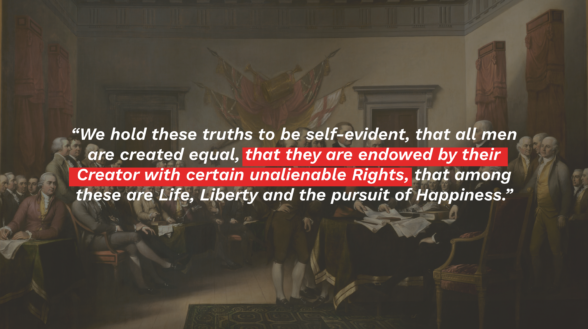
Today marks the 250th anniversary of the adoption of the Declaration of Independence. It is perhaps the most famous political document ever written. Freedom movements around the world have looked to the Declaration for inspiration, and its principles continue to shape debates about liberty and self-government. But what does the Declaration actually mean, and why does it remain so important?
Many Americans remember the Declaration as our breakup letter with Great Britain or simply as a rejection of monarchy. Yet it is far more than that. For centuries, governments claimed legitimacy through kings, conquest, or inherited authority. Individuals were regarded primarily as subjects, and whatever rights they enjoyed were understood to exist because political authority recognized them. For the American colonists, this conflict came to a head when Parliament asserted that it possessed supreme authority over the colonies in “all cases whatsoever,” leaving no meaningful limits on its legislative power. The Declaration rejected that conception of government. Instead, it proclaimed a radical idea: individual rights preexist government, and governments are legitimate only insofar as they protect those rights.
 Although revolutionary in its implications, the Declaration was not a new argument or principle. It was distilling principles that had become widely accepted among the American people leading up to revolution: that all individuals are created equal, that they possess inherent rights by virtue of their humanity, and that governments are instituted not to grant those rights but to secure them. In doing so, the Declaration transformed a colonial legal dispute into a universal statement about individual rights and what constitutes a legitimate government.
These radical and beautiful ideas placed individuals in control of their own lives. We all have a right to think and speak as we wish, to acquire property, earn a living, raise a family, serve our community, cultivate virtue, and practice our religion. In sum, we all have the right to pursue the American Dream. And while we have sometimes failed in practicing and applying this principle consistently throughout our history, it is this philosophy that produced the most successful and prosperous country in the world.
Unfortunately, beginning in the early 20th century, the idea that individuals possess natural rights came under sustained assault. Increasingly, the dominant political theory held that rights are social constructs and that the political community—that is, government—is their source. But if the government creates rights, then it may redefine or withdraw them whenever it wishes. Thus, the idea that individuals were presumed free and that the government had to justify restricting liberty to protect the rights of others, or for genuine health and safety concerns, flipped into the idea that individuals needed government permission to engage in otherwise peaceful conduct.
This has resulted not only in a loss of freedom but also in real-world consequences. For example, nearly one in four American workers today requires a license to earn a living in their chosen profession. This stifles competition and drives up prices for goods and services. Similarly, about 75% of residential land in American cities is zoned solely for single-family homes. This artificial restriction on land use largely contributes to America’s housing crisis. More importantly, both examples limit the freedom of individuals to make an honest living, provide goods and services, use their property, and live their version of the American Dream.
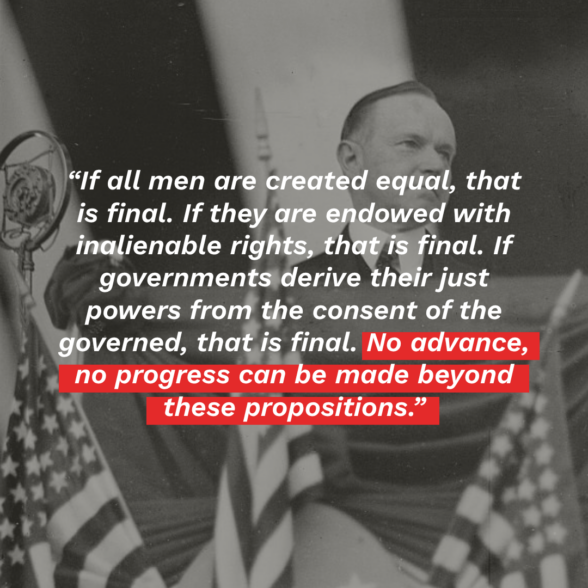 Yet this is not a time for pessimism. Our country is still the greatest country on earth. As evident from the recent reactions of our foreign guests during the World Cup, America is still the land of opportunity, and the American spirit of liberty is something others in the world still yearn for. That’s why at Beacon, we strive to protect the rights of Tennesseans and all Americans to earn a living, to acquire, enjoy, and use property, and for parents to have control of their children’s education. And although we hear calls to abandon individual liberty in favor of more government control from all sides of the political spectrum, we would be wise to remember that deviations from the principles of the Declaration are not progress. Rather, they are regressions to the very idea of government our revolution rejected. As President Coolidge remarked at the 150th anniversary of the Declaration, “If all men are created equal, that is final. If they are endowed with inalienable rights, that is final. If governments derive their just powers from the consent of the governed, that is final. No advance, no progress can be made beyond these propositions.”
Two hundred and fifty years later, the Declaration remains a revolutionary document because it reminds us that our rights do not come from the government. They belong to us by nature, and the government exists to protect them—not to dispense them. If we want to preserve the American experiment for another 250 years, the solution is not more government permission over our lives, but a renewed commitment to individual liberty.