“All Models Are Wrong. Some Are Useful.” – George Box

George Box’s line is correct and useful: every model is a simplification, therefore “wrong” in some absolute sense. Usefulness depends on how clearly the simplifications, assumptions, and uncertainty are stated, and on whether the model is treated as a tool for thinking or as a finished authority.
Yale published a paper “Projected economic gains and lives saved under universal healthcare in the United States” by Abhishek Pandey, Chad R. Wells, Yang Ye, Meagan Fitzpatrick, and Alison P. Galvani (Yale Center for Infectious Disease Modeling and Analysis) in July on medRxiv.
The model is explicitly described by the authors as a “stepwise accounting framework” — a static, one-year spreadsheet-style adjustment of 2024 National Health Expenditure (NHE) data, not a dynamic simulation, microsimulation, or full econometric model.

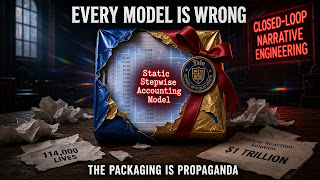
The packaging of this particular Yale preprint aims to convince, not inform.
“That combination of absolute language, selective omission, prestige signalling (“Yale”), and pre-packaged policy destination is the operational definition of narrative packaging, not neutral scientific communication.“
What the packaging actually does is to take a non-peer-reviewed, static one-year spreadsheet whose largest line items rest on contested secondary parameters (51 % drug-price cut, flat Medicare rates with no supply response, an 8 % “fraud” residual drawn from a 2003 Taiwan residual, an interpolated underinsurance hazard ratio) and presents the outputs as “Confirmed.”
The model converts results into large, round, emotionally charged numbers (114,000 lives, $1 trillion) that travel easily.
The Yale publication omits or minimises the authors’ prior advisory relationship to the legislation being modelled, the absence of peer review, the sensitivity case that drops savings to $663 billion, the lack of transition costs, provider-response modelling, and the fact that a substantial share of the “lives saved” comes from reversing 2025 policy changes rather than from the pure coverage expansion.
The piece frames the entire exercise inside a classic Problem–Reaction–Solution loop: current spending + coverage gaps → anxiety about waste and preventable death → single national program as the only remaining step (“only enactment required”).
That combination of absolute language, selective omission, prestige signalling (“Yale”), and pre-packaged policy destination is the operational definition of narrative packaging, not neutral scientific communication. In the language of the Watchtower frameworks we have been using, it scores as closed-loop narrative engineering.
The model itself vs. the packaging:
The stepwise accounting exercise can still be examined on its own terms. It is transparent about its arithmetic. It discloses (in the preprint) many of its key assumptions. It supplies a sensitivity case. Those features make it more useful than a pure black-box claim. But usefulness collapses the moment the packaging strips away the caveats and converts the exercise into an authoritative, settled, moral fact.
Box’s principle cuts both ways. Because all models are wrong, the duty of honest communication is to keep the wrongness visible.
The packaging does the opposite: it hides the wrongness behind institutional prestige and emotional urgency. That is propaganda in the classic sense—not because the arithmetic is fabricated, but because the presentation systematically manages perception of the arithmetic’s limits and political implications.
So the short answer is: the model is a set of assumptions arranged in a spreadsheet. The packaging is propaganda.
While Yale University has not officially commented on or disavowed the preprint; rather, the Yale School of Public Health promoted the study and its findings in a press release on August 13, 2026. The study, published on medRxiv, remains part of the university’s promoted research on healthcare modeling.
In an institutional context, keeping theofficial announcementlive on the university website is a deliberate, active endorsement rather than a passive one.
Because the Yale School of Public Health proactively drafted, published, and continues to host a press release promoting the paper’s specific findings, it goes beyond silence. The institution has physically lent its name and digital real estate to the research. In the landscape of academic publishing, leaving promotional materials online while public debate continues signals that the university stands by its researchers and their modeling.
Agree/Disagree with the author(s)? Let them know in the comments below and be heard by 10’s of thousands of CDN readers each day!
Agree/Disagree with the author(s)? Let them know in the comments below and be heard by 10’s of thousands of CDN readers each day!