Key points:
- Texas schools have acquired millions of one-to-one devices for use as educational technology.
- These devices are used for instruction, practice, assessment, and independent study.
- Significant evidence suggests that using screens reduces students’ reading ability, and the evidence for other subjects is mixed.
- Exposure to screens also risks harm to students’ safety, data privacy, and critical thinking skills.
- Education technology has not delivered on its promise of a superior education and carries a substantial resource and human cost.
Executive Summary
Over the last twenty years, the use of technology, especially one-to-one devices like laptops, has proliferated across Texas schools. Yet, despite the enthusiasm of schools and technology advocates, parents have raised the alarm about the effectiveness and impact of a technology-based education.
The use of laptops for standardized testing began the adoption of digital devices, but the response to COVID-19 has made these devices ubiquitous. In 2020, the state helped pay for 2 million laptops and tablets. Since then, 250,000 devices have been purchased through the Instructional Materials and Technology Allotment alone (IMTA).
In 2024-2025, Texas schools purchased 8.7 million individual instructional materials that were primarily delivered electronically or online through IMTA. These digital materials included assessments, curricula that guide teachers and students through lessons, and independent practice, as well as specialized instruction such as special education. Digital materials accounted for 68% ($364 million) of the instructional material disbursements from IMTA in 2024-25. Since 2020, school districts have also passed $2.8 billion in bonds classified solely as technology, with an additional $6.2 billion with some technology component. On the expenditures side, school districts purchase from innumerable vendors; in 2023 and 2024, school districts spent over $1.5 billion on technology from just 14 vendors.
Despite this massive outlay of resources, the evidence for the effectiveness of educational technology indicates it may have severe deficiencies, especially in the subjects of reading and writing. Students reading on a screen experience a “screen inferiority” effect which reduces their reading ability by two-thirds of a grade, and taking notes by hand results in a third more “As” than typing them. The evidence for mathematics is more mixed, as technology can assist in demonstrating some math principles, but it is not a replacement for a complete mathematics instructional program. Furthermore, studies of international tests show a negative correlation between screen time and academic achievement.
Aside from the question of instructional effectiveness, technology poses a danger to the safety and mental health of students. Despite best efforts, the internet will collect data on students and can expose students to harmful materials. One example of this is the use of artificial intelligence (AI). Even if students use AI responsibly during class, the practice will accustom them to relying on AI, which can lead to problems from a weakening of critical thinking skills to forming an unhealthy relationship with AI chatbots. Moreover, just the act of engaging with screens can disrupt students’ ability to sleep and even reduce their brain size.
Other states have already begun restricting educational technology. Utah has banned the use of screens through 3rd grade and the assignment of technology-based homework through 6th grade. Alabama has also charged its agencies with creating screen-time recommendations. Texas should protect the education and well-being of its students by implementing the following restrictions on educational technology:
- Prohibit the use of screens through 6th grade.
- Prohibit the assignment of homework requiring technology through 8th grade.
- Prohibit the use of digital materials for whole-class (Tier 1) instruction in all grades.
- Remove one-to-one devices as an allowable expense under the Instructional Materials and Technology Allotment.
- Prohibit the use of bonds for the purchase of one-to-one devices.
- Prohibit a student-to-device ratio of less than six to one.
Introduction
The field of education is uniquely susceptible to fads. The need for leadership to appear to be innovative and the weak feedback loops for both successful and failing policies means that school leadership is incentivized to constantly push “the next big thing” (Pondiscio, 2026). Unlike other fads, though, like three-cueing or “new math,” which may apply to one subject or one type of learning, technology has been shoehorned into almost every aspect of education. Schools use digital technology to keep student records (including attendance and grades), to communicate with parents and students, and even to operate public address and security systems.
By far the most impactful application of technology in schools, however, has been instructional technology, particularly the use of one-to-one devices such as laptops or tablets. With a laptop on every desk, instructional technology, through online access and software, presents the lesson, provides examples and practice questions, and assesses knowledge.
Digital instructional curricula transform the way students and teachers experience the learning process, and parents have not been given transparency or a voice beyond a yearly technology release form. Moreover, technology offers fads within fads, as the next version promises a new transformation. Artificial intelligence is the new darling, and, even as industry experts grapple with its far-reaching consequences, some schools have already begun experimenting on Texas students.
Bit by bit, school districts accumulated laptops and introduced digital curriculum, first as a supplement and then as a replacement for traditional instructional materials. Texas school districts now spend billions of dollars each year to replace laptops or buy new instructional software, funded by general revenue, the instructional materials allotment, and bonds.
Now that technology has found its way into nearly every classroom in Texas, the questions of the effectiveness and safety of educational technology remain. Do the educational results from instructional technology justify the enormous expense, or is access to technology—no matter how useful—poisonous to young minds?
History of Technology Adoption
Texas is not unique in its embrace of classroom technology but follows a greater nationwide trend. As with the nation at large, standardized testing, federal and state initiatives, and the pivot to virtual schooling during the COVID-19 pandemic accelerated the procurement of one-to-one devices and the adoption of technology-oriented instruction in Texas.
Computers have been present in significant numbers in public schools since the 1990s, but the push to “digitize” classrooms accelerated in the early 2000s (Old Dominion University, 2015). The foundational education bill known as No Child Left Behind (NCLB) created the Enhancing Education Through Technology (EETT) grant program in 2001, replacing an earlier grant structure with an initial funding of $675 million, and was designed to provide schools with devices, expand connectivity, and ensure appropriate professional development in technology (State Educational Technology Directors Association, 2015). Moreover, NCLB ushered in the nationwide regime of standardized testing that has enabled the mass adoption of one-to-one devices (Buck, 2025). This push for more technology at the federal level has continued until nearly the present day. In 2024, the U.S. Department of Education released a “call to action” pointedly described as “closing the digital…divides.” suggesting that inequalities in access to technology or its use are an injustice (U.S. Department of Education, 2024).
The Texas Legislature seemed to anticipate the eventuality of state testing becoming an entirely digital affair because in 2009 it passed a bill prohibiting TEA from requiring schools to administer assessments by computer, thereby protecting against concerns that school districts would be strongarmed into joining the digital world (HB 3, 2009). Within ten years, however, this dynamic was flipped. In 2011, the Texas Legislature fundamentally altered the instructional materials acquisition process by adding technology (including electronic instructional materials, technological equipment, and training) to the allowable expenses of the Instructional Materials Allotment (SB 6, 2011). By 2019, the spread of one-to-one devices had become widespread enough that the Legislature felt comfortable reversing its previous protections for pen-and-pencil tests. HB 3906 instructed the Texas Education Agency to redesign STAAR with the aim of a statewide electronic administration by 2022-23 (TEA, n.d.-a). It is worth noting, however, that in the 2018-19 school year, only 13% of STAAR tests were administered electronically (Swaby, 2021). The Legislature passed another bill, HB 3261, in 2021 to ensure that this rollout occurred despite the disruptions of the COVID-19 pandemic, including a $4 million matching grant (HB 3261, 2021). In 2023, HB 1225 gave parents the ability to request paper administration for tests, but the total amount of tests that could be administered by paper was capped at 3% for each district (HB 1225, 2023). At both the federal and state levels, the standardized testing regime provided the impetus for buying one-to-one devices (e.g., laptops), and the grants and allotments supplied the means to purchase them, guaranteeing that every public school in Texas would maintain a high device-to-student ratio.
The second major sea change in the adoption of educational technology was the response to the COVID-19 pandemic. When students left for spring break in March of 2020, they did not know that they would not return until the following fall at the soonest (Ballotpedia, n.d.-a). Schools abruptly switched to virtual learning, and around half of Texas schools did not open at the beginning of the fall term (Adams, 2025). Texas used federal CARES Act funds to reimburse schools $420 million for purchasing more than 2 million one-to-one devices and more than 800,000 internet hotspots (Office of the Texas Governor, 2020). These developments made one-to-one devices ubiquitous in Texas schools, effectively making the device-to-student ratio 1:1.
One-to-one devices are now nearly omnipresent in Texas classrooms, with the expectation that teachers will incorporate them into their instruction. This short history, however, shows that this adoption of technology was not predicated on principles of effective instruction but instead that instruction was expected to follow expediency and the agenda.
Usage of Technology in Classrooms
With nearly every Texas student having access to a one-to-one device, how are schools using this technology? Vendor payments and the Instructional Materials and Technology Allotment (IMTA) disbursement reports offer a glimpse into what resources districts are providing for student use. Digital materials are used, non-comprehensively, for teacher lesson plans, direct instruction, activities and practice, graded and formative assessments, data analysis, and virtual/remote learning.
According to responsive documents from a public information request to TEA, since the 2021-22 school year, schools have used the IMTA fund to purchase 125,626 laptops and 20,893 tablets (TEA, n.d.-b). While this is not a comprehensive inventory of district equipment, it does show that, while they are often grouped together in this discussion, laptops are much more common than tablets.
Almost 10% of the 8.7 million digital materials purchased in 2024-25 were from the Northwest Evaluation Association, a provider commonly known for producing the MAP (Measures of Academic Progress) test, despite only accounting for 3% of the total cost. The most common curriculum provider in 2024-25 was Amplify, which creates materials that provide direct instruction and practice activities and questions. These materials are primarily digital, but 22% of materials purchased also came with a print component. Figure 1 shows an example of a 7th-grade mathematics lesson, and Figure 2 shows the teacher instructions that accompany this slide in the lesson. The materials provide instructional recommendations to teachers to guide the students through the interactive lesson. While this lesson, at least, is designed for the teacher to provide the instruction and not merely allow the students to work through the program on their own, the program sets the bounds for the instruction.
Figure 1
Interactive Lesson “Shira the Sheep”
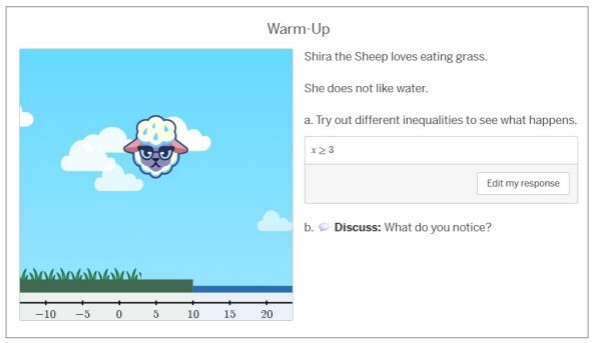
Note. From Lesson 16: Solving Inequalities and Negative Numbers, by Amplify Classroom, n.d. (https://classroom.amplify.com/activity/66a2a18be61d0ce3d78dae6b?collections=6658a03d1fdc8715ed0f50c3%2C66a2a189e61d0ce3d78da308).
Figure 2
Teacher’s Guide from “Shira the Sheep”
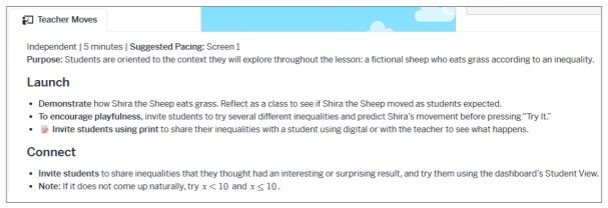
Note. From Lesson 16: Solving Inequalities and Negative Numbers, by Amplify Classroom, n.d. (https://classroom.amplify.com/activity/66a2a18be61d0ce3d78dae6b?collections=6658a03d1fdc8715ed0f50c3%2C66a2a189e61d0ce3d78da308).
Another major provider, Savvas, offers a similar lesson and coursework model in earth science, as the example in Figure 3 shows.
Figure 3
Sample Lesson on Plate Tectonics
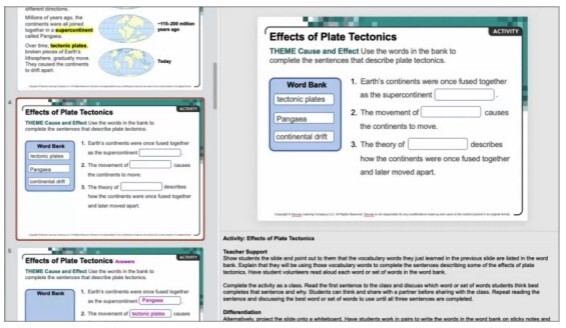
Note. From Experience Science Middle School Science Curriculum, by Savvas Learning company, n.d. (https://www.savvas.com/solutions/science/core-programs/experience-science-6-8/data/pages/virtual-sampling).
Great Minds, known for their Eureka mathematics lessons, also provides assessments and data analysis, such as classroom reports, individual reports, and administrative reports (Great Minds, n.d.).
Digital materials are also used for special education and differentiated education. 8,379 courses were purchased in 2024-25 with the course name Dyslexia (TEA, n.d.-b). A further 5,289 courses were purchased for Special Education courses. One prominent vendor for differentiated education is Everway, which provides a wide variety of assistive tools. Figure 4 shows an example of Everway’s reading support tool that provides similar assistance as the STAAR program, such as highlighting, audio pronunciation, and a picture dictionary (Everway, n.d.).
Figure 4
Screenshot of Read&Write Tool Demo from Everway’s Website
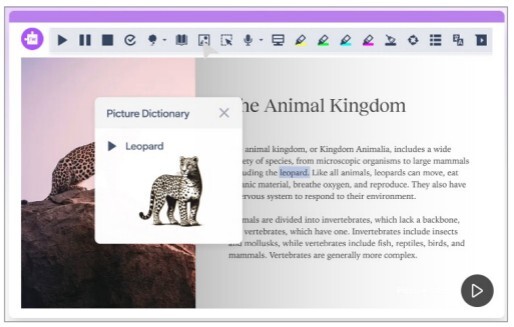
Note. From Read & Write Education, by Everway, n.d. (https://www.everway.com/products/read-and-write-education/).
The usage of technology to serve students with special needs offers promise and peril. Technology can provide tools that would be impossible or impracticable for conventional curricula, but the teacher and student rely on the digital curriculum to guide them well. These materials are reviewed for TEKS alignment, but the usage of the technology is harder to control. A particular danger for special education, since it requires a greater level of expertise than ordinary instruction, is that the curriculum replaces the teacher and the digital material becomes a substitute for effective instruction.
A special use case of digital materials is for remote and virtual instruction. The Texas Education Agency accredits virtual school programs through the Texas Virtual School Network (TVSN) (TEA, n.d.-c). These online programs allow students to take courses that may not be offered at their local school or to enroll in a full-time online school. These courses align with TEKS and are led by a classroom teacher (Texas Administrative Code, §70.1005). Online programs are administered by school districts (currently 20) who usually partner with an online materials provider (TVSN, n.d.). Over 62,000 students are currently enrolled in Texas virtual schools, and this number is likely to grow with the passage of SB 569 (2025), which more thoroughly codifies and normalizes virtual schooling in Texas (TEA, 2025a).
This cross-section of school districts’ use of technology shows the variety of its applications. While these examples demonstrate the potential of technology-based solutions for instruction, they also pose the risk that technology consumes the instructional program. The challenge of the education system is to decide which of these myriad options provides the most effective and efficient benefit or if a non-technological option is preferable.
Finance
Apart from all other considerations of instructional efficacy or harm, it is certain that an enormous sum of money is spent on educational technology in Texas public schools every year. Both operational and non-operational dollars are used to buy devices, software, services, and virtual curriculum. Unfortunately, due to limitations in financial reporting, it is impossible to know exactly how much money is spent on educational technology. Nevertheless, the estimates and examples available profile a staggering outlay that poses a risk to the efficient use of school resources because of the extravagant expense, the opportunity costs of school misspending, and as a source of ill-advised long-term debt.
The Texas Legislature has specifically allocated funding, the Instructional Materials and Technology Allotment (IMTA), for instructional technology. Originally intended to fund textbooks and other curriculum, it was expanded in 2011 to include technology such as computers, virtual instructional materials, supporting equipment such as laptop carts, and salaried technology specialists (TEA, n.d.-d). For the 2026-27 biennium, the legislature allocated $174.69 per student and an additional $14.87 per Emergent Bilingual student (TEA, 2025b). This allotment was over $988 million for the 2026-2027 biennial allotment, and 13 schools received more than $10 million through the IMTA (TEA, n.d.-e).
For the 2025-2026 school year, $428,981,753 was disbursed from the IMTA fund (TEA, n.d.-b). This fund is established with each legislative budget for the biennium, so schools have two years to submit requests for each funding cycle. Out of the $364 million that was spent on instructional materials, 68% ($247 million) went towards online or electronic materials. Likewise, 74% of the technology equipment disbursements ($18.6 million out of $25.1 million) were spent on laptops or tablets.
IMTA and other operational funds have not been sufficient to quench the lust for technology expenditures, so school districts have increasingly taken to proposing bond issuances which, when approved by local voters, allow districts to obtain loans to be repaid by the local interest and sinking (I&S) tax. The Texas Open Data Portal lists 152 passed bonds totaling over $9 billion since 2020 with “technology” as part of their purpose description, with another $184 million pending for the May 2, 2026, election (Texas Open Data Portal, n.d.). By isolating bonds described only as “Technology,” and thus removing the broader bonds related to school building construction, renovation, and maintenance, this figure is reduced to $2.8 billion in bonds carried over from 2020 to 2025.
Two sources of confusion, however, obscure the use of these funds: First, districts may aggregate many different uses into a single bond proposition and are not required to itemize each purpose. For instance, the ballot language for the May 3, 2025 DeSoto ISD Proposition B asks for $152 million “for the construction, acquisition, renovation, improvements, and equipment of school buildings, including technology equipment used for school security purposes and technology infrastructure integral to the construction of DeSoto ISD facilities, and for the purchase of necessary sites for DeSoto ISD facilities” (Texas Comptroller, n.d.). This description suggests that most of the funds will go towards school buildings, but it is uncertain if any funds will support instructional technology, directly or indirectly. Second, technology is a sufficiently broad category that it may encompass administrative or building uses as well as instructional technology. On November 4, 2025, Belton ISD voters approved a $6 million “for the acquisition or update of district technology equipment, including student, teacher and staff devices” (Texas Comptroller, n.d.). Presumably most of this bond will be used to buy one-to-one devices like computers and laptops, but that may not be the only expenditure. Based on the totality of these factors, it is more reasonable to take the $2.8 billion figure as an estimate for the amount of bonds issued for instructional technology, but that is likely a conservative lower bound.
Excessive bond issuance to purchase technology is particularly concerning because it imposes additional costs on items with inherently limited lifespans. The Belton ISD bond, though relatively modest at only $6 million, will accrue an additional $820,000 in interest over the life of the bond (Belton ISD, n.d.). One-to-one devices such as laptops have a short lifecycle, and many schools plan to replace these devices every five years (Leander ISD, n.d.). Consequently, devices may already be out of service before the debt has even been paid off. This is a poor strategy for the efficient use of taxpayer resources, but it is popular because it allows the school to make these large, high-status purchases without dipping into operational funds.
On the expenditure side, the amount schools are spending on instructional technology is similarly unclear but immense. Expenditures on instructional technology are not disaggregated in financial reporting from other instructional costs, nor is the extent of these devices’ use knowable. Nevertheless, through numerous public information requests to school districts, some understanding of the scope and vendors is available. Two vendors, Dell Computers and Apple, Inc., made sales of over $100 million each to Texas public schools in both 2023 and 20241 (Open the Books, n.d.). In 2023 and 2024, Texas public schools bought over $1.5 billion from just the sampling of the top 14 vendors seen in Table 1. While determining exactly what was purchased by the state’s 1,200 school districts and charters from these vendors would be a colossal undertaking, this sampling is likely a gross undercount of the true scope of instructional technology spending.
Table 1
Sales Made by Select Instructional Technology Vendors to Texas Public Schools in 2023 and 2024
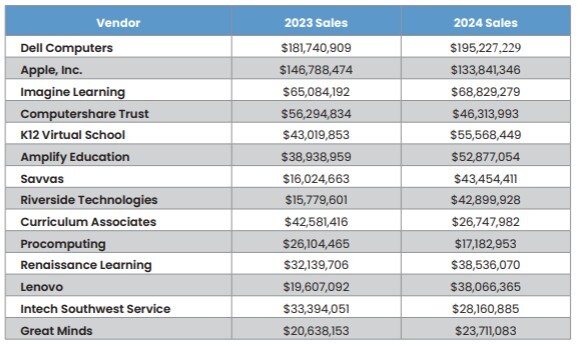
Note. Data from Texas, by Open the Books, n.d. (https://www.openthebooks.com/).
One notable category in technology spending is virtual schooling because not only is virtual education a different form of instruction, but it also affects students’ settings and enrollment patterns. The most prolific virtual school provider in Texas is Roscoe Collegiate Independent School District. According to public information requests submitted by Open the Books, Roscoe CISD paid $55,568,449 in 2024 and $43,019,853 in 2023 to K12 Virtual School (formerly known as Stride, Inc.) (Open the Books, n.d.). Enrollment at Roscoe CISD grew from 681 students in the 2020-2021 school year to 14,906 students in 2025-2026, indicating that this spending is driven by the aggressive matriculation of virtual students who do not reside near Roscoe (TEA, n.d.-f).
Instructional technology purchases should be made with careful consideration because of the enormous opportunity cost of district resources and of other instructional approaches. Once a significant purchase has been made, teachers must either commit to using that hardware or software or, if they are even given a choice, pursue alternatives with fewer resources. The state would make better educational policy with more information about the specifics of education technology expenditures.
Educational Effects
Perhaps the single most significant question in the issue of education technology is whether technology contributes towards educational achievement. Scientific consensus on the effects of technology is still being formed, and, unlike the relatively narrow phenomenon of cell phone usage, educational technology has a wide variety of applications. Unfortunately, the results of research on technology’s effects on educational outcomes have been mixed to negative; certainly, they do not justify the immense number of resources dedicated to it.
Teachers and researchers have expressed fear that educational achievement is declining, with the blame assigned to a mix of educational technology and smartphones, and this fear is most palpable in the language arts, where university professors describe English majors who cannot read whole books (Clement & Miles, 2018; Horowitch, 2024). The evidence is mounting that interacting with digital technology negatively affects language-related activities in a fundamental way.
Whether print books are superior to e-readers has been a debate among readers since the introduction of tablets, but research has shown that reading on digital devices consistently results in less understanding than reading in print. An eye tracking study in 2022 found that students (willing undergraduates) retain slightly less information when reading on a digital tablet than when reading in print (Delgado & Salmeron). Researchers recorded that when reading on a digital medium, the reader spent less time on each word and the eye had larger saccades (i.e., rapid eye jumps). In essence, reading on a digital device promotes “skimming” and results in less total reading time, as measured by visual engagement. This “screen inferiority” effect has been reproduced in several meta-analyses. In one meta-analysis, the screen inferiority effect was around two-thirds of a student’s average yearly growth in reading comprehension (Delgado et al., 2018). In other words, a student reading on a digital device in May is reading with the same level of comprehension they had with print in November. Another meta-analysis of 33 studies found an even larger gap, although both meta-analyses noted that this effect is stronger in expository passages than in narrative passages (Clinton, 2019).
Nor is this effect limited to reading for instructional time. A meta-analysis of 25 studies examining the effects of digital reading for leisure found negative effects on reading comprehension among digital readers, suggesting that the assertion that “any reading is good reading” may not be entirely true (Altamura et al., 2023). Crucially, though, this effect was strongest in the elementary and middle grades, suggesting that print reading is especially important in the early grades.
A groundbreaking MRI study in 2017 detected that when children read, the left visual word form area of the brain had higher levels of functional connectivity to the left-sided language, visual, and cognitive control regions (Horowitz-Kraus & Hutton, 2017). Reading on a screen, however, resulted in lower levels of connectivity with these areas. The researcher, Tzipi Horowitz-Kraus, argues that the learner’s brain needs synchronization in order to perform complex tasks like reading and writing, and, without this synchronization, there will be learning delays (Institute of Digital Media and Child Development, 2026). She also says that this synchronization could be vital for developing executive function in children.
A common explanation for the screen inferiority effect is that digital formats do not offer the same physical spatial cues as books and paper (Oxford Learning, 2025). MRI studies have found that reading in print activates different parts of the brain related to spatial and structural information (Umejima et al., 2026). Without a physical framework, such as pages or the arrangement of information on the page, readers have fewer references on which to hang details.
Another explanation is the shallowing hypothesis, which suggests that, because readers are conditioned to engage with digital content in a brief and superficial manner, they are predisposed to skim whenever reading on a digital format (Altamura, 2024). Finally, reading from a digital device may impose a higher visual and cognitive load, as the brain must process screen light and pixelation as well as interpret the text.
The research on writing versus typing notes is not as developed as with reading, but, just as with reading, students do not retain as much information when choosing the technological option for taking notes. A 2024 meta-analysis that examined 24 studies found a significant advantage in knowledge retention for handwritten over typed notes and expected that handwritten notes would produce up to one-third more “A” letter grades than typed notes (Flanigan et al., 2024). A major observation in these studies is that typers generally transcribe what they read or hear, while those who take handwritten notes engage in more paraphrasing (Kuepper-Tetzel, 2024). This observation suggests that writers engage in more processing than typers, resulting in greater content retention.
As the review of educational programs used by Texas schools demonstrated, mathematics is a popular subject for educational technology curriculum. Educational technology in mathematics is framed as a means of delivering an educational experience that would be impossible without technology by boosting student engagement through interactive lessons, presenting visual and graphical representations of concepts, and providing feedback on student performance (Joshi, 2025). While the literature is mixed, studies, including a meta-analysis that examined 92 studies, have found that instructional technology can provide minor to moderate benefits to mathematics instruction (Hillmayr et al., 2020). This analysis, however, involved a wide variation in programs that complicates the conclusions. For instance, the meta-analysis noted that the longer-term studies produced smaller effects than the shorter studies. This may indicate that the benefits from educational technology are the result of excitement, novelty, and short-term intensity.
A study from Italy, however, shed more light on how technology is best used in mathematics instruction. By examining the scores of Italian students from the 2012 Programme for International Student Assessment (PISA), the study found that instructional and communications technology showed positive impacts on mathematics achievement in gaming, information management, content creation, and problem-solving. The study found, however, that the effect was negative when technology was used for communication, collaboration, or instruction (Meggiolaro, 2018). Between the caveats of the meta-analysis and the mixed results of the Italian study, the use of instructional technology may not be as uniformly positive in mathematics as advertised.
Unfortunately, optimism for the potential of educational technology is not reflected in studies of student achievement. Data from three international studies of achievement—the PISA, the Trends in International Mathematics and Science (TIMSS), and the Progress in International Reading Literacy Study (PIRLS)—found an inverse relationship between screen time in school and student achievement across all countries in mathematics, reading, and science (Horvath, 2026).
Educational technology vendors tout the data backing up the effectiveness of their products, but research-backed results are often lacking. For instance, IXL Learning, a digital education platform that has been used in Texas, claims a 15-17% score boost, but a Johns Hopkins study found that the benefit of their program was closer to 5% (Randazzo et al., 2025). Another unpublished study by Johns Hopkins called IXL Learning’s effect “directionally positive, but statistically insignificant.”
Since the early 2000s, educational technology has been pushed as a way to revolutionize education for the 21st century (Culp et al., 2003). This brief review, however, suggests that not all aspects of effective instruction can be fulfilled by technology and, in some instances, like reading and writing, the use of technology may be essentially opposed to achievement in that subject. Before weighing the costs and dangers of educational technology, a strong argument for its value must be established. This evidence is lacking. Moreover, technology is often deployed as an intervention to poor academic performance, so these studies are not comparing technology against effective instructional programs. Educational technology should not be used as a panacea to absolve schools of their responsibility to educate students.
Dangers of Educational Technology
Protecting Students from Exposure to Harmful Materials and Their Data Privacy
The two most urgent considerations for the use of educational technology are to ensure that students are not harmed either by exposure to harmful materials or communications or by an invasion of their data privacy through the devices. These two issues, although disparate in the nature of the harm, both involve issues of device access and an overlapping regulatory framework and, so, are best considered together.
The use of technology to access or disseminate harmful materials or collect information on minors has been a recurring concern for parents, affected children, school officials, the state legislature, and even Congress. These dangers are not merely hypothetical either: In August of 2025, Killeen ISD sent out a notice that an inappropriate video of two minors was being circulated through phones (KWTX, 2025). Multiple school districts have also dealt with “deepfake” incidents where the images of students, sometimes using school-obtained photographs, were digitally altered into obscene material (Miller, 2026). While these cases do not specifically involve school-issued devices, it is doubtless that students access obscene material at school. A 2022 poll by Common Sense Media found that 31% of teens had viewed pornography at school and 44% of these teens had viewed it on school-issued devices (Robb & Mann, 2022).
A related issue to student privacy is parental transparency and control. Parents are often not told to what extent their child is using devices at school, let alone given full transparency around what these programs are teaching (Alaimo, 2026). Parents who object to excessive screen time or the “gamification” of education may have little recourse. Opt-in/opt-out policies amount to students working on separate assignments while the rest of the class works on laptops.
In response to these dangers, both the federal and the state of Texas have enacted laws to protect children from the misuse of technology. The federal government regulates digital services through two broad acts of legislation: The Family Educational Rights and Privacy Act (FERPA) and the Children’s Online Privacy Protection Act (COPPA). FERPA grants parents control over their children’s education records (transferring to the child at 18) and prevents disclosure of personally identifiable information (PII) without consent (U.S. Department of Education, n.d.). These rules apply both to schools and service providers that may obtain PII. Similarly, COPPA obligates online services with users under the age of 13 to clearly post their data collection policies, a notice to parents with instructions on how to review or request deletion of data, and a choice of consenting or denying participation in data collection, including disclosure to third parties (Federal Trade Commission, n.d.).
Not satisfied with these protections, however, the state of Texas passed the Securing Children Online through Parental Empowerment (SCOPE) Act (HB 18) in 2023. This act requires digital service providers to register the age of the user, limit the collection of minors’ PII, and prohibits the sale or sharing of information (TXOAG, 2024). The digital service provider must also create parental tools that allow parents to monitor and restrict the minor’s use of the service. Additionally, the act creates a duty for the digital service provider to work with advertisers to prevent ads from targeting minors with unlawful products, services, or activities and to verify the age of users seeking to access harmful or obscene material. However, federal lawsuits have resulted in three of the law’s provisions being enjoined until the suits are resolved. The judge temporarily blocked the provisions requiring that social media companies filter content accessible to minors, that they restrict certain ads being directed at minors, and that they obtain age verification (Runnels, 2025).
The federal and state government have enacted regulatory safeguards to protect children, but, as is often the case, the main danger is the curiosity of the children themselves. There is ample evidence that students bypass firewalls and security filters to access inappropriate material, but students accessing obscene materials at school—while horrifying to parents and lawmakers—is likely too commonplace to even warrant newsworthiness (Powell, 2018). Instead of learning to play marbles and jacks, students now learn how to install virtual proxy networks and other workarounds in a constant cold war with authority figures’ efforts to prevent access (GoGuardian, 2026).
Despite these efforts, there is frustration among legislators that the current protections are lacking and that there are limited additional options, especially with regard to what the law can ask of digital service providers. The U.S. Senate passed a new bill, the Kids Online Safety Act (KOSA), in July of 2024 to regulate AI and chatbots, but concerns over censorship and restricting access to information from both the right and left has the bill stalled into 2026 (Andrews et al., 2024; Nazzaro, 2026). With the enjoinment of elements of the SCOPE Act that place requirements on providers, the options remaining to Texas appear limited. Moreover, with the inevitability of student curiosity, creating a foolproof technical and regulatory regime may be a constantly moving target. There is one guaranteed way to stop children from being harmed by technology at school, and that is to prevent or limit access to technology at school.
The Impact of Technology on Mental Health
While many of the dangers to mental health caused by technology, such as exposure to harmful materials and the documented (and now litigated) harms of social media, can be subsumed under the access framework, not all harms are the result of harmful content or abusive algorithms (Kang, Mac & Tan, 2026). The neutral use of technology can create negative consequences, especially for young learners.
The negative effects of technology on the mind have been well-documented. High screen exposure can lead to a shortened attention span, delayed social development, and changes in motivation (Rock, 2025). Studies have shown that even reasonable amounts of screen time can cause effects on the brain, with atrophy of “gray matter,” the parts of the brain responsible for “processing” (Perina, 2014).
Attention spans have declined considerably over the last 20 years, with one study showing from two and a half minutes to 45 seconds, and this lack of focus has been reported by schools to negatively affect student learning (Moulton, 2024; Institute of Education Sciences, 2024).
Digital content that elicits a dopamine response, such as video games, can lead to weakened responses in the reward centers of the brain, thereby leading users to seek out stronger forms of stimulation (Rock, 2025). Although research on the “gamification” of education suggests that game elements can improve learning and increase student engagement, there is worry that gamification, especially through technology, can cause the same desensitization and that it will tie students’ desire to learn to extrinsic motivation (Busch, n.d.).
While these types of harms can be mitigated to some degree by well-designed programs, the “blue light” that screens emit is a constant. Blue light has been shown to suppress melatonin, a hormone that facilitates sleep (Rock, 2025). For growing children, high-quality sleep is crucial for their development, so excessive screen use inherently poses a particular risk to the physical and mental health of children.
The question faced by parents, teachers, and school administrators is whether all “screen time” is created equal. Does using a laptop in school exacerbate the negative effects of scrolling Instagram? Proponents of educational technology argue that, by designing educational programs that encourage deep thinking, many of these pitfalls can be avoided (Prothero, 2026). What cannot be mitigated, however, is that time spent on technology is time spent in that digital world and not the real world, with its digital way of presenting information as opposed to verbal face-to-face interactions. According to one poll, 40% of middle and high school teachers said that students use devices for three hours or more just during the school day (Miller & Mervosh, 2025). Higher screen time out of school is associated with lower reading and math achievement, so more screen time in school likely exacerbates our society’s excessive use of digital technology (Keown-Stoneman et al., 2025).
The Challenges of Artificial Intelligence
When discussing the use of artificial intelligence in schools, cheating often takes center stage. This framing, however, ignores the broader uses of AI in instruction and as a tool for teachers in instructional design. As with the other examples of digital technology, the power of a tool like AI is no guarantee that it will be educationally effective or not carry drawbacks.
For teachers, the greatest source of anxiety concerning AI is the potential for cheating (Prothero, 2024). AI can deliver precise results without any thinking at all. Even computational tools like Wolfram Alpha required some understanding of the subject, but tools like Google Gemini and ChatGPT can provide detailed answers to any subject with copy-and-paste. For teachers who assign essays, AI poses an especially novel threat, as the ability to obtain a unique, sophisticated response to a writing prompt was uncommon before the emergence of generative AI. Fortunately, research from Stanford University suggests that the advent of AI has not significantly increased students’ self-reported cheating, which remains at a horrifying but stable rate of about 60-70% (Spector, 2023). Turnitin, a website commonly used by teachers to detect plagiarism, found that 11% of submissions used 20% or more AI-generated content and only 3% of submissions contained 80% or more AI content (Prothero, 2024). This data suggests that while AI cheating is commonplace, it has not become an epidemic.
Nevertheless, even a few students per class intent on cheating is an instructional and policy nightmare for teachers. Teachers have adjusted their assignments to prevent the use of AI, such as proctoring essays in class or conducting brief oral knowledge checks (Northern Michigan University, n.d.). AI cheating anxiety, however, also creates negative effects. Several instances of schools accusing innocent students of using AI to cheat have made national news (Kingkade, 2026). In response, some students have resorted to dumbing down their language or using “humanizing” AI to avoid suspicion.
More dire than the prospect of cheating, however, is the possibility that a reliance on AI will reduce students’ educational quality and cause their critical thinking to atrophy. Research conducted with university students found that students who used ChatGPT to research information for an assignment experienced lower cognitive load, but their responses were less thorough, offering fewer and less detailed arguments than those of students using traditional search engines (Hedrih, 2024). Likewise, an MIT study found that students who relied on ChatGPT showed less and less engagement and neural activity over time (Chow, 2025).
Most significantly—and perhaps most direly—a detailed survey of workers in select “knowledge” fields found that generative AI changed the way that these workers processed information (Lee et al., 2025). The most straightforward pitfall of AI is that users may simply uncritically accept what the AI presents to them. Ironically, the study found that users who had less trust in AI approached the generative responses more critically and so were able to better apply AI best practices. The researchers also found that when engaging with generative AI, users reported spending more time on verifying the accuracy of the claims, modifying the response to fit the context, and stewarding the AI prompts. Overall, these findings point to a process where engagement with knowledge is deprioritized in favor of the secondary process of shepherding AI to produce useful responses. AI may be a powerful tool for sophisticated academics, but young students should be focused on developing their own intellectual capabilities.
Apart from educational effects, AI also creates unique risks that fall under the safety and access framework, including exposure to harmful material and mental health impacts (Burns et al., 2026). AI chatbots have been implicated in several cases of teenage suicide where the chatbot offered help, such as in drafting a suicide note (Chatterjee, 2025). Moreover, children are particularly susceptible to reactive language models which can appear eerily human (Sanford, 2025). The chatbot may seem like a real friend or even a romantic partner to vulnerable children, including those suffering from mental illness, and contribute to their social isolation and a worsening of their mental health, a phenomenon dubbed “AI psychosis” (Wei, 2025). While the students may not engage in this behavior during class, exposure to AI in class may accustom students to seeking help from AI and chatbots.
In response to the new realities of AI proliferation, state and federal authorities have created laws and frameworks regulating this technology and its use. Every single state has introduced AI-related legislation since 2024, and 45 states have already introduced 1,561 bills in March of 2026 (Multistate, 2026). Most state-level laws address narrow, traditional policy concerns such as privacy, transparency, and honest business practices (Gluck, 2025). Others tackle unprecedented challenges of AI, especially the use of AI to produce nonconsensual intimate imagery (NCII), child sexual abuse material (CSAM), or misleading images or both of elected officials (Dawson, 2025). Colorado passed one of the broadest laws in the country, targeting AI systems that “make(s), or is a substantial factor in making, a consequential decision,” requiring transparency, monitoring, and anti-discrimination measures (SB 24-205, 2025). California, on the other hand, passed several issue-specific bills targeting the use of AI to produce content, including deepfakes of elected officials, candidates, and performers, living or dead (Dawson, 2025). Texas passed its own AI-oriented consumer-protection bill in 2025 (HB 149), known as the Texas Responsible Artificial Governance Act (TRAIGA) (TXOAG, 2026). This bill prohibits the most abusive uses of AI, including manipulation into self-harm or criminal activity, social scoring, or the creation or distribution of sexually explicit text, videos, or images that violate the Texas Penal Code. Disclosure requirements, however, only apply to government-deployed AI, not to private providers (Transparency Coalition, n.d.).
The federal government has yet to pass any broad AI regulation, but it has taken action against AI-produced images. In 2025, Congress passed S.146, the Take It Down Act, that criminalized the publication of nonconsensual intimate images, including “digital forgeries” or deepfakes, and required digital service providers to create a process for victims to flag images for removal. The bill went into effect on May 19, 2026 (U.S. Congress, n.d.). The White House also published A National Policy Framework for Artificial Intelligence in March 2026 (The White House, 2026). This nonbinding document made recommendations to Congress on how best to approach AI regulation, encouraging a permissive regulatory environment that would lead to innovation, economic growth, and “American AI dominance.” The document emphasized parental controls and the protection of children, but the only reference to education involved AI skills training.
While these bills touch on issues that may affect schools and students, states have passed little education-specific AI legislation, opting instead for guidance on school policy. Thirty-four states had issued guidance on the use of AI in schools as of October 2025 (AI for Education, 2025). These frameworks mostly concern nonbinding best practices, but mentions of where AI may implicate data security or privacy requirements are common. Many of these guidances contain “core ethical principles” or “foundational pillars” of AI use. Most stress that AI should be subordinate to human judgment and activities and should further instruction, with reference to state and local standards and policies. One state, Idaho, has explicitly banned AI from replacing human instruction (Aaron, 2026).
Texas has not issued similar statewide guidance, but the Texas Association of School Boards (TASB) has created extensive resources to educate school officials and school board members about AI (TASB, n.d.). TASB has also created board policies that local school boards may adopt in whole or part (Belton ISD, n.d.). The board policies instruct the school to adopt policies relating to creating a code of ethics for AI use, AI security standards, and training. The policies also note that schools must abide by the provisions of TRAIGA, including prohibitions on social scoring, discrimination, and the capture of biometric data.
Artificial intelligence is uncharted territory and a rapidly evolving field even for the most cutting-edge technology operators. Public policy and schools will be playing catch-up to both utilize its power and grapple with its challenges for the foreseeable future.
State Legislative Approaches to Educational Technology
With increased scrutiny of educational technology, states have begun enacting legislation to prevent runaway technology use in classrooms. Forty-four states have passed laws regarding cell phones in K-12 (Ballotpedia, n.d.-b). Thirty-five of these states banned or limited cell phone use in class, five states ask school districts to adopt a cell phone usage policy, and four states encourage school districts to limit cell phone use. Texas enacted a bell-to-bell ban on cell phones in public schools in 2025 (HB 1481, 2025).
States have been slower to adopt statewide legislation restricting educational technology in schools in general, but the movement to do so is rapidly growing.
Utah passed HB 273 in its 2026 legislative session, which bans all “screen time,” except for computer literacy courses and standardized testing, for students in kindergarten through 3rd grade (HB 273, 2026). For grades 4 through 6, students may not be issued a school-owned device or assigned homework that requires internet access. For grades 7 through 12, parents must consent to students being allowed to take a school-issued device home. Parents may opt out of technology use in high school.
Alabama, in HB 78, deferred to the Department of Early Childhood Education, the State Department of Human Resources, and the State Board of Education to create standards for age-appropriate screen time limits for children in schools and childcare (HB 78, 2026). The bill does stipulate that the guidelines recommend no screen time for children under the age of two.
Twelve other states have introduced screen time restrictions (Telgenhof, 2026). Iowa and Oklahoma are proposing a limit of 60 minutes a day of digital instruction, while Kentucky and Missouri set the cap at 45 minutes a day. The bill introduced in Kansas prohibits all digital devices in kindergarten through 5th grade and requires physical textbooks in all grades. Maine and New Mexico are currently conducting studies into the effects of digital instruction and screen time.
These pioneering states have provided an example and several policy options for Texas to follow. These first efforts, however, have been relatively mild, only demanding strict restrictions on the lowest grades. Texas should ensure that technology is used appropriately from kindergarten through 12th grade.
Conclusion
Based on this analysis of Texas schools, technology has not lived up to its promise of transforming education for the better. The effectiveness of instructional technology is unproven, and the evidence that technology has a lasting negative impact on students’ reading and writing skills is mounting. At best, technology provides what a well-designed instructional program with high-quality instructional materials could accomplish without spending billions of dollars on rapidly depreciating equipment each year. Texans, from legislators to parents to teachers, should not abdicate their responsibility to do the hard work of educating Texas students by relinquishing education to the nanny-tutor of technology.
Moreover, online technology poses unique dangers to students through exposure to harmful materials and risks to data privacy. Even if these risks are completely mitigated during the school day, the use of technology and artificial intelligence acculturates students into the digital ecosystem, making them more likely to use these tools outside of school.
Apart from the purely academic benefits of instructional programs, there are two other commonly cited arguments for using technology in schools. Perhaps the most common argument for technology in schools is the idea that because technology is so prevalent in modern society and an increasing number of jobs rely on technology, students must learn about technology to become productive workers and citizens. However, as the review of the technology expenditures showed, most of the technology is used for instructional programs similar to print instructional materials. Very little is dedicated to coding, data analysis, or modern technology. If educators and industry leaders believe that students need exposure to certain kinds of technology in order to be prepared for the future, a more focused and intentional approach would better prepare students for a lower cost of time and money.
Furthermore, as was discussed previously, users who are AI skeptics are better at applying best practices such as verifying the credibility of results. Understanding logic, scientific principles, and rhetoric—skills found outside of crafting AI prompts—makes students more adept at using AI. The best way to ensure that students are prepared for the future is to not let their reading, writing, and independent thinking skills wither.
The second common argument is that technology is both helpful to disadvantaged students in delivering a quality education and necessary to ensure they are given the same opportunities as less disadvantaged students. “Bridging the digital divide” has become a rallying cry for both more technology and more funding (EdTrust-West, 2020). Like any other social program, billions can be spent to ensure every student has a laptop and internet access at home, like the 800,000 hotspots Texas purchased around 2020, or Texas can deliver a quality education that does not require technology.
Ironically, as is so often the case with efforts to stamp out inequality, a high-technology regime may be particularly harmful to the students it purports to aid. Disadvantaged students are more likely to be behind in reading, and the “screen inferiority effect” will only exacerbate these deficiencies. Lower-income students have also been found to spend more time on screens than their higher-income peers, about two hours longer for teens and tweens (Molla, 2019). Students with access to books and stable families may be able to weather excessive technology, but for students in more precarious positions, all of the negative academic and mental effects of technology will be intensified. For the proof of the pudding, consider how the most successful private and charter schools operate. The richest and highest-proficiency students, by and large, use less technology than the average public school student. Silicon Valley parents famously restrict their children’s access to unnecessary technology (Weller, 2018). One affluent Austin-area private school described their approach to technology as “medieval.” These highly resourced and informed parents do not reject technology but take a balanced approach.
Policy Recommendations
With technology use in Texas excessive in some respects and toxic in others, how can the Legislature moderate the proliferation of educational technology in Texas schools?
The most effective way to mitigate the effects of technology is simply not to have it in the classroom. Most recommendations for children’s use of technology, such as the 2026 U.S. Surgeon General’s Warnings on the Harms of Screen Use, focus on the strict developmental and mental health aspects of screen time and so are relatively permissive. The report recommended a limit of one hour per day for children under 6 and two hours per day for 6- to 18-year-olds (U.S. Department of Health and Human Services, 2026). The studies previously mentioned, however, show that technology continues to have deleterious effects on students’ academic performance, mental health, and brain development even past five years old. As responsible stewards of Texas students, legislators should insist that educational technology not be introduced unless there is a strong case for its use. Following the example of Utah, Texas could ban the use of digital screens, including one-to-one devices, for students in kindergarten through 3rd grade. However, an even more ambitious plan to safeguard students’ brain development and academic foundations would be to ban one-to-one devices from kindergarten to 6th grade.
Another safeguard the Legislature can take is to ban all out-of-class assignments that require internet or technology until high school. Similarly, the use of technology could be restricted to a designated learning environment, what pre-digital age students remember as the computer lab. Computer labs focus the instructional program around learning specific skills, such as typing, and compartmentalize technology time from the rest of the school day (Cass, 2025).
To restrict the inappropriate instructional use of technology, several states are considering time-based restrictions. While a time limit on screens is necessary for student health, centering state policy around a time limit would be awkward and unenforceable. A time limit would impose a burden on teachers to coordinate and compromise among themselves, and it would be difficult to know or enforce the rule should it be flouted by an unscrupulous teacher. Instead, the Legislature should restrict what kinds of instruction educational technology can fulfill. The Legislature should ban the use of educational technology for most types of Tier 1 instruction under the multi-tiered system of supports (MTSS) framework, which includes universal, whole-class instruction (TEA, n.d.-g). By banning technology in Tier 1 instruction, district and campus officials can design instructional programs that are guaranteed to follow the law, with oversight and assistance from TEA and the State Board of Education, in their roles as reviewers of instructional materials. Furthermore, parents can be assured that technology is not replacing the teacher in the classroom. This ban could, of course, include several carve-outs for cases where technological solutions are necessary or preferable, such as advanced classes that are not offered by a school district or specialized lessons for special education learners.
One policy that is often mentioned is the ability of parents to withhold consent for using technology. While parental transparency and control are vital, this measure does not strike at the heart of the problem. If a school orients its entire instructional program around technology yet allows students to opt out of this program, those who opt out will not be receiving a full educational experience.
Furthermore, there will be an attempt to sanitize educational technology. Vendors will promise that their devices are safe and tamper-proof. AI training and bans will be proposed. Time limit rubrics that claim to avoid negative mental and physiological effects will be advanced. Anything to ensure that the core purchasing and functionality requirements of the current high-technology regime stay in place.
On the supply side, the Legislature is loath to restrict districts’ latitude in purchasing because of the varied needs of the 1,200 districts, but options for targeted constraints do exist. As discussed in Part II, the Instructional Materials Allotment was expanded 15 years ago to allow for the purchase of technology-related expenses. Since then, technology has become the largest share of spending in what used to be the fund for buying textbooks. If legislators want instruction to return to print, the spigot for the technology that replaced it must be turned off. Disallowing one-to-one student devices from acceptable bond purchases is another alternative, but both policies still allow for schools to use other sources of funding to buy technology.
For too long, the proliferation of technology in Texas public schools has gone unexamined. Far from delivering the promised revolution in education, educational technology has produced lackluster results while importing novel and unavoidable harms into the classroom. Texas schools are currently spending over $100 billion a year for worse results than what can be achieved with a blackboard. If legislators want to provide effective instruction to Texas students while ensuring their safety and protecting their mental health, they must break schools’ addiction to technology.
References
21K School. (2026, June 10). 12 advantages and disadvantages of technology in education.
https://www.21kschool.com/in/blog/advantages-disadvantages-of-technology-in-education/
Aaron, I. (2026, April 9). How states are regulating AI in education this legislative session. Multistate. https://www.multistate.us/insider/2026/4/9/how-states-are-regulating-ai-in-education-this-legislative-session
Adams, L. (2025, March 13). 5 years later: How covid affected Central Texas education. KXXV. https://www.kxxv.com/news/local-news/in-your-neighborhood/5-years-later-how-covid-affected-central-texas-education
AI for Education. (2025, October 28). State AI guidance for K12 schools. https://www.aiforeducation.io/ai-resources/state-ai-guidance
Altamura, L. (2024). Turning the page: What research indicates about print vs. digital reading. Oklahoma Education Journal, 2(4), 18-22. https://oej.scholasticahq.com/article/125437-turning-the-page-what-research-indicates-about-print-vs-digital-reading.
Altamura, L., Vargas, C., Salmerón, L. (2023). Do new forms of reading pay off? A meta-analysis on the relationship between leisure digital reading habits and text comprehension. Review of Educational Research, 95(1), 53-88. https://doi.org/10.3102/00346543231216463
Amplify Education, Inc. (n.d.). Shira the Sheep. Retrieved May 15, 2026. https://classroom.amplify.com/activity/66a2a18be61d0ce3d78dae6b
Andrews, N., Peterson, K., & Wells, G. (2024). Inside big tech’s bid to sink the online kid safety bill. Wall Street Journal. https://www.wsj.com/politics/policy/meta-google-lobbying-child-online-safety-bill-5ee63dcc
Ballotpedia. (n.d.-a). School responses in Texas to the coronavirus (COVID-19) pandemic. Retrieved July 1, 2026, from https://ballotpedia.org/School_responses_in_Texas_to_the_coronavirus_(COVID-19)_pandemic
Ballotpedia. (n.d.-b). State policies on cellphone use in K-12 public schools. Retrieved July 1, 2026, from https://ballotpedia.org/State_policies_on_cellphone_use_in_K-12_public_schools
Belton Independent School District. (n.d.-a). Voter Information Document: Belton Independent School District- Proposition C. Retrieved May 12, 2026, from https://resources.finalsite.net/images/v1755266629/bisdnet/e9yuykccizngjdgbiovh/PropositionCVoterInformationDocument081425.pdf
Belton Independent School District. (n.d.-b). Board policy manual: CQD—Technology resources: Artificial intelligence. Retrieved May 30, 2026, from https://pol.tasb.org/PolicyOnline/PolicyDetails?key=164&code=CQD#legalTabContent
Buck, D. (2025, October 28). The digitalization of American schooling. The American Enterprise. https://theamericanenterprise.com/the-digitization-of-american-schooling/
Burns, M., Winthrop, R., Luther, N., Venetis, E., & Karim, R. (2026). A new direction for students in an AI world: Prosper, prepare, protect. Center for Universal Education at Brookings. https://www.brookings.edu/wp-content/uploads/2026/01/A-New-Direction-for-Students-in-an-AI-World-FULL-REPORT.pdf
Busch, B. (n.d.). Can gamification in education lead to better learning? InnerDrive. Retrieved July 1, 2026, from https://www.innerdrive.co.uk/blog/gamification-in-education/
Chatterjee, R. (2025, September 19). Their teenage sons died by suicide. Now, they are sounding an alarm about AI chatbots. NPR. https://www.npr.org/sections/shots-health-news/2025/09/19/nx-s1-5545749/ai-chatbots-safety-openai-meta-characterai-teens-suicide
Clement, J., & Miles, M. (2020). Technology is making our kids less intelligent, judging by my experience as a teacher. The i Paper. https://inews.co.uk/news/education/screen-schooled-technology-children-learning-joe-clement-matt-miles-126928?srsltid=AfmBOor5ngRIh8Dgfl0lTHSgG_dN2Bjcs54jiw-4Bz5yNWXnbNaCaKNP
Clinton, V. (2019). Reading from paper compared to screens: A systematic review and meta-analysis. Journal of Research in Reading, 42: 288–325. https://doi.org/10.1111/1467-9817.12269.
Culp, K.M., Honey, M., & Mandinach, E. (2003). A retrospective on twenty years of education technology policy. U.S. Department of Education, Office of Educational Technology. https://www.ed.gov/sites/ed/files/rschstat/eval/tech/20years.pdf
Dawson, G.S., Desouza, K.C., Denford, J.S., & Picavet, M.B. (2025). How different states are approaching AI. Brookings. https://www.brookings.edu/articles/how-different-states-are-approaching-ai/
Delgado, P., & Salmerón, L. (2022). Cognitive effort in text processing and reading comprehension in print and on tablet: An eye-tracking study. Discourse Processes, 59(4), 237–274. https://doi.org/10.1080/0163853X.2022.2030157
Delgado, P., Vargas, C., Ackerman, R., & Salmerón, L. (2018). Don’t throw away your printed books: A meta-analysis on the effects of reading media on reading comprehension. Educational Research Review, 25, 23–38. https://doi.org/10.1016/j.edurev.2018.09.003
Everway. (n.d.). Read&Write. Retrieved May 17, 2026, from https://www.everway.com/products/read-and-write-education/
Federal Trade Commission. (n.d.). Children’s online privacy protection rule (“COPPA”). Retrieved May 25, 2026, from https://www.ftc.gov/legal-library/browse/rules/childrens-online-privacy-protection-rule-coppa
Flanigan, A.E., Wheeler, J., Colliot, T., Lu, J., Kiewra, K.A. (2024). Typed versus handwritten lecture notes and college student achievement: A meta-analysis. Educational Psychology Review. 36(78). https://doi.org/10.1007/s10648-024-09914-w
Gluck, J. (2025). The state of state AI: Legislative approaches to AI in 2025. Future of Privacy Forum. https://fpf.org/blog/the-state-of-state-ai-legislative-approaches-to-ai-in-2025/?_issues=education-privacy
GoGuardian. (2026). How students bypass school web filters & how to stop them. https://www.goguardian.com/blog/how-students-bypass-school-web-filters-and-how-to-stop-them
Great Minds. (n.d.). Assessment overview: Visibility into student learning. Retrieved May 14, 2026, from https://greatminds.org/math/eurekamathsquared/assessments#data
HB 78. Enrolled. 2026 Alaska Regular Session. (2026). https://alison.legislature.state.al.us/files/pdf/SearchableInstruments/2026RS/HB78-enr.pdf
HB 273. Enrolled. 2026 Utah General Session. (2026). https://le.utah.gov/Session/2026/bills/static/HB0273.html
Hedrih, V. (2024). Study finds ChatGPT eases students’ cognitive load, but at the expense of critical thinking. PsyPost. https://www.psypost.org/study-finds-chatgpt-eases-students-cognitive-load-but-at-the-expense-of-critical-thinking/
Hillmayr, D., Ziernwald, L., Reinhold, F., Hofer, S. I., & Reiss, K. M. (2020). The potential of digital tools to enhance mathematics and science learning in secondary schools: A context-specific meta-analysis. Computers & Education, 153, 103897. https://doi.org/10.1016/j.compedu.2020.103897
Horowitch, R. (2024). The elite college students who can’t read books. The Atlantic. https://www.theatlantic.com/magazine/archive/2024/11/the-elite-college-students-who-cant-read-books/679945/
Horowitz-Kraus, T., & Hutton, J. S. (2018). Brain connectivity in children is increased by the time they spend reading books and decreased by the length of exposure to screen-based media. Acta Paediatrica (Oslo, Norway: 1992), 107(4), 685–693. https://doi.org/10.1111/apa.14176
Horvath, J. C. (2026). Written testimony before the U.S. Senate Committee on Commerce, Science, and Transportation. U.S. Senate Committee on Commerce, Science, and Transportation. https://www.commerce.senate.gov/wp-content/uploads/media/doc/Horvath_Written%20Testimony.pdf
National Center for Education Statistics. (2024). About one-quarter of public schools reported that lack of focus or inattention from students had a severe negative impact on learning in 2023-24. Institute of Education Sciences. https://ies.ed.gov/learn/press-release/about-one-quarter-public-schools-reported-lack-focus-or-inattention-students-had-severe-negative
Joshi, D. R., Sharma Chapai, K. P., Upadhayaya, P. R., Adhikari, K. P., & Belbase, S. (2025). Effect of using digital resources on mathematics achievement: Results from PISA 2022. Cogent Education, 12(1). https://doi.org/10.1080/2331186X.2025.2488161
Kang, C., Mac, R. & Tan, E. (2026, March 25). Meta and YouTube found negligent in landmark social media addiction case. https://www.nytimes.com/2026/03/25/technology/social-media-trial-verdict.html
Kingkade, T. (2026). To avoid accusations of AI cheating, college students are turning to AI. NBC News. https://www.nbcnews.com/tech/internet/college-students-ai-cheating-detectors-humanizers-rcna253878
Kuepper-Tetzel, C. (2024). Handwritten versus typed note-taking effects on college students’ performance. The Learning Scientists. https://www.learningscientists.org/blog/2024/7/18-1
KWTX. (2025). Killeen ISD warns parents of pornographic material circulated by students. https://www.kwtx.com/2025/08/26/killeen-isd-warns-parents-pornographic-material-circulated-by-students/
Leander Independent School District. (n.d.). Bond: Technology devices. Retrieved May 10, 2026, from https://www.leanderisd.org/bond_technologydevices/
Lee, H., Sarkar, A., Tankelevitch, L., Drosos, I., Rintel, S., Banks, R., & Wilson, N. (2025). The impact of generative AI on critical thinking: Self-reported reductions in cognitive effort and confidence effects from a survey of knowledge workers. Association for Computing Machinery, 1121, 1-22. https://doi.org/10.1145/3706598.3713778
Li, X., Keown-Stoneman C.D., Omand, J.A., et al. (2025). Screen time and standardized academic achievement tests in elementary school. JAMA Network Open. 8(10): e2537092. doi:10.1001/jamanetworkopen.2025.37092
Meggiolaro, S. (2018). Information and communication technologies use, gender and mathematics achievement: evidence from Italy. Social Psychology of Education, 21 497–516. https://doi.org/10.1007/s11218-017-9425-7
Miller, S. (2026, February 20). Itasca PD investigate sexually explicit, deep fake images of ISD students, staff. NBCDFW. https://www.nbcdfw.com/news/local/itasca-sexually-explicit-deep-fake-images-students-staff/3987547/
Moulton, C. (2024, January 23). Squirrel! Why attention spans seem to be shrinking and what we can do about it. Northeastern Global News.
https://news.northeastern.edu/2024/01/23/decreasing-attention-span/
Multistate. (2026). Artificial intelligence (AI) legislation tracker 2026: All 50 states. https://www.multistate.ai/artificial-intelligence-ai-legislation
Nazzaro, M. (2026, June 25). House breakthrough on kids online safety faces long odds in Senate. The Hill. https://thehill.com/policy/technology/5938935-house-breakthrough-on-kids-online-safety-faces-long-odds-in-senate/
Northern Michigan University. (n.d.). Creating AI-resistant assignments, activities, and assessments (designing out). Retrieved May 27, 2026, from https://nmu.edu/ctl/creating-ai-resistant-assignments-activities-and-assessments-designing-out
Office of the Governor. (2020, November 18). Governor Abbott, TEA, TDEM announce $420 million reimbursement program for Texas schools to continue supporting remote learning during COVID-19 [Press release]. https://gov.texas.gov/news/post/governor-abbott-tea-tdem-announce-420-million-reimbursement-program-for-texas-schools-to-continue-supporting-remote-learning-during-covid-19#:~:text=Governor%20Greg%20Abbott%20today%20announced,devices%20and/or%20WiFi%20hotspots
Old Dominion University. (2015). History of computers in education. https://www.cs.odu.edu/~tkennedy/cs300/development/Public/M06-HistoryOfComputersinEducation/index.html.
Open The Books. (n.d.) Texas. Retrieved May 12, 2026, from https://www.openthebooks.com/texas/
Oxford Learning. (2025, March 14). Screen vs. paper: Which one boosts reading comprehension? https://oxfordlearning.com/screen-vs-paper-which-one-boosts-reading-comprehension/
Perry, K. (2026). Measuring how screens change young brains | Tzipi Horowitz-Kraus, PhD [Audio podcast]. Screen Deep Podcast. https://www.childrenandscreens.org/learn-explore/research/measuring-how-screens-change-young-brains-tzipi-horowitz-kraus-phd/
Powell, J. (2018, April 13). Leander students bypass filter, accessing inappropriate images on laptops. KXAN. https://www.kxan.com/news/local/williamson-county/leander-students-bypass-filter-accessing-inappropriate-images-on-laptops/
Prothero, A. (2024, April 25). New data reveal how many students are using AI to cheat. EducationWeek. https://www.edweek.org/technology/new-data-reveal-how-many-students-are-using-ai-to-cheat/2024/04
Prothero, A. (2026, April 20). The good, bad, and ugly of screen time: An explainer. EducationWeek. https://www.edweek.org/technology/the-good-bad-and-ugly-of-screen-time-an-explainer/2026/04
Randazzo, S., Barnum, M., Jargon, J. (2025, January 22). Screens have taken over classrooms. Even students have had enough. Wall Street Journal. https://www.wsj.com/us-news/education/schools-phone-screens-technology-research-c268bda5
Robb, M.B., & Mann, S. (2022). Teens and pornography. Common Sense. https://www.commonsensemedia.org/sites/default/files/research/report/2022-teens-and-pornography-final-web.pdf
Rock, K. (2025, June 20). Screen time and the developing brain: Are “iPad kids” at risk? University of Rochester Medicine. https://www.urmc.rochester.edu/news/publications/health-matters/screen-time-and-the-developing-brain-are-ipad-kids-at-risk
Runnels, A. (2025, February 7). Texas’ social media law takes another hit with temporary blocks on three more provisions. The Texas Tribune. https://www.texastribune.org/2025/02/07/texas-scope-act-minors-social-media-restrictions/
Sanford, J. (2025, August 27). Why AI companions and young people can make for a dangerous mix. Stanford Medicine. https://med.stanford.edu/news/insights/2025/08/ai-chatbots-kids-teens-artificial-intelligence.html
SB 6 Bill Analysis. Senate Research Center. 82nd Texas Legislature. Regular. (2011, March) https://capitol.texas.gov/tlodocs/82R/analysis/pdf/SB00006I.pdf
SB 24-205. Enrolled. Colorado 74th General Assembly. 2nd Regular Session. (2024). https://leg.colorado.gov/bill_files/47770/download
Spector, C. (2023, October 31). What do AI chatbots really mean for students and cheating? Stanford Graduate School of Education. https://ed.stanford.edu/news/what-do-ai-chatbots-really-mean-students-and-cheating
State Educational Technology Directors Association. (2015). Revised EETT included in Obama Administration budget request. https://www.setda.org/2015/02/04/revised-eett-included-in-obama-administration-budget-request/
Swaby, A. (2021, January 5). Texas unveils plan to have all students take STAAR online by 2022. The Texas Tribune. https://www.texastribune.org/2021/01/05/texas-staar-online/
Texas Association of School Boards (TASB). (n.d.). Revolutionizing special ed with smart tech: An intro to artifical [sic] intelligence. Retrieved July 1, 2026, from https://www.tasb.org/resources/revolutionizing-specialed-with-smart-tech-an-intro-to-artifical-intelligence
Telgenhof, A. (2026, April 8). Elementary school screen time limits gain momentum in 2026. Multistate. https://www.multistate.us/insider/2026/4/8/elementary-school-screen-time-limits-gain-momentum-in-2026
Texas Administrative Code tit. 19, §70.1005 (2026). https://texas-sos.appianportalsgov.com/rules-and-meetings?$locale=en_US&interface=VIEW_TAC_SUMMARY&queryAsDate=05%2F28%2F2026&recordId=224071
Texas Comptroller. (n.d.). HB 103 bond details: DeSoto Independent School District. Retrieved April 15, 2026, from https://comptroller.texas.gov/transparency/local/hb103/hb103-details.php?bondId=1949cbf89229-42e5-4225-9bc2-a204814caf16
Texas Education Agency (TEA). (n.d.-a). STAAR redesign. Retrieved July 1, 2026, from
https://tea.texas.gov/assessment-and-accountability/assessment-initiatives/staar-redesign
Texas Education Agency (TEA). (n.d.-b). Instructional materials and technology allotment disbursements for 2020-2025 [Public Information Request]. Released May 15, 2026.
Texas Education Agency (TEA). (n.d.-c). Texas virtual school network. Retrieved July 1, 2026, from https://tea.texas.gov/curriculum-and-instruction/learning-support-and-programs/texas-virtual-school-network/texas-virtual-school-network
Texas Education Agency (TEA). (n.d.-d). Instructional materials funding. Retrieved July 1, 2026, from
Texas Education Agency (TEA). (n.d.-e). Instructional materials and technology allotment. Retrieved July 1, 2026, from https://tea.texas.gov/curriculum-and-instruction/instructional-materials/procure-instructional-materials-emat/2026-27-imta-funds-1.pdf
Texas Education Agency (TEA). (n.d.-f). Student enrollment reports. Retrieved July 1, 2026, from https://rptsvr1.tea.texas.gov/adhocrpt/adste.html
Texas Education Agency (TEA). (n.d.-g). Multi-tiered system of supports (MTSS). Retrieved July 3, 2026, from https://tea.texas.gov/special-populations-and-support/special-education/programs-and-services/multi-tiered-system-supports-mtss
Texas Education Agency (TEA). (2025a, August 21). SB 569 overview: Virtual and hybrid learning guidance for the 2025-2026 school year. https://tea.texas.gov/taa-letters/sb-569-overview-virtual-and-hybrid-learning-guidance-2025-2026-school-year
Texas Education Agency (TEA). (2025b, July 17). Instructional materials and technology allotment for fiscal years 2026 and 2027. https://tea.texas.gov/taa-letters/instructional-materials-and-technology-allotment-fiscal-years-2026-and-2027#:~:text=The%20Instructional%20Materials%20and%20Technology%20Allotment%20(IMTA),enrollment%20data%20from%20the%202024%E2%80%9325%20school%20year.
Texas Office of the Attorney General. (n.d.). Securing children online through parental empowerment. Retrieved July 2, 2026, from https://www.texasattorneygeneral.gov/consumer-protection/file-consumer-complaint/consumer-privacy-rights/securing-children-online-through-parental-empowerment
Texas Office of the Governor. (2026). Consumer AI rights. Retrieved May 30, 2026, from https://www.texasattorneygeneral.gov/consumer-protection/file-consumer-complaint/consumer-ai-rights
Texas Open Data Portal. (n.d.). Local debt bond election results. Retrieved May 4, 2026, from https://data.texas.gov/Government-and-Taxes/Local-Debt-Bond-Election-Results/kbmc-qmvg/about_data
Texas Virtual School Network. (n.d.). OLS campuses. Retrieved May 15, 2026, from
https://www.txvsn.org/OLS-Campuses
The White House. (2026). National policy framework for artificial intelligence. https://www.whitehouse.gov/wp-content/uploads/2026/03/03.20.26-National-Policy-Framework-for-Artificial-Intelligence-Legislative-Recommendations.pdf
Transparency Coalition. (n.d.). The revised guide to TRAIGA 2.0, the Texas Responsible AI Governance Act. Retrieved May 27, 2026, from https://www.transparencycoalition.ai/news/analysis-whats-in-traiga-the-texas-responsible-ai-governance-act
Umejima, K., Sunada, Y., Sakai, K.L. (2026). Manga reading on paper vs. digital devices: Prospective effects on core and supportive integration processes in the brain. PloS One 21(6): e0349778. https://doi. org/10.1371/journal.pone.0349778
Killion, V. (2025). The TAKE IT DOWN Act: A federal law prohibiting the nonconsensual publication of intimate images. https://www.congress.gov/crs-product/LSB11314
U.S. Department of Education. (n.d.). What is FERPA? Retrieved May 20, 2026, from https://studentprivacy.ed.gov/faq/what-ferpa
U.S. Department of Education (2024, January). A call to action for closing the digital access, design, and use divides. 2024 National Educational Technology Plan. ERIC. https://eric.ed.gov/?id=ED641164
Wei, M. (2025, November 27). The emerging problem of “AI Psychosis.” Psychology Today. https://www.psychologytoday.com/us/blog/urban-survival/202507/the-emerging-problem-of-ai-psychosis