The epidemic of uncertified teachers in Texas schools is the result of the collapse of the teacher preparation program, especially university programs. These programs have traded a focus on the classroom for social activism.
Key points:
- More than 10% of teachers in Texas schools are now uncertified.
- The teacher preparation pipeline has dramatically declined.
- Teaching has lost its prestige in part because teacher preparation programs do not actually prepare students for the classroom.
- The center of teacher preparation should be moved from schools of education to schools of civic leadership.
Executive Summary
The turbulence in the teaching profession is not limited to Texas and has both long-term and more recent causes. Increasing pressures on the profession, such as the diverging wage gap from other degreed professions, deteriorating school discipline, and the poor management of schools, have damaged the reputation of teaching as an attractive profession. More recently, the response to COVID-19 caused great upheaval in teaching, with higher-than-usual attrition rates and a diminished teacher pool. Schools, especially in the past three years, have taken to hiring an increasing number of uncertified teachers with no teaching experience.
The primary reasons for this surge in uncertified teachers, however, are not attrition or a lack of teacher supply but the behaviors of the school districts themselves. Schools have continued to hire teachers even though current enrollment patterns do not justify additional hiring. Moreover, the willingness of school districts to hire uncertified teachers has signaled to applicants that alternative certifications are unnecessary.
Regardless of the behavior of school districts, it is undeniable that the ideal method of teacher training—university preparation programs—has deteriorated in the last decade. Both in terms of teacher production and the academic effectiveness of university-prepared teachers, the university teacher pipeline has diminished considerably.
While some of the challenges facing the teaching profession are external to teacher preparation, such as teacher pay and administrative support, the university programs themselves are far from ideal. Nearly every university preparation program in Texas shows signs of valuing abstract theory over practical application, overemphasizing special topics and groups, providing inadequate clinical teaching experience, and, above all, promoting left-wing social and political activism. These deficiencies degrade the teaching profession by driving out dedicated teachers who are not interested in political activism and by reducing teachers’ classroom effectiveness.
Schools of education cannot be trusted to make the changes that the Texas education system needs. The center of university teacher preparation should therefore be reformed in programs associated with schools of civics to reflect the role of educators as teachers of civic knowledge. Secondary grade teaching programs like UTeach have shown that much leaner programs can produce high-quality teacher preparation. By avoiding the controversy and excess of the schools of education, schools of civics can create teacher preparation programs that future teachers will be excited to join.
In the meantime, the Texas Legislature can help to focus all teacher preparation programs by requiring them to train their students on how to teach all topics required by law in the relevant subjects (especially Social Studies topics and the new literature and vocabulary requirements) in the proper use of effective curriculum and high-quality instructional materials (such as the Bluebonnet Learning open education resources), and to use proven methods of cognitive science in their instruction.
With these steps, Texas can begin to restore esteem to the teaching profession.
Introduction
The last decade has been tumultuous for the teaching profession in Texas. The disruptions of the COVID-19 Pandemic and associated consequences saw record levels of attrition that have stabilized but not returned to pre-COVID levels. This inciting incident, however, has revealed deep-seated problems of job satisfaction within the teaching profession in Texas that prompted and were explored by the Teacher Vacancy Task Force (TEA, 2023). That study proved prescient, as the newest crisis to face the teacher workforce is the rapid increase in uncertified teachers in Texas classrooms. A worrying number of Texas students now receive instruction from teachers who have received no training outside of the local education agency, thereby circumventing the guidelines set by the State Board of Educator Certification, established to ensure uniform training to Texas educators.
The Texas Legislature responded by passing HB 2 (2025) in the 89th Legislature, which provides $8.5 billion for teacher raises, a teacher retention allotment, and an expanded teacher incentive allotment (TEA, n.d.-a). The bill also phases out uncertified teachers through District of Innovation exemptions in foundational subjects by the 2027-2028 school year (TEA, n.d.-b).
While these measures may be helpful in boosting teacher compensation and removing uncertified teachers, they do not address the root causes of why the educator pipeline has slowed to a trickle and why schools have taken to filling vacancies with uncertified teachers. Accordingly, this research will examine the characteristics of teacher certification and teacher preparation to determine why schools have turned to uncertified teachers and what has gone awry in the educator preparation pipeline.
The State of the Teacher Workforce in Texas
At the turn of the 2020s, very few uncertified teachers taught in Texas public schools. In the 2020 and 2021 school years, less than 4% of teachers were uncertified (TEA, 2025a). From 2020 to 2025, though, the number of uncertified teachers in Texas public school classrooms more than tripled, from 12,908 (3.5%) teachers in 2020 to 42,103 (11.3%) in 2025 (TEA, 2025a).
This growing population of uncertified teachers was driven by schools’ increased reliance on new hires without certificates or permits in order to fill teaching vacancies. Thirty percent of new teacher hires in the last three years have been uncertified, totaling 43,586 hires (TEA, 2025b). When re-enterers (i.e., formerly employed teachers who have not been employed for a year) are excluded, 44% of new hires were uncertified in these years. These new hires represent Texas’s new teacher pipeline. While TEA did not track uncertified teachers in their 10-year attrition study that ended in 2024, a 2022 University of Texas study found that 30% of uncertified teachers left teaching after their first year and only 40% remained after five years, further contributing to high teacher turnover (TEA, 2025c; The University of Texas at Austin, 2024).
These hiring trends transformed the composition of Texas’s teaching corps. The total number of uncertified teachers has grown to 11.3% in 2025 (TEA, 2025a; TEA, 2025d). These uncertified teachers, however, are not only teaching electives. While non-core subjects have the highest proportion of uncertified teachers (22.6% of high school Career and Technology Education FTEs are filled by uncertified teachers), the greatest number of uncertified teachers teach in core subjects: English, Mathematics, Science, and Social Studies (TEA, 2025e). In elementary grades alone, around 9,000 uncertified teachers, or 11-12% of total FTEs, taught in each of the four core subjects in 2025.
The gain in share by uncertified teachers has been at the expense of teachers trained in university programs, whether undergraduate or post-baccalaureate. As Figure 1 shows, in 2020, over half of all Texas teachers came from universities, but that share has declined to 43.7% (TEA, 2025d). Teachers from out of state and with alternative certifications have only increased slightly over the last six years.
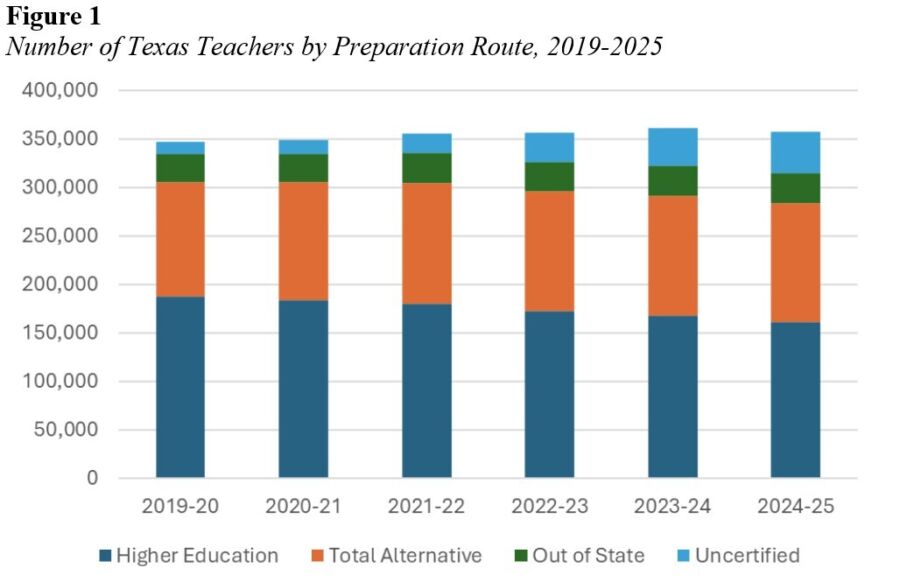
Note: Data from Employed and Certified Teachers by Preparation Route 2015-16 through 2024-25, from Texas Education Agency, 2025d (https://tea.texas.gov/reports-and-data/educator-data/employed-and-certified-teachers-by-preparation-route-2024-2025.pdf).
This great need for new teachers, however, has been brought about by schools’ insistence on hiring new teachers, regardless of the availability of qualified teachers. Texas’s ratio has been below the national average of 15.4 (in 2023) for the last decade (Common Core of Data, n.d.). Texas’s ratio hovered just over 15:1 from 2016 to 2020 before reaching its lowest point in 2021—14.5 students per teacher—as a result of the COVID-era drop in enrollment, but before the post-COVID increase in teacher attrition occurred (TEA, 2025b). This ratio was achieved while only 3.7% of the total teacher pool were uncertified teachers.
If every single uncertified teacher were removed from Texas public schools, the student-to-teacher ratio would only increase to 16.8—not ideal, but also not a crisis for public schools. Taking a conservative estimate of 93% average daily attendance, the functional student-to-teacher ratio in 2025 would have only been 15.7 without uncertified teachers. A more realistic scenario would reduce the number of uncertified teachers to the 2020 level of less than 13,000. Without these teachers, the student-to-teacher ratio would be 16.2 or 15.1 when adjusted for average daily attendance, which is the same as the 2020 pre-adjusted ratio. (This analysis, of course, is a generalization and does not represent the situation of each particular school district, campus, or class.)
Reducing class size is a popular education policy intervention, but sacrificing educator quality to achieve smaller classes may not be effective. The Texas Legislature requires districts to maintain an overall student-to-teacher ratio of less than 20 and limits class sizes from prekindergarten to fourth grade to 22 students, although school districts may apply for waivers (Texas Education Code, Sec. 25.111-2). A review of class-size research by Matthew M. Chingos and Grover J. Whitehurst found that the benefits of small class sizes are not unequivocal (2011). The strongest support for smaller class sizes comes from a Tennessee study from the 1980s, which compared classes of 15 to classes of 22, a 30% difference. This study found an immediate effect equivalent to three months more of schooling for students in smaller classes and, years later, a 2% higher likelihood of college enrollment. The results of California’s class size reduction program, however, provide a more nuanced picture of the effects of these policies. California saw positive effects from similar class-size reductions, though not as pronounced as in Tennessee, but because many of the new teaching positions were filled by new and uncertified teachers, much of the benefit of smaller class sizes was lost. This offers a pertinent lesson for Texas: hiring unprepared teachers merely to fill a perceived need may be unproductive. Furthermore, Chingos and Whitehurst conclude that, even holding the effect as linear, reducing class sizes by only one or two students produces a vanishingly small positive effect. These observations suggest that reducing the student-to-teacher ratio by bolstering the teacher corps with unqualified teachers, such as those without certification, is both ineffective and expensive.
While the demand for new teachers is artificial, the supply of teachers from university programs has dwindled. As Figure 2 shows, the number of teachers entering Texas schools with a standard certificate each year has steadily declined since at least 2015 (TEA, n.d.-d). Over the last decade, the number of new teacher hires who are standard certified (meaning already fully certified at the beginning of the year) has declined by nearly 45%, from 7,879 to only 4,342. Over this time period, intern certification (i.e., completing certification requirements during an initial year of employment) has had significantly more entries than entering with full certification. In 2021, the number of interns spiked sharply, from about 10,000 hires in 2020 to 14,000, at the same time that standard certified hires dipped from 6,519 to 5,287—a drop of nearly 20%. This one year, however, seems to have drained this reservoir of potential teachers because the number of intern hires dropped from its highest point in 2021 to its lowest point in the past seven years—8,676—in 2022, and it has continued to decline every year until it fell below standard certified hires in 2025. As mentioned earlier, the number of hires with no certification surged from 4,294 in 2021 to 15,902 in 2024—a 270% increase. While the hiring of uncertified teachers is not commensurate with the need for new teachers, the university pipeline of teachers is clearly faltering. The reasons for this decline will be explored in the next section.
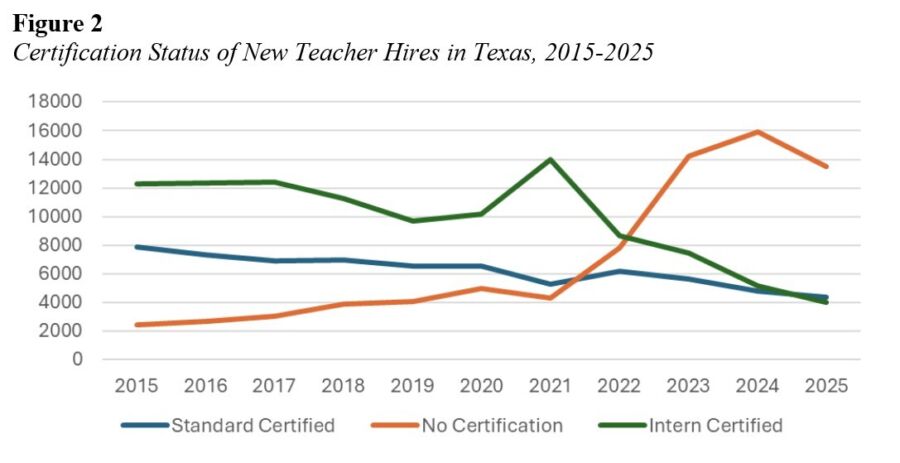
Note: Newly Certified and New Teacher Hires Dashboards, from Texas Education Agency, n.d.-d (https://tea4avcastro.tea.state.tx.us/oess/edrs/regional-dashboards/).
How Effective Are Texas Teachers?
With so many uncertified teachers in Texas public schools, the natural question is what effect this has had on student achievement. Most experimental studies agree that students learn less when taught by an uncertified teacher with no classroom experience. As shown in Figure 3, research using data from Texas schools from 2012 to 2019 found that students lost up to six months of learning when taught by an uncertified teacher with no prior classroom experience (Marder, 2024). The subjects that were most impacted by being taught by an uncertified teacher were some of the most important: high school English, mathematics, and social studies. A similar study from Texas Tech University found an even greater loss for elementary students: three months of learning in mathematics and four months in reading (University of Texas at Austin, 2024).
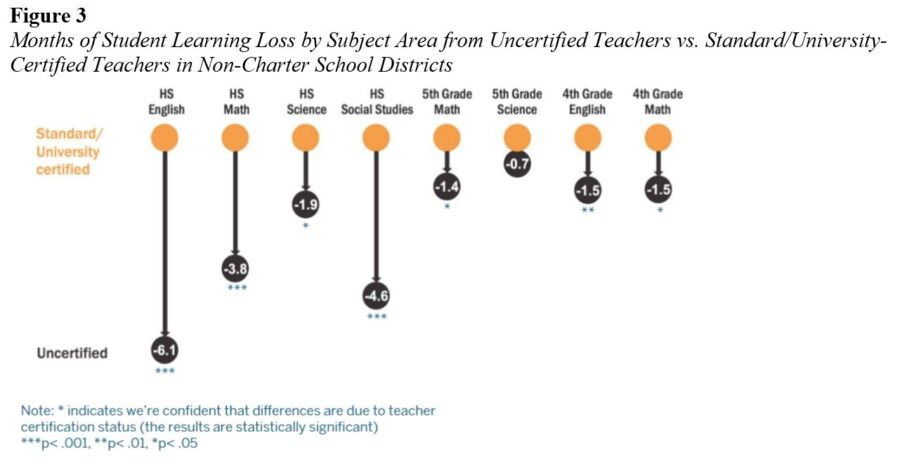
Note: Image from Beyond the tipping point: Rise of uncertified teachers in Texas, from Marder, M., Torres, L.G., Martinez, 2024 (https://issuu.com/texaseducation/docs/ttp_riseofuncertifiedteachers_report_design_17x11_?utm_source=digital&utm_medium=issuu&utm_campaign=BTTP+report+F24).
If the increase in uncertified teachers has had ill effects on student achievement, however, they are undetectable at the state or even district level. Since 2022, as Table 1 shows, as the percentage of uncertified teachers increased from 5% to 11%, the share of students meeting grade-level standards on the state assessment continued its post-COVID recovery before leveling off or even slightly improving. The same trend held true (as shown in Table 2) in Houston ISD, Alief ISD, and Austin ISD, which are the three districts that have hired the most uncertified teachers (TEA, n.d.-c). In 2024 and 2025, Houston ISD hired 2,143 uncertified teachers, equal to 20% of their total teachers. Despite this, Houston ISD has shown some of the strongest academic growth in the state, although this is confounded by the policies implemented by the superintendent appointed after the state takeover. Likewise, Alief ISD and Austin ISD hired a number of uncertified teachers equivalent to 16% and 12% of their 2025 teaching staff in 2024 and 2025, and their state assessment scores have held steady.
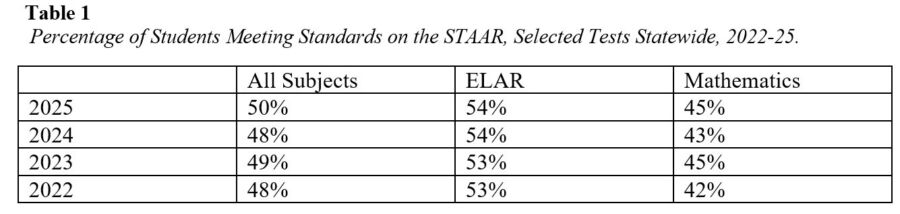
Note: Texas Academic Performance Reports, 2022-2025, from Texas Education Agency, n.d.-c (https://tea.texas.gov/school-and-district-leaders/accountability/academic-accountability/performance-reporting/texas-academic-performance-reports).
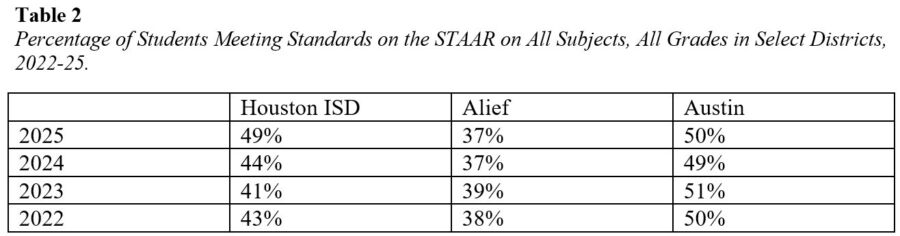
Note: Data from Texas Academic Performance Reports, 2022-2025, from Texas Education Agency, n.d.-c (https://tea.texas.gov/school-and-district-leaders/accountability/academic-accountability/performance-reporting/texas-academic-performance-reports).
Statewide results from the Nation’s Report Card have also failed to identify declining standards. Texas, like most other states, had no significant difference in score in Reading or Mathematics between the 2022 and 2024 assessments (The Nation’s Report Card, n.d.).
Researchers may be able to peer into individual teachers’ performance, but for state policy decisions, the differences between certified and uncertified teachers have so far not emerged at the macro level.
Exploring the Decline of University Preparation Programs
The most pressing question, then, for the statewide policymaker is: What is the cause of the decline of university programs?
In 2019, institutions of higher education in Texas produced 6,987 teachers who were hired by public schools (TEA, n.d.-d), but by 2025, that number had declined to 4,655, a 33% decrease. Texas’s two largest university teaching programs, Texas State University and Texas A&M University, have seen the number of teachers hired from their schools fall by 31% and 39%, respectively.
While the proportion of new teacher hires that are newly certified has dropped considerably from 2019 to 2025, from 56% to 33%, primarily driven by the hiring of uncertified teachers, the share of newly certified teachers that come from university programs has remained unchanged, thereby suggesting a decline across levels of teacher preparation pathways (TEA, n.d.-d). In 2019, 7,958 teachers were hired from alternative certification programs, but that number had declined by 61% to 3,107 in 2025 (TEA, n.d.-d). The largest alternative program in Texas, A+ Texas Teachers, peaked in enrollment in 2021 at 6,220 students, but by 2025, the number of teachers hired from A+ had fallen by 81% to 1,124. One explanation for why alternative certification numbers have fallen is that, as schools have shown themselves all too willing to hire teachers without any form of certification, acquiring even alternative certification has lost its value. Regardless, with the availability of a relatively large number of alternative certification programs that can be completed in a few months, the lack of preparation before beginning a teaching position suggests that schools are hiring applicants who did not consider teaching until mere months before employment, signaling a lack of interest in the teaching profession as a whole.
The last five years have been tumultuous for the teaching profession across the United States and in Texas. As noted earlier, 2023 to 2025 had the highest levels of teacher attrition in the past 10 school years (TEA, 2025b). The disruptions, stress, and learning loss caused by the COVID-19 shutdown doubtless contributed to this in large part. Texas also faced a growing issue of classroom discipline, leading to the passage of HB 6 in the 89th Texas Legislature (McCormick, 2025; Dey, 2025). The recent decline in teacher production may have more to do with a lack of candidates than any development in the preparation programs themselves.
Even if this is the case, though, teacher feedback suggests that teacher preparation may play a role in poor teacher satisfaction. In the Teacher Voice survey of Texas Teachers taken in 2022, among recently retired/resigned teachers, personal overload was the area of concern for most respondents (65%), even more than those concerned with salary (TEA, 2022). Apart from salary and overload, the only domain that 30% or more of respondents felt was an area of concern was health/mental health impact.
Both survey responses point to areas of weakness that can be addressed through enhanced teacher preparation. As the Teacher Vacancy Task Force Final Report notes, teachers may spend up to 12 hours per week sourcing instructional materials (TEA, 2023). The report recommends providing high-quality instructional materials (HQIM) to teachers to eliminate the need for this searching, but it also notes that, according to a RAND survey, only 8% of teachers report receiving training on using the provided curriculum, and 57% reported not receiving training on how to use and modify curriculum in their preparation programs. While improved teacher retention and satisfaction will not immediately restart the teacher pipeline, rehabilitating the teaching profession’s reputation is vital to attracting new recruits.
University Educator Preparation Programs in Texas
With these factors influencing the teaching landscape, we can now turn to an examination of the university educator preparation programs in Texas. While no two university programs are the same, reviewing the course offerings for these programs reveals three recurring observations that schools of education have departed from their mission to produce qualified teachers for Texas schools. Firstly, there is an overemphasis on special populations. Secondly, schools of education have allowed political ideology to infect their courses. Finally, despite attempts in the last few decades to make teacher preparation more practical, the course requirements of schools of education are still bloated with theory and non-essential courses.
The first significant observation of major university programs is the preoccupation with specific groups of learners. Texas State University, the most prolific university education program in Texas, does not have a general elementary teaching major; it only offers programs with an English as a Second Language, Bilingual, or Special Education concentration (Texas State University, n.d.). While these are important focuses that serve needs in schools, it is curious that Texas State assumes that every teaching student should concentrate on populations that account for approximately 20% (emergent bilingual) and 15% (special education) of the Texas student population. This emphasis on special groups is reflected in the course offerings as well, with three of the thirteen required major courses emphasizing the nebulous concept of “diversity”: “Education and Equity in a Diverse Society;” “Play in Educational Settings for Diverse Learners;” and “Teaching Mathematics to Diverse Children, 3rd-6th grade.” Similarly, the University of North Texas, the second largest university program in Texas, offers specializations in Early Childhood, Inclusive Education, and Interdisciplinary Studies, which seems to have a critical theory component (University of North Texas, n.d.-a). Notable UNT education courses include “Classrooms as Communities” and “Culture-Centered Social and Emotional Learning in the School.” Interviews with recent school of education graduates corroborate these inferences that the emphasis is less on learning pedagogical methods and more about affirming that American society is the main obstacle to “disadvantaged” students (personal communication, 2026). While some of these topics could be helpful for teacher preparation, the proliferation of such courses suggests that schools of education are not primarily interested in teacher preparation but in advancing particular social policies and ideologies.
But this speculation is circumstantial without corroborating evidence, preferably from the same course offerings. Unfortunately, this evidence is not in short supply. The Texas State course “Education and Equity in a Diverse Society” description says it “will examine elementary education from a sociocultural, sociopolitical, and sociohistorical lens to reveal the need for equity in the current American schooling system” (Texas State, n.d.). That is not the language of teacher preparation but the language of activism. UNT is even more direct. Its “Teaching as Advocacy for Equity” course “focuses on structures and educational inequality, as they relate to race, class, and gender…and teaching as a form of intervention in these processes” (UNT, n.d.-b). These are the watchwords of critical theory which encourage viewing individuals through the lens of identity. The splash page for the University of Texas at Austin All-Level Special Education bachelor’s program promises future teachers that they will “become an advocate,” “adopt the values social-emotional learning and infuse it into your curriculum,” and “learn about the importance of creating inclusive classrooms” (The University of Texas at Austin, n.d.-a) The Texas Legislature has taken steps to remove Leftist ideology from classrooms, such as the ban on DEI from public schools via SB 12 (2025) during the 89th Legislature (Acharya & Edison, 2025). Texas State, UNT, UT, and many other universities, however, are still teaching future teachers to be activists in the classroom.
Apart from the politically motivated corruption of schools of education, too much of the course load is still bloated with theoretical or tangential topics that do not have a direct relation to classroom instruction. Noted educational psychologist Daniel Willingham argues that, while theoretical knowledge is necessary, not all theory equally prepares a student-teacher to appropriately apply this knowledge (Willingham, 2019). For instance, a student may learn several theories of learning that are mutually incompatible. Having learned both the basics of behaviorism and constructivism, a student may become confused, haphazardly applying these theories in various scenarios, or, worse, arrive at a kind of theoretical relativism where best practices are confused for suggestions. After all, if even Skinner and Piaget cannot agree, who is to tell the student-teacher what is correct? Another danger, Willingham points out, is that students may interpret theoretical knowledge too broadly. For example, students may encounter the statement (or epistemic assumption) “learning is social” and conclude that students should work in groups to “construct their own knowledge” as much as possible. Willingham concludes that the study of educational psychology theory should be limited to the specific knowledge, usually empirical generalizations like “learning improves with practice,” that student-teachers need to know, and that clinical teaching should emphasize connecting these generalizations to practice. The implications for teacher preparation programs are that overly theoretical courses may not produce effective teachers, and that excessive focus on theory may, in itself, be counterproductive.
Texas’s university teacher preparation programs show significant variation, and it is impossible to determine from course titles and descriptions how well these programs adhere to the principles Willingham endorses. Nevertheless, some programs show varying degrees of emphasis on educational psychology and theory. The UNT course “Early Language and Literacy Development” rightly mentions the Science of Teaching reading in its description, but it also includes “historical, political, and local perspectives of language and literacy development,” which appears to be extraneous to practical teaching skills (UNT, n.d.). The Sam Houston State University Major in Education, EC-6 core contains at least five heavily theoretical or conceptual courses, including “Early Childhood Education Theories” and “Human Growth & Learning” (SHSU, n.d.). Of course, almost any course that falls under the first two observations, overly emphasizing specific populations or political ideology, would be excessively theoretical, as these topics require extensive theory to support specific worldviews.
While this review of university teacher preparation programs is not comprehensive and relied on the front-facing course titles and course descriptions, no program in a school of education was free of these three defects, especially left-wing political activism. The programs themselves affirm the reports of recent graduates and the observations made by previous research that university schools of education are obsessed with promoting leftist theories and policies above and beyond teacher preparation (personal communications, 2026; Bierly, 2026). If Texas is to restore a high-quality teacher pipeline, schools of education cannot be trusted to faithfully enact the needed reforms.
Conclusions and Recommendations
This analysis of the hiring and certification patterns in Texas schools paints a bleak picture of the Texas teacher pipeline. The collapsing number of students attending preparation programs signifies that teaching as a profession has suffered reputational damage, with a demanding workload and low wages relative to other professional jobs (TEA, 2023; Allegretto, 2025). Some of the recommendations of the Teacher Vacancy Task Force Final Report are beyond the scope of this paper. Compensation increases are, in a way, fungible. Higher salaries will always attract more attention and reduce attrition, but this is independent of the profession’s overall attractiveness or the effectiveness of the teachers. Four of the five recommendations from the TVTF Final Report, however, can be influenced by reform to teacher preparation programs (TEA, 2023). Apart from the two recommendations that directly relate to the pipeline/pre-service preparation and teacher mentorship, better training in using high-quality instructional materials and classroom management, paired with effective practicums, would relieve these sources of stress and impediments to quality instruction. Moreover, the obsession with grievance, the endless promotion of left-wing politics, and the elevation of activism over instruction at schools of education likely discourages potential teachers who would rather focus on pedagogy or do not share the prevailing political beliefs. One interviewee who recently graduated from a major school of education recounted having to take care to avoid angering vitriolic left-wing professors and classmates and described the building as “a dark place” (personal communications, 2026).
To repair Texas’s teacher pipeline, the teaching profession’s reputation must be restored. This can only be accomplished by treating teachers as true professionals with effective, practical preparation.
The Texas Education Agency, under the authority granted to it by the Texas Legislature through the Texas Education Code, imposes certain requirements on educator preparation programs (Texas Education Code, 1995/2025, Sec. 21.044). Most of these requirements concern program standards, such as admissions criteria and guidelines for credit hours and clinical teaching. Most of the program content requirements are quite general, such as “classroom management” and “instruction in digital learning.” Very specific content requirements are sparse: alignment with TEKS, science of teaching reading, and a ban on three-cueing. Given the typical freedom the Legislature has granted institutions of higher education, direct legislative reforms to schools of education seem an ill-fitting tool. Luckily, there are models outside of schools of education that offer valuable lessons.
One wrinkle of university teacher preparation programs is that schools of education are more likely to focus on the elementary and middle grades, while programs for secondary educators are more likely to be housed as certificate programs in the appropriate departments. This is not always the rule, but, for instance, UNT’s basic undergraduate program is a Bachelor of Science in Elementary Education (UNT, n.d.). Secondary teacher certification is offered as a graduate certification program. The University of Texas at Austin similarly offers Elementary Generalist, Special Education, and Elementary Bilingual Education through its College of Education, and is also home to the UTeach Program, where students complete a preparation program while earning a separate major (UT-Austin, n.d.-b). This arrangement is natural, as secondary grades demand a higher level of subject-matter expertise than elementary material. Moreover, biology and English majors think of themselves primarily as scientists and writers, not as teachers (Bailey & Chung-Parsons, 2018). Recruiting these potential teachers will be more successful if they can continue to pursue their acquisition of knowledge, rather than trying to recruit them to the more explicitly occupational school of education.
The UTeach model has a lot to commend itself. The program is quite lean, can be completed in three or four semesters, and consists of at most eight courses (UTeach-Liberal Arts, n.d.). Students receive field experience throughout the sequence, beginning in their first course, unlike in some other programs, where students may not receive field experience until the second semester. This early experience is vital to ensure that students and teaching are a good fit and to help students connect their classroom knowledge with practical application.
The UTeach program model has expanded to over 50 universities across the country (UTeach Institute, n.d.). The Texas universities that use the UTeach model have shown impressive results, with recent graduates demonstrating teaching effectiveness in mathematics that is better than that of a teacher with 10-plus years of experience, compared to non-UTeach graduates (Backes et al., 2018). Because of UTeach’s success and intuitive structure, this model should be considered the ideal for preparing secondary teachers.
In order to decide how to replace schools of education as the center of university preparation, the goal of education should be considered. A PDK poll from 2016 showed that respondents were torn on the purpose of education, with no response receiving a plurality (Walker, 2016). This apparent disagreement, however, belies the ready ability of teachers to fulfill all of these purposes. A university program will allow teachers to realize the goals of “prepar(ing) students academically” (45%) and “prepar(ing) students for work” (25%) through subject matter expertise and effective pedagogy courses paired with clinical practica, which can be managed by much leaner programs than those offered by schools of education. The third and final response was to “prepare students to be good citizens” at 26%. A connection between schools of education may seem odd, but the schools themselves seem to think their goal is to create better citizens. The program materials of schools of education and teacher preparation programs drip with social justice activism language: the University of Texas at Austin says one of its strategic impact areas is “advancing equity and eliminating disparities in education” (UT-Austin, n.d.-c). The National Education Association, the largest education professional association in the country, wants to use education to “create a more just and inclusive society” and maintains an “Action Center” on its website to encourage political activism (National Education Association, n.d.). Clearly, schools of education and the teaching profession already see teachers and teaching as a way to form citizens, just not what most Texans would view as “good citizens.”
If the subject matter and pedagogical aspects of teacher preparation can be easily met by external programs, the center of teacher preparation should be housed in an organization that best realizes the purpose of training teachers for future citizens. Luckily, Texas universities have recently taken steps to create just such programs. The most prominent of these is the School of Civic Leadership at the University of Texas at Austin, but West Texas A&M University and Texas Southern University have received a grant to promote better civics instruction (Chandler, 2026). This is an excellent opportunity for these institutions to reform how teachers learn and teach civics.
In the meantime, the Texas Legislature can take steps to improve the quality of all teacher preparation programs. The state requires that schools cover certain topics, and instruction to ensure familiarity with these topics and how to teach them should be part of every relevant teacher preparation program. These topics include:
- The elements of Sec. 28.002(h-1) (1), (2), (3), and (4) of the Texas Education Code, including the Declaration of Independence, the United States Constitution, and the Lincoln-Douglas debate (TEC, Sec. 28.002(h-1), 2005/2025).
- Sec. 28.002(h-11) (1) through (8) of the TEC, including historical events and atrocities attributable to communist regimes (TEC, Sec. 28.002(h-11), 2005/2025).
One common complaint among recent education school graduate interviewees is the lack of preparation to use a comprehensive curriculum. Students are not taught how to implement a curriculum and are often left to make their own decisions when performing their clinical teaching. While the statute and rule to teach how to use open education resource instructional materials are a welcome change, this education is not as comprehensive as it could be. University preparation programs should instruct their students on how to use a complete curriculum (preferably Bluebonnet Learning) and ensure that student-teachers are supported in using a high-quality curriculum and instructional materials in their practicum, whether that be the school’s chosen curriculum or the open education resources.
Finally, while the love of theory in educator preparation programs is well known, teachers in the U.S., unlike their British counterparts, have been slow to adopt its practical application in cognitive science. Over the last decade, cognitive science has become embedded in British education and is part of the curriculum that trains new teachers (White, 2025). Much as Texas applied “science of learning” to reading, the Legislature should ensure that these same basic principles, like working memory and cognitive load, prior knowledge activation, and metacognition, are taught to every future teacher (Toppo, 2025). Establishing these terms in statute would not only improve preparation quality but also focus preparation programs away from abstraction and towards relevance to classroom practice.
References
Acharaya, P., & Edison, J. (2025). Texas Senate approves bill banning DEI in K-12 public schools. https://www.texastribune.org/2025/02/24/texas-dei-public-schools-k12/
Allegretto, S. (2025). The teacher pay penalty reached a record high in 2024. Economic Policy Institute. https://www.epi.org/publication/the-teacher-pay-penalty-reached-a-record-high-in-2024-three-decades-of-leaving-public-school-teachers-behind/
Backes, B., Cade, W., Dodson, M., Goldhaber, D., & Sullivan, K. (2018) Can UTeach? Assessing the relative effectiveness of STEM teachers. Economics of Education Review, 64, 2018, 184-198. https://doi.org/10.1016/j.econedurev.2018.05.002
Bailey, J.M., & Chung-Parsons, R. (2018). The hierarchical (not fluid) nature of preservice secondary science teachers’ perceptions of their science teacher identity. Teaching and Teacher Education, 78, February 2019, 39-48. https://doi.org/10.1016/j.tate.2018.11.007
Chandler, C. (2026). WT, Texas Southern win $2 million federal grant to promote civics instruction. WT Newsroom. https://www.wtamu.edu/news/2026/02/wt-texas-southern-win-2-million-federal-grant-to-promote-civics-instruction.html
Chingos, M., & Whitehurst, G.J. (2011). Class size: What research says and what it means for state policy. Brookings. https://www.brookings.edu/articles/class-size-what-research-says-and-what-it-means-for-state-policy/
College of Education. (2024). Beyond the teacher tipping point: Half of newly hired teachers in Texas are uncertified. The University of Texas at Austin. https://education.utexas.edu/news/2024/08/20/uncertified-texas-teachers/#:~:text=As%20the%20shortage%20of%20teachers,featured%20in%20the%20supplemental%20study
Common Core of Data: America’s Public Schools. (n.d.). Table 2. Number of operating public elementary and secondary schools and districts, student membership, teachers, and pupil/teacher ratio, by state or jurisdiction: School year 2022–23. National Center for Education Statistics. Retrieved March 21, 2026, from https://nces.ed.gov/ccd/tables/202223_summary_2.asp
Dey, S. (2025). Texas Senate panel advances bill that gives schools more latitude to discipline students. The Texas Tribune. https://www.texastribune.org/2025/04/15/texas-house-school-discipline/
Marder, M., Martinez, C., & Torres, L.G. (2024). Beyond the tipping point: Rise of uncertified teachers in Texas. Report and recommendations from the University of Texas at Austin. Texas Education. https://issuu.com/texaseducation/docs/ttp_riseofuncertifiedteachers_report_design_17x11_
McCormick, M. (2025). Empowering teachers through classroom discipline. Texas Public Policy Foundation. https://www.texaspolicy.com/empowering-teachers-through-classroom-discipline/
National Education Association. (n.d.). [Home page]. Retrieved March 27, 2026, from https://www.nea.org/
Sam Houston State University. (n.d.). Bachelor of science, major in education, EC-6 core. Retrieved March 23, 2026, from https://catalog.shsu.edu/undergraduate/colleges-academic-departments/education/school-of-teaching-and-learning/bs-education-ec-6-core/
Texas Education Agency (TEA). (2022). Teacher Voice: An open solicitation of teacher perspectives.
Texas Education Agency (TEA). (2023). Developing a thriving teacher workforce in Texas: Teacher Vacancy Task Force Final Report. https://tea.texas.gov/texas-schools/health-safety-discipline/tvtf-final-report.pdf
Texas Education Agency (TEA). (2025a). Uncertified teacher rates 2019-20 through 2024-25. https://tea.texas.gov/reports-and-data/educator-data/uncertified-teachers-historic-2024-2025.pdf
Texas Education Agency (TEA). (2025b). Employed teacher attrition and new hires 2015-16 through 2024-25. https://tea.texas.gov/reports-and-data/educator-data/employed-teacher-attrition-and-new-hires-2024-2025.pdf
Texas Education Agency (TEA). (2025c). Teacher Retention by Preparation Route 2014-15 through 2023-24. https://tea.texas.gov/reports-and-data/educator-data/teacher-retention-by-preparation-route-2023-2024.pdf
Texas Education Agency (TEA). (2025d). Employed and Certified Teachers by Preparation Route 2015-16 through 2024-25. https://tea.texas.gov/reports-and-data/educator-data/employed-and-certified-teachers-by-preparation-route-2024-2025.pdf
Texas Education Agency (TEA). (2025e). Uncertified Teachers for SY 2024-25 by Grade Level and Subject Area. https://tea.texas.gov/reports-and-data/educator-data/uncertified-teachers-grade-subject-2024-2025.pdf
Texas Education Agency (TEA). (n.d.-a). House Bill 2. Retrieved March 27, 2026, from https://tea.texas.gov/about-tea/government-relations-and-legal/government-relations/house-bill-2
Texas Education Agency (TEA). (n.d.-b). HB 2 implementation: New certification requirements and incentives for uncertified teachers. Retrieved March 27, 2026, from https://tea.texas.gov/about-tea/news-and-multimedia/correspondence/taa-letters/hb-2-implementation-new-certification-requirements-and-incentives-for-uncertified-teachers
Texas Education Agency (TEA). (n.d.-c). Staff FTE counts and salary reports. Retrieved March 27, 2026, from https://rptsvr1.tea.texas.gov/adhocrpt/adpeb.html
Texas Education Agency (TEA). (n.d.-d). Newly certified and new teacher hires dashboards. Retrieved March 27, 2026, from https://tea4avcastro.tea.state.tx.us/oess/edrs/regional-dashboards/
Texas Education Code §21.044 (1995 & rev. 2025). https://statutes.capitol.texas.gov/?tab=1&code=ED&chapter=ED.21&artSec=21.044
Texas Education Code §25.1112 (2009 & rev. 2021). https://statutes.capitol.texas.gov/?tab=1&code=ED&chapter=ED.25&artSec=25.112
Texas Education Code § 28.002(h-1)(2005 & rev. 2025). https://statutes.capitol.texas.gov/?tab=1&code=ED&chapter=ED.28&artSec=
Texas State University. (n.d.). College of Education Advising: Majors and Programs. Retrieved March 11, 2026, from https://www.education.txst.edu/advising/degree-planning/majors-and-programs.html
The Nation’s Report Card. (n.d.). Performance trends for states and districts. Retrieved March 11, 2026, from https://www.nationsreportcard.gov/reports/reading/2024/g4_8/state-district-trends/?grade=4#score-trends-by-sta
The University of Texas at Austin. (2024). Beyond the Teacher Tipping Point: Half of Newly Hired Teachers in Texas are Uncertified. College of Education. https://education.utexas.edu/news/2024/08/20/uncertified-texas-teachers/.
The University of Texas at Austin. (n.d.-a). All-level special education (early childhood – 12th grade) bachelor’s program. Retrieved March 27, 2026, from https://education.utexas.edu/academics/bachelors/all-level-special-education/
The University of Texas at Austin. (n.d.-b). Educator preparation programs. Retrieved March 11, 2026, from https://education.utexas.edu/academics/educator-certification/
The University of Texas at Austin. (n.d.-c). College of Education. Retrieved March 27, 2026, from https://education.utexas.edu/
Toppo, G. (2025). ‘Cognitive science,’ all the rage in British schools, fails to register in U.S. The 74. https://www.the74million.org/article/cognitive-science-all-the-rage-in-british-schools-fails-to-register-in-u-s/
University of North Texas. (n.d.-a). Education, BS. Retrieved March 26, 2026, from https://catalog.unt.edu/preview_program.php?catoid=37&poid=18585&returnto=4292
University of North Texas. (n.d.-b). Elementary Education Degree. Retrieved March 26, from https://coe.unt.edu/teacher-education-and-administration/index.html
UTeach-Liberal Arts. (n.d.). Required coursework. Retrieved March 26, 2026, from https://liberalarts.utexas.edu/uteach/undergraduate-information/required-coursework.html
UTeach Institute. (n.d.). UTeach programs nationwide. Retrieved March 27, 2026, from https://institute.uteach.utexas.edu/uteach-programs-nationwide
Walker, T. (2016). What’s the purpose of education? Public doesn’t Agree on the answer. NeaToday. https://www.nea.org/nea-today/all-news-articles/whats-purpose-education-public-doesnt-agree-answer
White, S. (2025). Cognitive science is trending. But what if you’re not a cognitive scientist? CPD in 5. https://www.cpdin5.com/p/cognitive-science-in-education
Willingham, D.T. (2019). Ask the cognitive scientist: Should teachers know the basic science of how children learn? American Federation of Teachers. https://www.aft.org/ae/summer2019/willingham#:~:text=Question:%20Is%20it%20useful%20for,new%20ideas%20for%20instructional%20methods.