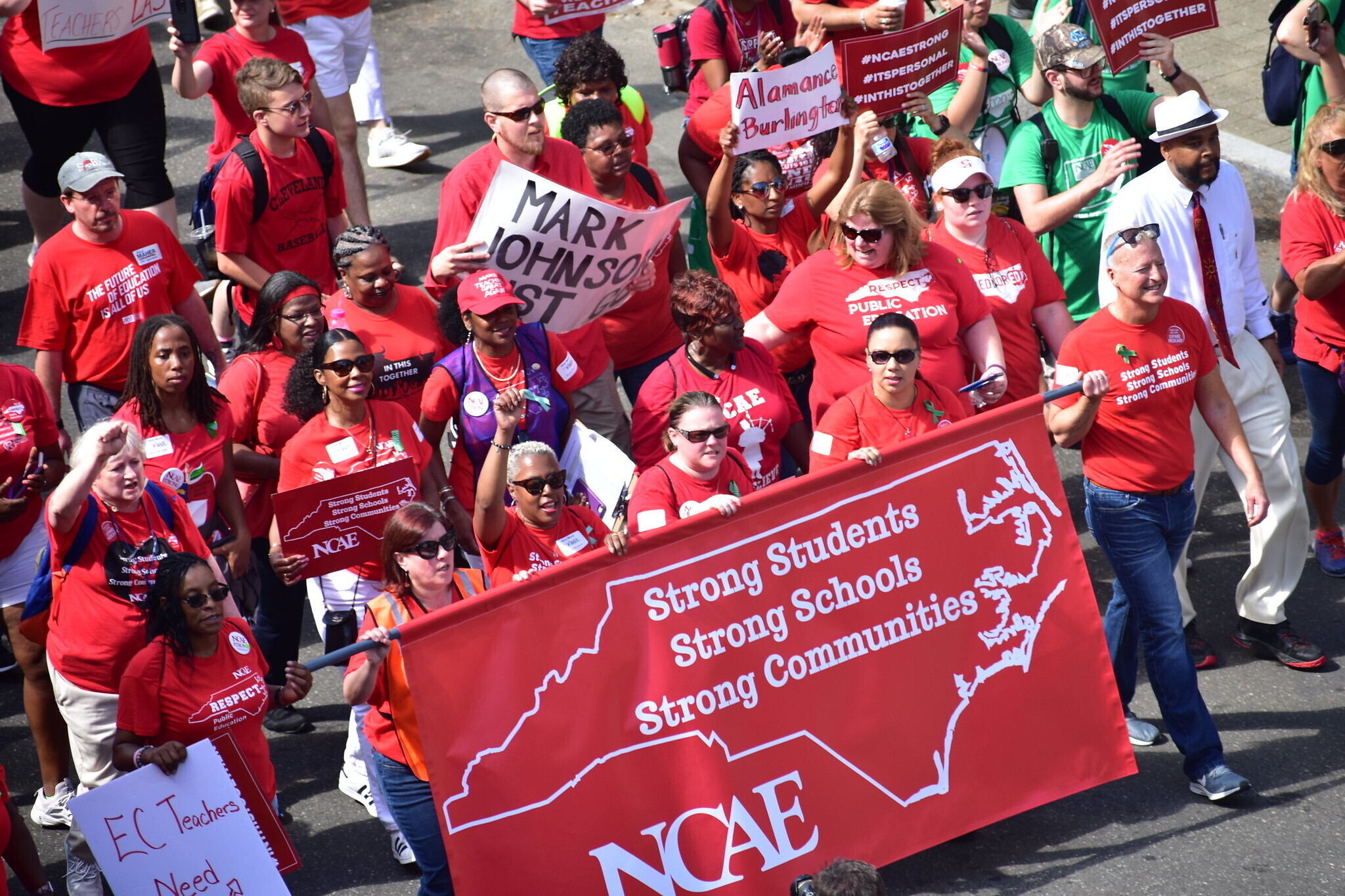
The North Carolina Association of Educators (NCAE), the largest professional teacher organization in the state, is hosting a rally today — May 1 — in Raleigh to urge lawmakers to choose “kids over corporations,” boost teacher pay, and provide more funding for North Carolina public schools.
The rally is the NCAE’s attempt to turn up the heat on legislators and bolster its membership and visibility. In reality, however, the rally highlights how the NCAE’s policies have contributed to the very problems the organization seeks to address.
The NCAE describes the rally’s goal with a lot of lofty rhetoric, citing a need to “take back our schools” and “give students the change they deserve[KS1] .” The May 1 rally has been called a march, rally, and a walk-out. Call it what you will — it’s a strike. And it’s illegal in North Carolina. Section 95-98.1 of the North Carolina Statutes prohibits strikes by public employees.
The rally takes students out of the classroom and forces parents to juggle work schedules and day care. A review of the rally’s goals reveals the usual laundry list of improving per-student funding, securing more money for teacher pay and facilities, and obtaining better health care and retirement benefits. If you missed the emphasis on academic improvement, you’re not alone. At last count, 20 districts are scheduled to close so that teachers can participate in the rally. Closures are expected to cost these distrricts over $40-million dollars. Who will pay for those costs?
Despite all the rhetoric about helping democracy, teachers, and students, the NCAE is first and foremost a teachers’ union. Teachers cannot collectively bargain in North Carolina. Nevertheless, NCAE members are required to join its parent organization, the National Education Association (NEA), the largest teachers’ union in the country.
The NCAE’s job is simple: grow membership and increase wages. NCAE has largely failed at these tasks. Although experiencing a small uptick in the last couple years, NCAE membership is down 63 percent in the last decade. Since 2020, cumulative teacher pay increases totaled 15.6 percent while the consumer price index has increased 26.5 percent, according to data reported by the North Carolina Department of Public Instruction.
Its politicized agenda and actions detach the organization from its base supporters and alienate it from the legislators it seeks to influence. Like its parent organization, the NCAE’s political contributions flow overwhelmingly (90 percent or more) to Democrats, even though the political representation of teachers in North Carolina and nationally is more diverse.
The NCAE has moved beyond traditional labor advocacy of improving pay and benefits to promoting a radical, far-left, anti-parent agenda that centers on race, class, and gender in the classroom. Meanwhile, the NCAE and the NEA have been slow to embrace education reforms like school choice and charter schools and work to block efforts to like establishing merit pay and removing ineffective teachers.
The NCAE lobbies repeatedly for higher pay, more funding for teachers, and better recruitment and retention policies. Yet it ignores how its allegiance to the teacher salary schedule is at the root of many of the problems it reportedly seeks to remedy.
Unions lobby hard for salary schedules, which spell out teacher pay by years of experience and credentials. This favors union interests over individual merit, high performance, and steady salary growth. Salary schedules are premised on the faulty notion that all teachers are the same and should be paid accordingly. Such notions run counter to two statements we know to be true: We are all different and we should be paid not according to our years of experience but by the value we add to our work.
By tying raises to credentials such as master’s degrees or other certifications, rather than effectiveness in the classroom, the NCAE and other teachers’ unions can control the career paths of teachers and reduce pay disparities. This gives the union greater discretion over pay at the expense of administration and elevates longevity over high performance. Fixed salary schedules raise wages for all workers at once. They also reduce pay differentiations, thus securing loyalty to the union.
Backloading higher pay to veteran teachers — a staple of teacher salary schedules — makes it more difficult to attract younger talent. Young teachers who produce excellent outcomes will be undercompensated for their efforts, resulting in teachers of varying quality receiving the same salary. This fuels recruitment and retention problems.
The teacher salary schedule pays people the same based on experience and credentials. We know that not everyone lives in the same place and under the same conditions, however. To adjust for this reality, the state and local communities provide what are known as local salary supplements. Ranging from $0 to almost $11,000, these funds are added to account for differences in the cost of living and other factors. The need for these supplements is also a tacit admission of a fundamental truth: Teachers don’t fit into one salary schedule. They live and work in 115 different labor markets.
There is something wildly perverse about telling people they have an important job, asking them to be dedicated to excellence, and then telling them that no matter how well they perform, their salaries are largely capped. Doing so prompts many to leave teaching. It elevates conformity and the interests of the union over the individual and slowly kills any commitment to excellence. Yet, we trudge on and wonder why school choice has become so popular.
The NCAE’s unflagging support for ever-rising employee benefits is another way the organization has limited teacher pay. According to a Reason Foundation report, North Carolina had the 13th-highest percentage increase in per-student spending on K–12 employee benefits between 2002 and 2023 of the 50 states and the District of Columbia. During that time, per-student spending on employee benefits increased from $1,521 per student to $3,023, an increase of 98.9 percent. In 2024–25, the North Carolina Statistical Profile Online reported that the same number had risen to $3,129 per student.
The total value of benefits as a percentage of salary has also risen significantly in recent years. In 2011, total compensation (salary and benefits) for the average North Carolina teacher was just above $60,000. Hospitalization costs were $4,929 per teacher. Retirement costs were 10.51 percent of salary. Fifteen years later, those costs have ballooned. Hospitalization costs are now $8,500 per student. In addition, retirement costs have escalated to 24.67 percent of salary. Over that period, the value of total compensation has increased 49 percent while the percentage of benefits to average salary has increased from 28.6 percent to 46.2 percent. Such increases simply are not sustainable and limit the pool of resources available for teacher pay.
The NCAE choose May 1 as the date to rally the troops against Republican lawmakers. May Day? How can there be any doubt about the NCAE’s left-wing sympathies? The slogan “Kids over Corporations” shouts class struggle, another false narrative designed to mask NCAE’s real agenda.
Of course, the NCAE has every right to hold a teacher rally in Raleigh and demand higher pay for teachers. Americans of all persuasions have the right to peaceably assemble and express their views. Still we’d be negilgent if we’d forget NCAE’s role in creating the current mess and the ever-present teacher pay problems. Still there are solutios. When teachers are represented by an organization that values their individual contributions to the classroom and incentivizes excellence, North Carolina will be on a path to solving teacher pay. Until then, teacher pay will remain the problem that never goes away.