“Voters in local school levy elections aren’t really deciding whether schools get ‘fully funded’; they’re deciding whether to authorize spending above the state-guaranteed level.”
The following has been adapted from an excerpt of the Frontier Weekly Newsletter written by Cheryl Tusken for the April 30th edition.
There have been multiple articles lately repeating the same talking point: the state is not fully funding schools, causing local school boards to ask voters to make up the difference in local property taxes. Of course, it is implied that they wouldn’t need to go to voters if the state would not shirk its job and fund schools adequately. Here’s an example from one recent article:
“Administrators in many districts say they don’t have a choice: if they don’t go to voters, they won’t be fully funded. That’s because the state pays for roughly 80% of a school’s budget.”
But the claim that the state only pays 80% of a school’s budget is simply not accurate. This is rhetorical sleight of hand, not fact. Let’s break it down:
Montana law sets two lines: the BASE general fund budget, which is the floor districts cannot go below, and the MAX general fund budget, the ceiling districts cannot go above. Everything between those two lines is a choice made by trustees, not a requirement imposed by the state.
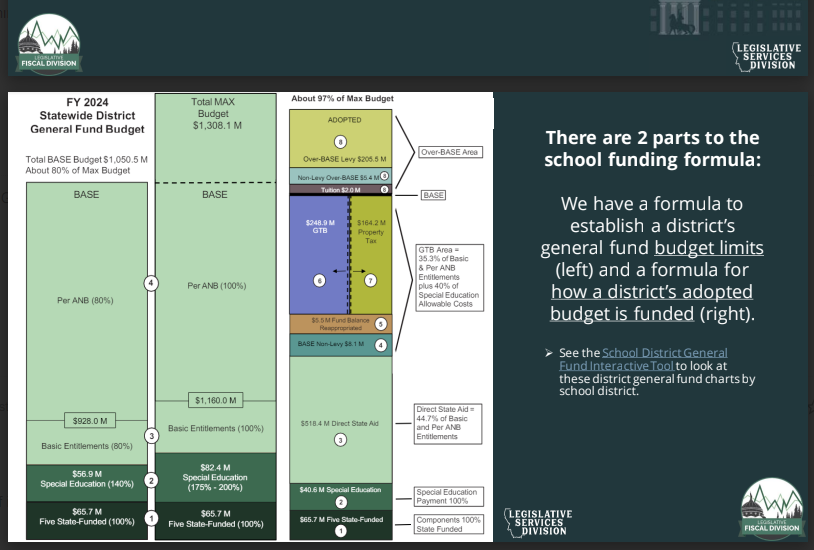
The BASE Budget floor is essentially the amount of funding the state has determined it takes to adequately run a school, and that amount is guaranteed to every district via a combination of state and local tax dollars. In fact, BASE stands for Base Amount for School Equity – alluding to its purpose to fulfill Montana’s constitutional requirement to adequately fund public schools.
The Max Budget limit is a voluntary ceiling the trustees can opt to target, fixed at about 20% higher than the BASE. The optional portion of the school budget that exceeds the BASE amount is funded by local property tax levies that must be approved by local voters. Voters in local school levy elections aren’t really deciding whether schools get “fully funded”; they’re deciding whether to authorize spending above the state-guaranteed level.
👉🏻 Here’s the sleight of hand: they talk about the MAX budget limit as if it is the baseline.
Saying schools won’t be “fully funded” without voted property tax levies treats the MAX ceiling as the baseline and voted property tax levies as a shortfall-filler. “Fully funded” in this context means funded to whatever level the district asks for. Which is a fine thing to advocate for, but it’s advocacy, not a statement of fact about the funding system. It’s more accurate to say: the trustees chose to pursue a budget above the BASE, and state law requires voter consent for that choice.
The framing matters politically: “the state only covers 80%, so we have to ask voters for the rest” sounds like the state is shortchanging schools and voters are the last line of defense.
“Trustees chose to pursue a budget above the state-guaranteed floor, and state law requires voter approval for that choice” sounds like the system working as designed: local control over discretionary government spending.
Same facts, very different story.
Framing matters, and conflating a limit with a voluntary budget amount is a disservice to voters.